
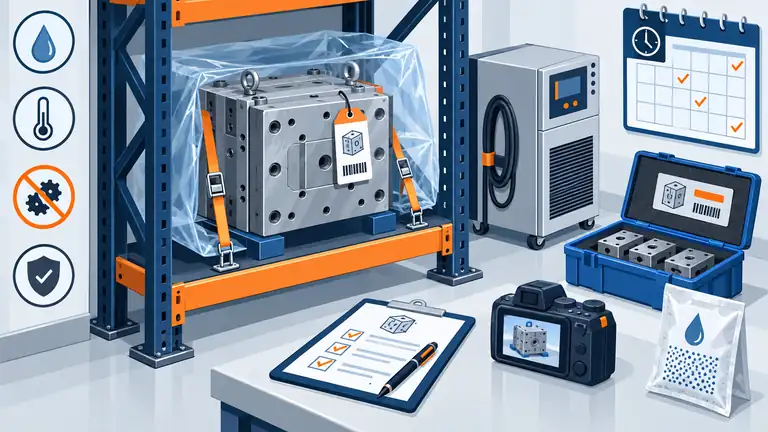
When an automotive mold sits idle for months, responsibility can become vague. The customer may own the asset, the molder may possess it, and a tool shop may perform repairs. Without a written custody and reactivation process, corrosion, stale records, missing spares, or an unapproved change may appear only when the next release is due.
Assign one accountable custodian for the tool’s physical condition and records, while separately defining who authorizes and pays for maintenance, repair, engineering changes, storage, insurance, and transfer. The storage plan should specify shutdown condition, preservation, location, inspections, access controls, and the evidence required before production restarts. Ownership alone does not answer those operational questions.
Separate ownership, custody, authorization, and cost
These four roles may belong to different organizations. Treating them as one word—“customer tool”—creates gaps.
Ownership concerns the legal and commercial rights in the asset and should be determined by the applicable purchase documents and jurisdiction. Custody identifies who physically controls the mold today. Authorization identifies who can approve opening, welding, machining, moving, or disposing of it. Cost responsibility allocates routine preservation, normal wear, misuse, customer design changes, and optional improvements. This article provides an operating checklist, not legal advice.
Create an asset responsibility matrix with named organizations and contacts, not only departments. Include the mold, hot runner, controllers, loose inserts, gauges, fixtures, handling bars, lifting devices, special hoses or cables, spare components, drawings, process records, samples, and customer-supplied materials. A mold may be present while a required controller or gauge has been moved elsewhere.
Mark the physical asset with the controlled tool number, ownership identification where required, part numbers, revision, weight, center-of-gravity or lifting information if specified, and storage location. Cross-check the markings against the asset register and photographs. The operating molder should not rely on filename or memory to identify a tool with similar plates.
Define access. Who may inspect the tool? Must the customer approve removal from the site or use for a different part? How quickly must location or damage be reported? What records must accompany a transfer? Ford’s published production purchasing terms illustrate why tooling and buyer intellectual property are explicit commercial subjects in automotive purchasing; each project must follow its actual governing documents (Ford terms overview).
Link this matrix to the separate mold ownership checklist and to the maintenance plan. The custody document should not silently create an ownership conclusion, and the ownership document should not be assumed to define day-to-day preservation.
Define the shutdown condition before the mold enters storage
Storage quality begins at the last production run. The team needs a controlled shutdown record that captures what was made, how the tool was left, and what remains open.
Record the last part and drawing revision, mold revision, resin grade and color, production date, shot counter, cavity status, process record, last accepted inspection, and any temporary deviation. Attach defect or repair observations from the run. If a cavity was blocked, a temporary insert installed, or a parameter changed, mark it visibly in the tool record rather than allowing the next team to assume a standard condition.
Clean the mold and purchased systems using the applicable instructions. Remove material, residue, moisture, and contamination without damaging texture, coatings, seals, electrical components, or polished surfaces. Drain or protect cooling circuits as required for the storage environment. Inspect moving components, parting surfaces, vents, gates, ejectors, slides, and connectors. Apply approved corrosion protection to appropriate steel surfaces and identify any surfaces where protection must not be used.
The exact procedure depends on the mold and system. Husky’s hot-runner documentation, for example, instructs users to clean dirt, debris, and condensation, perform preventive maintenance, inspect moving components, and apply protective spray under specified storage procedures; it also includes safety warnings and system-specific requirements (Husky storage guidance). Use the actual supplier manual for the installed configuration rather than copying a generic sequence.
Close open work with a status: ready for storage, stored with planned service, or quarantined pending repair/approval. Photograph the mold from defined views, tag loose components, inventory spares, and protect openings and connectors. The custodian signs the shutdown record; quality or tooling approves the status required by the local process.
Control the storage environment and periodic inspections
“Inside the toolroom” is not an adequate storage specification. The plan should protect the asset from moisture, dirt, impact, unauthorized access, and loss of supporting components.
Define the exact location and storage method. Confirm rack load capacity, stable support, separation from floor moisture, protection from traffic, lifting access, and whether the mold is stored open or closed according to its design and preservation procedure. Record environmental limits when required by steel, electronics, seals, coatings, lubricants, or customer rules. If humidity or condensation is the concern, define how it is monitored and what action follows an excursion.
Set a periodic inspection based on environment, tool condition, storage duration, and supplier guidance. A checklist can include asset identity and location, preservation-film condition, visible corrosion, standing water, cooling-port protection, leaks, connector covers, loose-item inventory, rack or crate condition, unauthorized movement, and document status. Do not open or cycle mechanisms without the safe equipment and authorization required.
| Storage control | What to record | Escalation trigger |
|---|---|---|
| Asset identity/location | Tool number, rack/bay, date, custodian | Mismatch or unrecorded move |
| External condition | Photos, corrosion protection, covers, impact | Rust, contamination, damaged cover |
| Water and fluid circuits | Drained/protected state, capped ports | Moisture, leakage, uncapped connection |
| Electrical/hot runner | Connector protection and approved test status | Damage, contamination, out-of-date test |
| Loose items/spares | Item, quantity, labeled container | Missing or degraded item |
| Records | Current drawing, maintenance and last-run package | Revision conflict or inaccessible file |
| Open actions | Repair/change/approval owner and due date | Action threatens restart date |
The inspection is evidence, not a guarantee. A visually clean mold may still have blocked cooling, failed heaters, degraded seals, or dimensional wear. Use deeper checks during reactivation according to the tool’s risk and idle duration.
Plan reactivation as a controlled production event
The first release after a long gap should not be placed directly against an assumed production date. Build backward from customer need through retrieval, inspection, maintenance, setup, trial, measurement, approval, packaging, and shipment.
Start with a document review. Confirm current CAD and drawing, engineering changes since last run, material availability and status, approved supplier and grade, process record, customer-specific requirements, control plan, gauge calibration, packaging, and reference samples. A stored tool can be mechanically sound while the product or approval basis has changed.
Inspect the tool against the shutdown record and latest maintenance status. Remove preservation material safely, verify moving systems, cooling circuits, electrical circuits, hot runner, sensors, connectors, and safety functions under the applicable instructions. Check the destination machine interface and auxiliary equipment. Replace time- or condition-sensitive items where required.
Define the trial and release evidence by risk. It may include leak and flow checks, dry cycle, controlled startup, cavity-specific samples, dimensional layout, appearance comparison, assembly check, process monitoring, capability evidence, or customer submission. The project’s customer requirements determine approval; a successful first shot is not production release.
Illustrative planning example—hypothetical. A customer needs parts in eight weeks after an 18-month gap. The team reserves one week for document and material review, one week for tool inspection and planned service, several days for machine scheduling and setup, one week for trial and dimensional review, and time for customer disposition plus production and shipping. If any step has uncertain duration, the plan adds a decision date and contingency rather than hiding it inside “restart.” The quantities and dates must be calculated for the actual tool and lane.
The dedicated restart-after-a-long-gap guide covers this release decision. The storage agreement should provide the evidence that makes such planning possible.
Use a custody record that survives supplier changes
The record should be transferable without depending on one employee or one software login. Maintain a controlled asset package and update it after every movement or material intervention.
Include the asset register, photographs, design and component drawings, purchased-system manuals, maintenance and repair history, change records, spare inventory, shot/cycle record, last production and inspection evidence, preservation procedure, storage inspection records, and open-action list. Protect customer intellectual property and access according to the governing agreement.
When a transfer is proposed, perform a joint condition review before shipment. Compare the physical tool with the records, identify damage or missing items, decide what must be repaired before movement, and preserve evidence of condition at handover. Do not overwrite old records; issue a dated transfer package and obtain receipt at the new custodian.
Illustrative example—hypothetical. A customer-owned two-cavity mold is stored at the serial molder, while its controller and spare inserts are held in separate locations. The custody register links all three locations, names the inspection interval, and requires a joint inventory before transfer. Without that linked record, confirming only the mold plates would give a false impression that the production asset is complete.
For quotation or contract review, provide the expected production gaps, storage location, environment, asset components, ownership requirements, maintenance standard, inspection frequency, response expectations, insurance requirements if applicable, access and transfer rules, and reactivation process. Ask the molder to identify inclusions, exclusions, records, and charges.
The most useful question is not “Do you store molds?” It is “Who is accountable for each physical and information control from the last accepted run until the next approved run?” A written answer protects both buyer and supplier.
Conclusion
Assign mold custody deliberately. Separate ownership, physical control, authorization, and cost; record the shutdown state; specify environment and inspections; and define reactivation evidence before the mold goes idle. A complete custody package turns a stored asset into a recoverable production resource.