
Stage-Specific Service
Automotive DFM & Moldflow Analysis Before Tooling
Resolve moldability, appearance, dimensional, and process risks while geometry can still change. DFM defines decisions; moldflow is used only at the agreed depth and does not replace trials or physical validation.
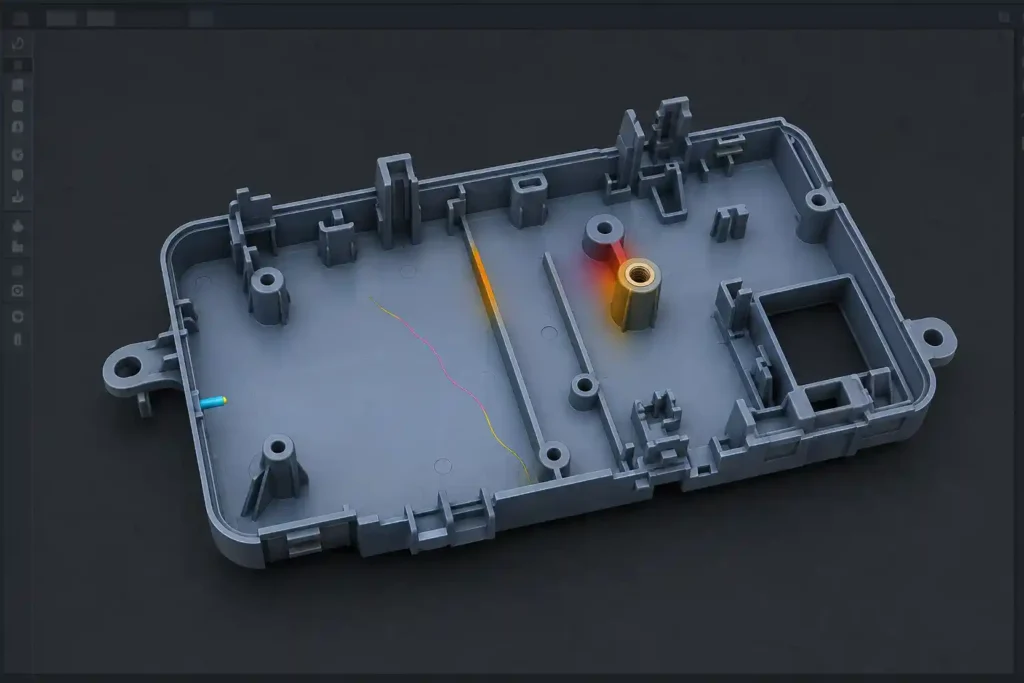
When This Route Fits
Use this route before mold steel release, during supplier feasibility comparison, or when a redesign needs an independent manufacturing-risk review. Early work can start before every requirement is final if open assumptions are clearly marked.
Design Baseline and Analysis Inputs
Unknown items can remain open, but the quote and next gate must identify them.
1
Native or neutral 3D CAD, preferably STEP or Parasolid
2
2D drawing with datum scheme, critical dimensions and tolerances
3
Specified resin grade, color and surface requirement
4
Annual volume, target cycle, assembly interfaces and validation plan
5
Known machine, hot-runner, gate-location or packaging constraints
DFM Decision Path Before Steel Release
Each step produces a decision or record needed by the next stage.
1. Register the baseline
Record CAD/drawing revision, resin, appearance zones, datums, tolerances, loads, assembly, volume, press constraints, and validation ownership.
2. Screen high-consequence geometry
Review walls, ribs, bosses, draft, undercuts, shutoffs, actions, ejection, steel-safe conditions, gates, vents, weld lines, sink, and assembly interfaces.
3. Set analysis depth
Define qualitative DFM, filling/packing, cooling, warpage, fiber orientation, or a focused comparison—and list unavailable material or process data.
4. Issue ranked findings
Separate release blockers, recommended risk reductions, optional improvements, and assumptions; show the affected geometry and manufacturing consequence.
5. Disposition decisions
The customer accepts, revises, or consciously retains each significant risk. Updated models and drawings are checked against the decision log.
6. Release the tooling brief
Carry approved gate, parting, ejection, shrinkage, press, appearance, validation, and unresolved program assumptions into mold design.
Contracted Deliverables
The quotation identifies which items, samples, records, and revision loops are included.
1
Marked DFM presentation with issue priority and recommended actions
2
Proposed mold direction, parting line, gate and ejection concept
3
Moldflow summary when included in the quotation
4
Open-item list separating required decisions from optional improvements
Acceptance and Release Criteria
- The reviewed CAD/drawing revision, resin, and major process assumptions are identified.
- Release-blocking issues and high risks have an owner and documented disposition.
- Simulation scope and limitations are visible; model output is not presented as a guarantee.
- Accepted DFM decisions are reflected in the tooling brief or listed as controlled open items.
Customer-specific standards, submission levels, test methods, sample quantities, and approval authority must be named in the RFQ or purchase requirement.
Risks That Change the Scope
These issues should trigger clarification, test planning, or written disposition—not silent assumptions.
Incomplete application data
A part may fill but still fail gap/flush, clip force, sealing, texture, electrical, impact, or durability requirements.
Poor material model
A generic or unavailable dataset can make pressure, shrinkage, cooling, fiber, and warpage predictions less representative.
Uncontrolled revision
Findings lose value if mold design proceeds from a different model or drawing changes are not reconciled.
Design authority confusion
Manufacturing recommendations require customer approval; DFM does not transfer product-design or vehicle-validation responsibility.
Commercial Drivers and Boundaries
Price and lead time depend on assembly complexity, number of components, CAD condition, material-model availability, analysis depth, cooling study, warpage interpretation and the number of revision loops.
The service does not certify vehicle-level performance, replace OEM engineering approval or guarantee a result that depends on an unconfirmed resin grade, machine, test method or downstream assembly. Customer-specific standards must be supplied at RFQ.
Review the Part Before Steel Release
Send the current stage and available baseline first. The response will identify missing inputs, the next approval gate, and the scope that can be responsibly quoted.