
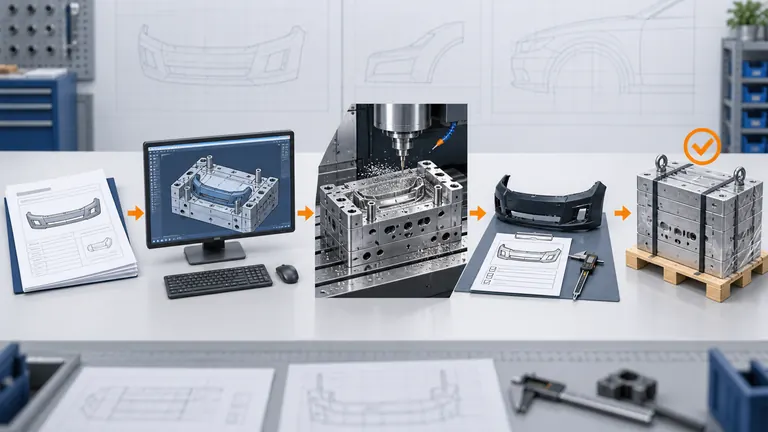
An injection-mold purchase can fail commercially even when the steel is eventually built. A deposit may start work, but later invoices can arrive before the buyer has received the design records, trial evidence, corrections, or ownership documents needed to control the asset.
Tie each payment to a defined, reviewable deliverable and an approval decision—not simply to elapsed time. The contract and purchase order should state scope, evidence, acceptance authority, treatment of open items, ownership, taxes, and remedies. The milestone plan is a commercial control tool, not legal advice; the buyer’s legal and finance teams should approve the final terms.
Define the commercial and technical baseline before the deposit
The first payment should release a controlled scope. If the quotation, purchase order, drawings, and technical assumptions do not agree, the supplier can start on one interpretation while the buyer expects another. That gap becomes expensive after steel has been ordered or cut.
Build a baseline package with the legal entities, currency, Incoterm where relevant, tax treatment, part numbers and revisions, mold concept, cavity count, resin and color, expected press interface, annual volume assumptions, quoted mold life basis, trial quantity, validation responsibility, documentation, spare parts, packaging, and shipping scope. Identify exclusions such as production material, texture, hot-runner controller, gauges, customer testing, or import charges. Do not let “complete mold” substitute for an itemized boundary.
The deposit decision should require more than an invoice. Ask for an acknowledged purchase order, final quotation, milestone schedule, responsibility matrix, and a design-input register showing unresolved items. If mold ownership matters, state when title transfers, how the tool is marked, where it may be used, and what records must follow it. Payment, possession, and ownership are related but not identical questions; the governing agreement must settle them.
Define who can approve each gate. A buyer’s engineer may approve a gate location but lack authority to accept a price change. A project manager may accept a trial plan but not waive a dimensional requirement. Record technical approval, commercial authorization, and customer approval separately. AIAG’s current APQP materials describe gated management and milestone-aligned documentation checks, which supports the discipline of evidence-based gates without prescribing payment percentages (AIAG APQP and Control Plan).
Before paying the deposit, close any assumption that could change the mold architecture or price materially. Open cosmetic zones, resin grades, machine interfaces, and part revisions should either be resolved or listed as explicit change triggers. This is the moment when ambiguity is cheapest to remove.
Match design payments to design maturity and release evidence
A design milestone should pay for demonstrated design maturity, not for a calendar label such as “design complete.” The buyer needs enough evidence to understand what will be cut, what remains open, and what changes will be treated as new scope.
Require a design-review package appropriate to the project: part orientation, shrinkage basis, cavity/core split, steel-safe strategy, gate and runner, venting, cooling, ejection, slides or lifters, insert plan, texture boundaries, mold base, lifting and handling, press connections, sensors, and identification. For an export mold, include the receiving machine envelope, locating ring, nozzle interface, clamp method, ejector pattern, electrical standards, water fittings, and transport restraints. The design package should carry revision identifiers and a disposition for every review comment.
Separate three decisions. “Concept accepted” means the general architecture can proceed. “Design released for steel” means defined components may be purchased and machining may start. “Design fully closed” means all agreed comments are resolved or formally deferred. A supplier may need a payment before every detail is final because long-lead components must be ordered; if so, list which purchases the payment authorizes and who owns them if the project stops.
Use a comment log with unique item numbers, owner, due date, disposition, and evidence link. “Noted” is not closure. Accepted-with-condition items need a test or correction plan and a deadline. A change after design release should enter a controlled quotation path that distinguishes buyer-requested change, correction of supplier nonconformance, and jointly approved optimization.
The buyer should also receive the promised native design data at the agreed stage, not only screenshots. Confirm file formats, software versions, reference models, standard-component lists, and rights of use. For high-risk actions or appearance surfaces, consider a partial steel-release gate rather than one blanket approval. The payment schedule should reward controlled progress while preserving enough leverage to obtain a usable, documented tool.
Define trial milestones by evidence, not by the existence of samples
“T1 completed” only proves that a molding attempt occurred. It does not prove that the mold ran safely, the intended material was used, every cavity produced identifiable parts, or the samples satisfy drawing and assembly requirements. A trial-linked payment therefore needs an evidence package.
Define the trial objective before the run. Early trials may check mold motion, filling, ejection, cooling, and obvious steel conditions; later trials may evaluate dimensions, appearance, process stability, cycle, automation, and production readiness. State the resin grade and lot, color, machine, screw and clamp capacity, mold temperature control, dryer condition, cavitation, trial duration, sample quantity, cavity marking, and measurement plan. If production intent cannot yet be achieved, label the limitation and do not treat results as final acceptance.
| Trial evidence | Buyer question | Gate disposition |
|---|---|---|
| Run record and settings | Was the intended mold-material-machine combination used? | Accept evidence, request clarification, or repeat |
| Cavity-identified samples | Can results be traced to every active cavity? | Continue or contain affected cavities |
| Mold action and safety check | Did slides, ejection, cooling, and protection operate correctly? | Release corrections before another run |
| Dimensional and appearance report | Which requirements pass, fail, or remain untested? | Approve, conditionally approve, or reject |
| Open-item list | Are owners and correction dates defined? | Hold only the amount tied to unresolved scope |
Illustrative example—hypothetical, not an AutoMoldingPro project. A four-cavity clip mold produces complete T1 samples, but one cavity shows flash and the cooling-circuit map is missing. The milestone should not be judged as simply “T1 done” or “T1 failed.” The buyer can accept the completed run evidence, require correction and cavity comparison, and retain the payment portion tied to unresolved acceptance deliverables according to the contract.
Avoid making final dimensional approval at T1 automatic. Tool corrections, resin conditioning, gauge readiness, and customer submission can require later stages. The milestone matrix should explain what T1 unlocks and what it does not.
Separate tool acceptance from production-part approval
Tool acceptance and part approval answer different questions. A mold can meet the agreed mechanical and documentation acceptance criteria while the customer’s product approval remains open; conversely, a set of acceptable samples does not prove that the mold is safe, maintainable, transferable, or capable of sustained production.
For tool acceptance, inspect the physical asset and its records. Typical areas include component identification, material and hardness certificates where specified, dimensions of agreed interfaces, action sequence, ejection, shutoffs, cooling-circuit pressure or leak checks, hot-runner electrical tests, spare and wear parts, drawings, bills of material, maintenance instructions, lifting points, preservation, and packaging. Export molds also need receiving-press compatibility and shipment acceptance. Reference the project-specific checklist rather than assuming one universal standard.
For production release, define the required sample source and evidence: production-intent material, approved cavities, agreed process window, dimensional results, capability where required, appearance standards, assembly or functional checks, packaging, traceability, and customer-specific submission. AIAG positions APQP, Control Plan, PPAP, FMEA, MSA, and SPC as linked core tools; the applicable customer requirement determines which records are mandatory (AIAG Quality Core Tools).
Write separate acceptance certificates or sign-off lines. A “tool acceptance” signature should not silently waive open product requirements. A “sample approval” should not transfer risk for hidden tool defects that were outside the sample review. Define treatment of punch-list items: severity, responsible party, due date, evidence, and whether they prevent shipment, production, or only final retention payment.
Final payment should be connected to the agreed final state: accepted tool, complete records, approved corrections, and the required transfer or custody condition. If customer approval will take months, consider a balanced retention mechanism instead of leaving an undefined large balance. Legal counsel should ensure that title, warranty, liability, inspection rights, and remedies are enforceable in the relevant jurisdictions.
Use a milestone matrix that finance and engineering can both audit
A useful payment schedule lets finance verify invoices without interpreting mold engineering and lets engineering stop a premature gate without renegotiating the entire purchase. Build one matrix and attach it to the purchase order or governing agreement.
For each milestone, record the trigger, deliverables, acceptance criteria, approver, review period, payment amount or percentage, tax treatment, treatment of disputed items, and consequence of delay. Percentages are commercial choices; do not copy a supplier’s standard split without considering project risk, lead-time purchases, bargaining position, and local law. The total must reconcile to the quoted scope and identify optional or pass-through costs separately.
| Milestone | Minimum evidence | Approval question |
|---|---|---|
| Order release | Signed scope, inputs, schedule, ownership terms | Is the project authorized to start? |
| Design/steel release | Controlled design package and closed review log | Is the released work technically defined? |
| Initial trial | Run record, samples, reports, open-item list | Was the planned learning gate completed? |
| Acceptance trial | Production-intent evidence and correction closure | Does the agreed acceptance state exist? |
| Shipment/custody | Asset records, preservation, packing, destination | Can the tool be transferred or retained safely? |
| Final retention | Signed acceptance and complete documentation | Are all contract deliverables closed? |
Create an invoice checklist with milestone number, purchase-order line, amount previously paid, deliverables received, technical approval, commercial approval, open claims, and payment recommendation. Store the evidence with the asset record. If a milestone is partially met, use the contract’s defined partial-acceptance process rather than informal promises.
For an RFQ, provide the part and tool scope, target schedule, intended ownership and location, trial and approval responsibilities, customer-specific requirements, data-delivery expectations, and proposed commercial gates. Ask the supplier to return its cash-flow assumptions, long-lead purchases, cancellation exposure, and evidence available at each gate. This comparison reveals whether a low deposit hides a large early payment with little acceptance protection.
Conclusion
Approve mold payments only against a controlled scope and named evidence. Separate design release, trial learning, tool acceptance, and production approval; assign the correct authority to each. Before issuing the purchase order, have engineering, procurement, finance, and legal review one milestone matrix and its remedies.