
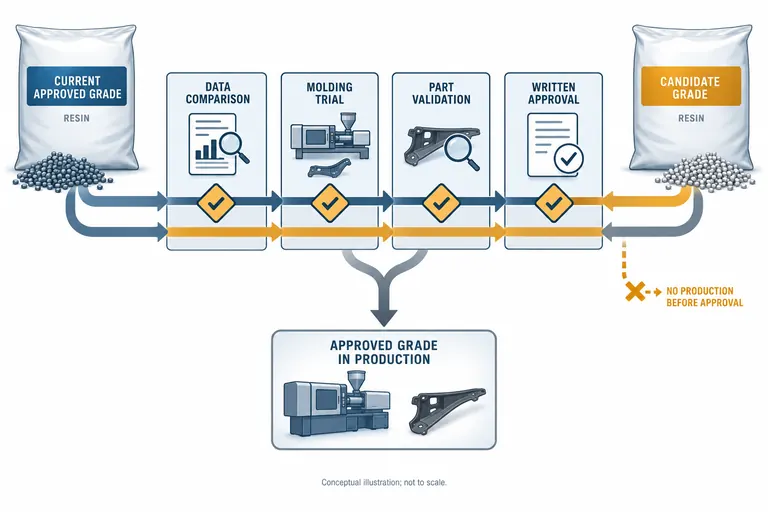
A resin shortage can turn an apparently simple purchasing decision into an uncontrolled product change. Two materials may share a polymer family and similar headline properties yet differ in reinforcement, additives, color package, shrinkage, processing window, long-term behavior, or declaration status.
Do not substitute an automotive resin on commercial equivalence alone. Freeze the current specification, identify the exact proposed grade, compare application-relevant evidence, assess tooling and process effects, define part and assembly validation, obtain the approvals required by the customer, and maintain separate lot and revision control until the change is formally released.
Start with the approved state, not the replacement supplier’s sales description
The first task is to establish what “the specified resin” actually means. A drawing may name a trade grade, an OEM material specification, a polymer and filler percentage, a color, or several of these. Purchase records may contain a newer supplier code than the drawing. The approved state therefore has to be reconstructed from controlled documents rather than memory.
Collect the released drawing and material specification, approved source and grade, color code, applicable customer-specific requirements, current IMDS or other material declaration, PPAP status, resin certificates, molding process revision, and the tests originally used for release. Record the document revisions and approval dates. If the original approval was conditional—for example, one resin source at one molding location—preserve that condition.
Then define the reason for change. Temporary shortage, permanent discontinuation, regional availability, regulatory reformulation, and cost reduction do not have the same approval path. A temporary deviation normally needs an expiry, quantity limit, affected lots, identification method, and restoration plan. A permanent alternative needs enduring specification and supply-chain control. Do not let “temporary” material continue indefinitely through repeated purchase orders.
Identify the proposed material by manufacturer, complete grade, reinforcement, color/additive package, and manufacturing region where relevant. “PA66-GF30 equivalent” is not a complete identity. The same nominal family can include heat stabilization, hydrolysis resistance, impact modification, flame retardancy, laser marking, or different glass-fiber and lubricant systems. BASF’s automotive polymer pages illustrate that one polymer family contains multiple grades optimized for different duties; the exact grade data, not the family name, is the comparison basis (BASF engineering plastics for automotive powertrain).
Create a one-page change definition before requesting samples. It should state current and proposed materials, reason, duration, affected part numbers and molds, intended first shipment, inventory segregation, requested approval route, and accountable owners. This prevents technical evaluation from proceeding with an ambiguous candidate.
Compare evidence by function, processing, compliance, and supply condition
A data-sheet comparison is necessary but insufficient. It shows standardized material-level results under stated specimen and conditioning conditions; it does not prove that a molded automotive part, its assembly, or the vehicle system remains acceptable.
Build a requirement-to-evidence matrix. Start with functions that can fail: structural load, clip retention, sealing, connector alignment, electrical insulation, heat aging, fluid exposure, appearance, dimensional stability, weld-line performance, fastener retention, or flammability when specified. For each, record the released requirement, original evidence, candidate evidence, difference, uncertainty, and proposed verification.
| Comparison area | Evidence to request | Approval question |
|---|---|---|
| Identity and formulation | Current TDS, safety/compliance declarations, grade and color codes | Is the candidate exactly defined and controlled? |
| Mechanical behavior | Relevant conditioned and unconditioned data with test methods | Do loads, creep, impact and weld-line risks remain covered? |
| Thermal/chemical duty | Aging and resistance data for applicable exposure | Are use temperature and fluids represented? |
| Molding behavior | Drying, melt/mold temperature, shrinkage and processing guide | Can the existing tool and machine run a stable window? |
| Dimensions/appearance | Shrinkage, moisture response, color/gloss information | What part features may move or look different? |
| Compliance/declaration | Current IMDS inputs and customer-required declarations | Must the material data record be revised and reaccepted? |
| Supply control | Plant of manufacture, lot certificate and change-notification policy | Can approved supply remain traceable? |
Compare like with like. A tensile value at one temperature and moisture state cannot close a requirement at another. A nominal shrinkage range does not predict local anisotropic shrinkage in a glass-filled housing. UL recognition, where applicable, does not replace customer part approval. Absence of a restricted substance in a supplier declaration does not establish assembly performance.
Flag missing data rather than converting it into assumed equivalence. Ask the material producers whether unpublished application data, processing guidance, or regulatory declarations are available. If the candidate requires a different drying window, barrel temperature, packing level, or mold temperature, record the likely effects on cycle, dimensions, appearance, degradation risk, and equipment. A change that looks neutral on material price may require tool correction or new inspection.
The output is not a winner score. It is a gap list that tells engineering and quality which differences require part-level evidence and which claims cannot yet be accepted.
Define molding, part, assembly, and system validation before the trial
Trialing first and deciding what to measure later wastes material and produces weak evidence. The cross-functional team should approve a validation plan tied to the change-risk assessment before the candidate enters the press.
Use the production-intent mold, representative machine, controlled candidate lots, approved colorant route, and documented drying. Record material certificates, moisture where relevant, purge and contamination controls, process parameters, cavity identity, sample timing, and conditioning before measurement. Establish whether the original process can be used or a candidate-specific process revision is needed. Do not force the substitute into old setpoints merely to claim “no process change.”
The trial should test a practical process window, not only one favorable setting. Review fill, pressure, cushion, recovery, cooling, part weight, visual condition, ejection, and cavity differences. Inspect critical dimensions in the defined material state and time after molding. Test functional features such as clips, threads, seals, weld lines, electrical spacing, or assembly fit according to released requirements. Product engineering must decide whether laboratory aging, environmental exposure, vibration, durability, flammability, or system tests need repetition.
Illustrative example—hypothetical, not an AutoMoldingPro project. A glass-filled connector housing faces a temporary shortage. The proposed grade has the same polymer and nominal glass loading, but its producer recommends a different drying range and reports different flow behavior. The team runs two documented lots, checks every cavity, measures terminal-position features after the specified conditioning, performs connector assembly and retention tests, and repeats the applicable environmental sequence. The example does not prove the grades are equivalent; it shows how a difference becomes a verification plan.
Define acceptance before molding: sample quantities, lots, cavities, measurement method, conditioning, functional tests, process-window criteria, and who signs each result. Include a failure route. If the substitute passes dimensions but fails assembly retention, the decision may be rejection, design change, tool correction, or a limited additional study—not selective reporting.
Obtain authorization and control the transition as a formal change
Technical success in an internal trial does not by itself authorize shipment. The supply agreement, drawing, PPAP status, customer-specific requirements, and change classification determine who must approve and what submission is required.
Prepare a change package containing the definition, risk assessment, comparison matrix, supplier declarations, material certificates, process study, dimensional and functional results, revised control documents, traceability plan, and requested effective point. Ask the customer whether a deviation, supplier change request, PPAP resubmission, IMDS update, or other approval is required. Record the written response and do not infer approval from silence.
IATF’s published minimum automotive QMS requirements for sub-tier suppliers state that the effects of changes, including supplier-originated changes, should be assessed and verification and validation defined to ensure customer requirements are met (IATF minimum automotive QMS requirements). The exact contractual requirement remains customer- and program-specific.
Separate old and new resin, work in process, finished goods, labels, and certificates. Define the first approved production lot and the last lot under the old state. Link resin lot to molding batch, cavities, inspection, packing, and shipment. If both grades remain approved, the order or release must specify which may be used and whether mixing lots or alternating grades is permitted. “Both are approved” is not permission to blend them.
Update the bill of material, material specification, work instruction, drying setup, process sheet, control plan, PFMEA as applicable, inspection plan, declarations, ERP purchasing controls, approved supplier list, and retained sample records. Include a rollback and containment plan if early production trends differ from the trial.
Use a substitution approval checklist at the RFQ and shortage meeting
Procurement can shorten the response without weakening control by requesting a complete package at the first shortage notice.
- Current and proposed manufacturer, grade, color/additive package, and manufacturing source.
- Reason, expected duration, available quantity, and required decision date.
- Affected part numbers, molds, customers, and open orders.
- Current TDS and processing guide for both grades, with test conditions.
- Application-relevant property and compliance comparison with gaps highlighted.
- Material declaration and change-notification information.
- Trial plan covering lots, cavities, process window, conditioning, measurements, and functional tests.
- Customer notification and submission route.
- Segregation, label, certificate, first/last lot, rollback, and restoration controls.
The checklist should be attached to the change record, not used as a verbal meeting agenda only. Assign engineering ownership for function, supplier quality ownership for evidence, purchasing ownership for availability and commercial terms, production ownership for process controls, and the customer’s designated function for authorization.
For a molding quotation or feasibility review, submit the released drawing, exact material requirement, annual demand, shortage timing, validation requirements, and any customer-specific change form. If a possible alternative is being considered, label it “candidate—approval required.” AutoMoldingPro can then review tooling and molding implications without presenting the candidate as pre-approved; contact us with the controlled material and part information.
Conclusion
Treat resin unavailability as a product-and-process change, not a purchasing swap. Define both grades precisely, compare evidence against part functions, validate on production-intent conditions, obtain written authorization, and control first and last lots. Until those gates close, the proposed resin remains a candidate.