
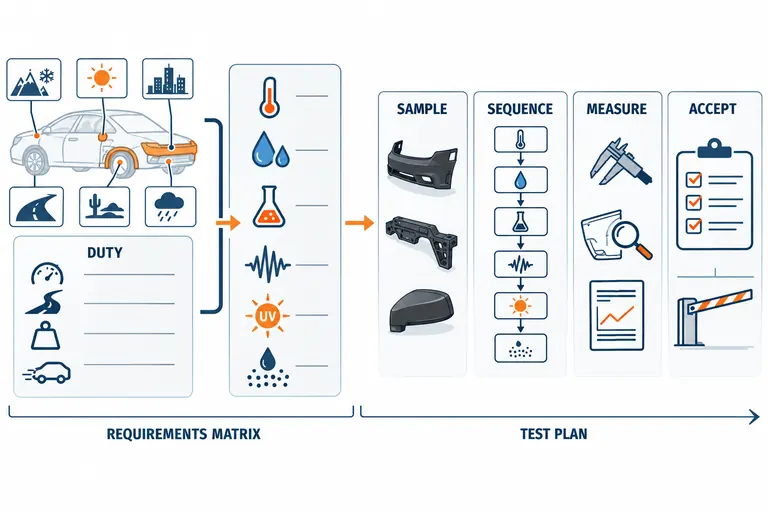
Environmental testing becomes expensive and slow when a supplier learns the real scope after the quote. “Automotive validation required” does not define samples, sequence, fixtures, conditioning, measurements, acceptance, laboratory responsibility, or whether a material coupon, molded part, assembly, or powered system is being approved.
Before quotation, convert the component’s location and duty into a test-responsibility matrix. Name the governing customer documents, exact conditions, sample source and quantity, sequence, pre- and post-measurements, acceptance rules, laboratory, reports, and failure route. Standards can define methods; they do not prove that a particular supplier owns the equipment or that a generic test applies to the part.
Start from service duty and failure modes
Describe where the part sits: cabin, exterior, underbody, engine compartment, battery pack, fluid circuit, connector system, or protected enclosure. Record storage and operating temperatures, duration and cycling, humidity, condensation, water or dust paths, UV, ozone, chemicals, vibration, shock, load, pressure, electrical operation, and handling. Include assembly state and nearby heat or stress sources.
Then list credible failures. Plastic can warp, creep, crack, discolor, lose impact strength, swell, shrink, embrittle, leak, lose seal compression, release a clip, reduce fastener torque, expose conductive paths, or fail appearance limits. Each failure needs a detection method and an acceptance criterion. A chamber cycle without a linked function is merely an exposure.
UL’s automotive environmental testing overview groups thermal shock, temperature/humidity, weathering, ozone, combined environments, ingress, vibration, and other influences, while emphasizing international and OEM-specific requirements (UL Automotive Environmental Testing). Use such service descriptions to understand possible disciplines, not to select tests by menu.
Separate development learning from formal qualification. Early comparative screens can rank materials or geometries with fewer samples. Formal validation must follow the released customer method, production-intent sample rules, calibrated equipment, and approval route. Quote both phases if both are expected.
Identify the governing document and exact test revision
Ask the direct customer for the specification number, revision, referenced standards, deviation history, and customer-specific reporting instructions. A broad reference such as IEC 60068, ISO 16750, SAE J1455, or an OEM family is not enough; those families contain multiple parts, severities, mounting conditions, and evaluation rules. Verify that the cited section applies to this component and location.
Create a requirement hierarchy. Regulatory obligations and contractual customer requirements are mandatory within their scope. Customer engineering may approve a tailored DVP&R or test plan. Material-producer data provides design evidence but does not replace finished-part approval. General industry guidance is useful for gap identification, not automatic acceptance.
Record parameters without paraphrasing away important conditions: temperature endpoints, ramp or transfer, dwell, humidity, fluid composition, concentration, spray or immersion, vibration axes and fixture, electrical state, number of cycles, recovery time, measurement condition, and allowed change. If the customer document is licensed or controlled, cite it in the internal plan without copying restricted content into a public article.
When requirements conflict, stop and obtain written resolution. Do not choose the less severe test because it fits available equipment. If a specification is unavailable at RFQ, price a defined assumption and list it as open, with commercial and schedule consequences.
Define samples, production state, fixtures, and sequence
State whether samples are plaques, standard test bars, single molded components, complete assemblies, or vehicle-level systems. Material tests answer different questions from assembled-part tests. A resin data sheet may support screening; it cannot establish a clip’s retention after thermal cycling or a housing’s leakage after vibration.
Specify production intent: exact grade and color, mold and cavity, process window, secondary operations, inserts, seals, fasteners, electronics, coating, adhesive, packaging, and conditioning. Identify lots and cavities. If prototype tooling or manually finished parts are accepted for a development test, mark which formal tests must repeat with production parts.
Fixtures can dominate results. Define mounting datums, torque, clamp, cable routing, mating components, load, pressure, and sensor placement. Assign design, manufacture, calibration, ownership, storage, and approval of fixtures. A vibration report without fixture definition may be impossible to reproduce.
Sequence tests when prior exposure changes later performance. Thermal cycling can move a seal; chemical exposure can soften a strain relief; humidity can change nylon dimensions; vibration can open a crack before ingress. Decide whether one sample group receives the combined sequence or separate groups isolate mechanisms. Record intermediate inspections so the failure window is not lost.
Use this planning table:
| Plan field | Required decision | Quote impact |
|---|---|---|
| sample article | coupon, part, assembly, powered system | material, molding and assembly quantity |
| sample source | tool, cavities, lots, process and condition | press time and traceability |
| test method | exact document, revision and parameters | equipment and laboratory eligibility |
| fixture/mating parts | design, supply, approval and calibration | tooling cost and lead time |
| sequence | combined or separate groups; intermediate checks | sample count and chamber time |
| measurements | before/during/after functions and condition | metrology and engineering hours |
| acceptance | limits, permitted change and approver | decision and repeat-test risk |
Assign responsibility and laboratory evidence
For each test, name the requirement owner, sample provider, fixture owner, executing laboratory, witness, data reviewer, report approver, and payer. If the molding supplier coordinates an external laboratory, clarify whether the customer must approve that laboratory and whether raw data, calibration, photographs, and failed samples are required.
Do not infer capability from a supplier website or certification logo. Request equipment range, method coverage, calibration status, relevant accreditation scope if required, chamber availability, sample capacity, fixture limits, and example report structure. A laboratory can be competent in a discipline yet lack the exact temperature, vibration force, fluid handling, ingress setup, or powered monitoring the test needs.
Include logistics: hazardous fluid shipment, customs, sample labeling, spare quantity, witness timing, data retention, and return or disposal of samples. External testing may drive the critical path more than mold manufacture. Reserve provisional slots only against a controlled plan.
UL notes that plastics tests may require defined drying or conditioning before measurement, because moisture affects properties and flow results (UL Physical Tests for Plastics). Carry that discipline into the quote: state preconditioning, recovery, and measurement environment instead of leaving “room condition” undefined.
Connect each exposure to measurable acceptance
Define baseline measurements before testing and the same measurements afterward where relevant. Possible outputs include dimensions, mass, color/gloss, surface condition, retention, torque, leak rate, pressure function, electrical continuity, insulation, stiffness, impact, or assembly fit. State equipment, datum setup, conditioning, and permitted change.
Avoid “no damage” unless the inspection method and threshold are defined. Visual inspection should include lighting, distance, magnification, surface zone, and defect criteria where appearance matters. Functional checks need load direction, speed, cycles, and fixtures. A leak test needs pressure, medium, stabilization, duration, and limit.
Use pass/fail gates rather than averaging unrelated criteria. A housing that remains dimensional but leaks has failed its sealing requirement. A color change may be acceptable for a hidden bracket but not a visible bezel. Customer engineering owns those priorities.
For a nylon sensor bracket exposed to heat, humidity, vibration, and splash, the plan might measure datums and retention in the defined conditioned state, assemble the bracket with production hardware, run the approved combined sequence, then repeat dimensions, torque/retention, crack inspection, and mating fit. Sample identity and intermediate checks help distinguish moisture movement, creep, and vibration damage.
Quote uncertainty without hiding it
If the exact customer specification is not available, state a priced baseline and open assumptions. Separate mandatory quoted work, optional development screens, externally quoted tests, customer-supplied tests, and exclusions. Identify how a later severity, sample-count, or fixture change affects price and schedule.
Add contingency rules: one included setup versus repeated tests, responsibility for failures caused by sample nonconformance, retest authorization, replacement samples, engineering investigation, and report revision. Do not promise unlimited validation in a fixed part price.
Build schedule gates around readiness. Before samples ship, confirm released revision, material certificates, cavity/lot plan, assembly completion, fixture approval, laboratory booking, method revision, and acceptance table. Before testing starts, reconcile received quantities and damage. Before report release, review deviations and raw results. These checks cost less than repeating a valid chamber sequence on the wrong revision or incompletely conditioned parts.
The automotive RFQ checklist covers common files and volumes. Attach the test matrix above so bidders use the same environmental scope. This makes quote comparison meaningful and reduces late commercial disputes.
Conclusion
Environmental validation should be quoteable before it is executable. Send AutoMoldingPro the drawing, component location, duty profile, customer specifications, sample expectations, mating parts, annual volume, and approval date through the contact page for a scoped molding and test-responsibility review.