
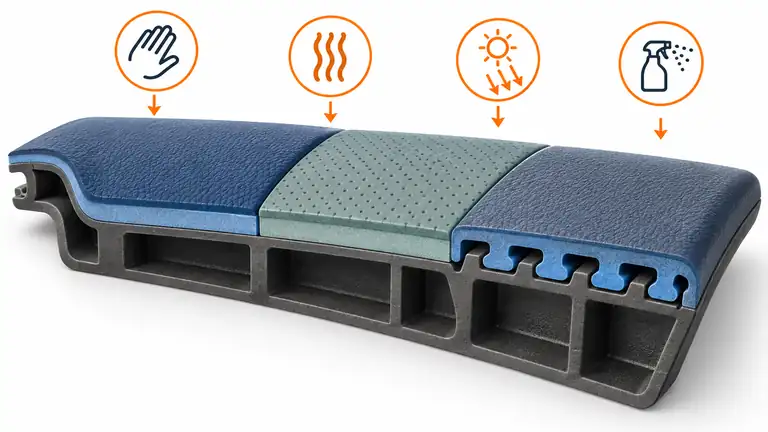
Two TPE grades can feel equally soft in a hand sample yet behave differently when bonded to PP, PC/ABS or polyamide, exposed to cabin heat, cleaners or skin oils, and molded across a thin shut-off. Shore hardness alone does not define compatibility or durability.
Define the required tactile or functional outcome, exact rigid substrate, interface, appearance and environment. Screen supplier grades for that substrate and color, design chemical and mechanical retention, then validate production-intent assemblies after conditioning, wear and required interior-emission testing.
The selection path runs from function and touch to exact chemistry, interface design, processing, service exposure and controlled approval.
Define what soft touch must accomplish
grip, comfort, damping, sealing, impact protection, noise control or appearance at a named surface must be resolved before the interface or tool is released.
Define turning subjective language into measurable zones, hardness range or feel references and functional tests, preserve the assumptions and verify the production-intent condition. A generic design rule or material label cannot approve the finished automotive part.
The review should begin with the physical function rather than a preferred manufacturing answer. The technical focus is grip, comfort, damping, sealing, impact protection, noise control or appearance at a named surface. Put that focus into the drawing, interface definition, quotation or validation plan that governs the work. Use the exact grade, geometry and condition under review, and identify connected characteristics that may move with the decision.
Use this sequence: turning subjective language into measurable zones, hardness range or feel references and functional tests. Assign unresolved inputs to named owners, freeze the working revision and state the next commitment that would be costly to reverse. Trials should use representative material, tooling, equipment and handling; a prototype or illustrative comparison must remain clearly identified when it is not production evidence.
The minimum inputs are contact area, user force, surface texture, thickness, temperature, fluids, wear cycles, color/gloss and approved tactile masters. Check units, conditioning, sample identity and requirement source. Request controlled customer documents instead of guessing proprietary rules. Lower hardness can improve cushioning but increase tack, deformation and molding difficulty; texture and thickness also change perceived feel. Preserve the rejected alternative and its reason because volume, environment, appearance, assembly or equipment changes can reverse the choice.
The main failure path is choosing the softest grade without checking support thickness, tack, dirt pickup, wear or assembly function. Isolate variables and watch coupled effects on dimensions, appearance, strength, cycle or inspection. Closure requires signed boundary samples and functional criteria show what the soft layer must do. Connect original evidence to part and drawing revision, cavity or fixture, material lot and process state; then record both an acceptance condition and a reaction that tells production when to stop or reopen the review.
Match the exact TPE to the substrate
polymer chemistry and supplier formulation that create adhesion to the exact rigid grade, color and surface state must be resolved before the interface or tool is released.
Define short-listing grades from manufacturer compatibility guidance and confirming the complete pair experimentally, preserve the assumptions and verify the production-intent condition. A generic design rule or material label cannot approve the finished automotive part.
Treat this as a controlled interface between design intent and production evidence. The technical focus is polymer chemistry and supplier formulation that create adhesion to the exact rigid grade, color and surface state. Put that focus into the drawing, interface definition, quotation or validation plan that governs the work. Use the exact grade, geometry and condition under review, and identify connected characteristics that may move with the decision.
Use this sequence: short-listing grades from manufacturer compatibility guidance and confirming the complete pair experimentally. Assign unresolved inputs to named owners, freeze the working revision and state the next commitment that would be costly to reverse. Trials should use representative material, tooling, equipment and handling; a prototype or illustrative comparison must remain clearly identified when it is not production evidence.
The minimum inputs are TPE family and grade, substrate manufacturer/grade/color, fillers, flame retardants, moisture, regrind, mold release and storage history. Check units, conditioning, sample identity and requirement source. Request controlled customer documents instead of guessing proprietary rules. A chemically compatible grade can simplify retention; mechanical locks provide backup but consume space and affect flow and appearance. Preserve the rejected alternative and its reason because volume, environment, appearance, assembly or equipment changes can reverse the choice.
The main failure path is assuming all TPEs bond to all ABS, PP or nylon, or changing a substrate grade after interface approval. Isolate variables and watch coupled effects on dimensions, appearance, strength, cycle or inspection. Closure requires representative molded peel, pull or functional evidence identifies the exact pair and failure mode. Connect original evidence to part and drawing revision, cavity or fixture, material lot and process state; then record both an acceptance condition and a reaction that tells production when to stop or reopen the review.
Design the soft-rigid interface
overmold thickness, edge shut-offs, flow path, radii, anchors, feather edges and local support must be resolved before the interface or tool is released.
Define creating a continuous fill and retention path while protecting visible boundaries and ejection, preserve the assumptions and verify the production-intent condition. A generic design rule or material label cannot approve the finished automotive part.
The useful question is not whether the option can work once, but whether its boundary conditions are visible. The technical focus is overmold thickness, edge shut-offs, flow path, radii, anchors, feather edges and local support. Put that focus into the drawing, interface definition, quotation or validation plan that governs the work. Use the exact grade, geometry and condition under review, and identify connected characteristics that may move with the decision.
Use this sequence: creating a continuous fill and retention path while protecting visible boundaries and ejection. Assign unresolved inputs to named owners, freeze the working revision and state the next commitment that would be costly to reverse. Trials should use representative material, tooling, equipment and handling; a prototype or illustrative comparison must remain clearly identified when it is not production evidence.
The minimum inputs are CAD sections, gate options, flow length, texture, draft, bond area, interlocks, shut-off angle, venting and substrate stiffness. Check units, conditioning, sample identity and requirement source. Request controlled customer documents instead of guessing proprietary rules. Thicker TPE improves filling and cushioning but increases material, cooling and shrinkage; thin edges look refined yet are less robust. Preserve the rejected alternative and its reason because volume, environment, appearance, assembly or equipment changes can reverse the choice.
The main failure path is using a zero-thickness edge, trapping air behind an interlock or letting injection pressure deform the first shot. Isolate variables and watch coupled effects on dimensions, appearance, strength, cycle or inspection. Closure requires tool sections and short-shot/section evidence show complete fill, clean boundaries and intended retention. Connect original evidence to part and drawing revision, cavity or fixture, material lot and process state; then record both an acceptance condition and a reaction that tells production when to stop or reopen the review.
Check interior environment and substances
heat aging, cold, UV through glass, humidity, cleaners, skin oils, sunscreen, abrasion, odor and fogging must be resolved before the interface or tool is released.
Define building an exposure matrix from vehicle location and customer specifications before material release, preserve the assumptions and verify the production-intent condition. A generic design rule or material label cannot approve the finished automotive part.
A supplier recommendation becomes actionable only when its assumptions can be checked against the released product. The technical focus is heat aging, cold, UV through glass, humidity, cleaners, skin oils, sunscreen, abrasion, odor and fogging. Put that focus into the drawing, interface definition, quotation or validation plan that governs the work. Use the exact grade, geometry and condition under review, and identify connected characteristics that may move with the decision.
Use this sequence: building an exposure matrix from vehicle location and customer specifications before material release. Assign unresolved inputs to named owners, freeze the working revision and state the next commitment that would be costly to reverse. Trials should use representative material, tooling, equipment and handling; a prototype or illustrative comparison must remain clearly identified when it is not production evidence.
The minimum inputs are temperature/time profiles, chemical list and concentration, contact method, wear, color/gloss, emissions methods and acceptance rules. Check units, conditioning, sample identity and requirement source. Request controlled customer documents instead of guessing proprietary rules. Broad resistance can narrow material choice and raise cost; focus on credible exposures but preserve customer-mandated tests. Preserve the rejected alternative and its reason because volume, environment, appearance, assembly or equipment changes can reverse the choice.
The main failure path is using generic chemical-resistance tables as product approval or testing only room-temperature adhesion. Isolate variables and watch coupled effects on dimensions, appearance, strength, cycle or inspection. Closure requires conditioned appearance, adhesion and function results support the stated service envelope. Connect original evidence to part and drawing revision, cavity or fixture, material lot and process state; then record both an acceptance condition and a reaction that tells production when to stop or reopen the review.
Establish the molding process and supply state
drying, substrate temperature, residence, injection speed, pressure, cooling and handling that influence adhesion and surface must be resolved before the interface or tool is released.
Define using grade-specific supplier guidance and representative transfer or two-shot timing, preserve the assumptions and verify the production-intent condition. A generic design rule or material label cannot approve the finished automotive part.
Separate the mechanism being controlled from the document used to report it. The technical focus is drying, substrate temperature, residence, injection speed, pressure, cooling and handling that influence adhesion and surface. Put that focus into the drawing, interface definition, quotation or validation plan that governs the work. Use the exact grade, geometry and condition under review, and identify connected characteristics that may move with the decision.
Use this sequence: using grade-specific supplier guidance and representative transfer or two-shot timing. Assign unresolved inputs to named owners, freeze the working revision and state the next commitment that would be costly to reverse. Trials should use representative material, tooling, equipment and handling; a prototype or illustrative comparison must remain clearly identified when it is not production evidence.
The minimum inputs are machine and tool, exact grades, dryer conditions, substrate age/cleanliness, melt and mold temperatures, cycle, regrind and shutdown practice. Check units, conditioning, sample identity and requirement source. Request controlled customer documents instead of guessing proprietary rules. A hotter substrate may improve adhesion but add handling and distortion risk; faster automated transfer improves consistency at greater capital. Preserve the rejected alternative and its reason because volume, environment, appearance, assembly or equipment changes can reverse the choice.
The main failure path is approving hand-loaded hot substrates while production loads cold aged parts, or using external release that weakens the interface. Isolate variables and watch coupled effects on dimensions, appearance, strength, cycle or inspection. Closure requires process-window trials and lot traceability demonstrate robust bonding and appearance. Connect original evidence to part and drawing revision, cavity or fixture, material lot and process state; then record both an acceptance condition and a reaction that tells production when to stop or reopen the review.
Approve the full construction and control changes
whether the finished part retains feel, appearance and bond across lots, cavities, time and environmental conditioning must be resolved before the interface or tool is released.
Define testing production-intent assemblies, documenting boundary samples and defining supplier/material/process change triggers, preserve the assumptions and verify the production-intent condition. A generic design rule or material label cannot approve the finished automotive part.
Close this point at the level of the specific feature, material state, process step or inspection result. The technical focus is whether the finished part retains feel, appearance and bond across lots, cavities, time and environmental conditioning. Put that focus into the drawing, interface definition, quotation or validation plan that governs the work. Use the exact grade, geometry and condition under review, and identify connected characteristics that may move with the decision.
Use this sequence: testing production-intent assemblies, documenting boundary samples and defining supplier/material/process change triggers. Assign unresolved inputs to named owners, freeze the working revision and state the next commitment that would be costly to reverse. Trials should use representative material, tooling, equipment and handling; a prototype or illustrative comparison must remain clearly identified when it is not production evidence.
The minimum inputs are sample genealogy, cavity, process settings, conditioning, force data, surface measurements, emissions and customer disposition. Check units, conditioning, sample identity and requirement source. Request controlled customer documents instead of guessing proprietary rules. Tight controls protect repeatability; approved alternatives can reduce supply risk only after equivalent evidence is established. Preserve the rejected alternative and its reason because volume, environment, appearance, assembly or equipment changes can reverse the choice.
The main failure path is calling a resin grade “automotive approved” for every use or accepting average adhesion with edge failures. Isolate variables and watch coupled effects on dimensions, appearance, strength, cycle or inspection. Closure requires approved evidence and a controlled material/interface specification preserve the tested state. Connect original evidence to part and drawing revision, cavity or fixture, material lot and process state; then record both an acceptance condition and a reaction that tells production when to stop or reopen the review.
Soft-touch TPE and substrate selection matrix
Use this worksheet—the soft-touch tpe and substrate selection matrix—during the supplier review. It is a decision aid for select an exact tpe and substrate pair that can deliver the required touch or function through production and service., not a substitute for the drawing, customer specification or validation record.
| Review line | Required input or evidence | Release question |
|---|---|---|
| Define what soft touch must accomplish | contact area, user force, surface texture, thickness, temperature, fluids, wear cycles, color/gloss and approved tactile masters | Is signed boundary samples and functional criteria show what the soft layer must do available and traceable? |
| Match the exact TPE to the substrate | TPE family and grade, substrate manufacturer/grade/color, fillers, flame retardants, moisture, regrind, mold release and storage history | Is representative molded peel, pull or functional evidence identifies the exact pair and failure mode available and traceable? |
| Design the soft-rigid interface | CAD sections, gate options, flow length, texture, draft, bond area, interlocks, shut-off angle, venting and substrate stiffness | Is tool sections and short-shot/section evidence show complete fill, clean boundaries and intended retention available and traceable? |
| Check interior environment and substances | temperature/time profiles, chemical list and concentration, contact method, wear, color/gloss, emissions methods and acceptance rules | Is conditioned appearance, adhesion and function results support the stated service envelope available and traceable? |
| Establish the molding process and supply state | machine and tool, exact grades, dryer conditions, substrate age/cleanliness, melt and mold temperatures, cycle, regrind and shutdown practice | Is process-window trials and lot traceability demonstrate robust bonding and appearance available and traceable? |
| Approve the full construction and control changes | sample genealogy, cavity, process settings, conditioning, force data, surface measurements, emissions and customer disposition | Is approved evidence and a controlled material/interface specification preserve the tested state available and traceable? |
For the decision to select an exact tpe and substrate pair that can deliver the required touch or function through production and service., read the rows together. A technically acceptable feature can still be commercially incomplete, and a complete quotation can still rely on an unverified process assumption. Mark each row accepted, accepted with a bounded action, or open. A bounded action needs an owner, due date, quantity or activity limit and the evidence required for final closure.
Worked decision scenario
Consider this decision pattern. A soft console button is initially specified only as 60 Shore A. Candidate TPEs feel similar, but one is intended for PP while the substrate is flame-retarded PC/ABS. The team freezes the exact substrate, uses supplier guidance to shortlist compatible grades, adds a hidden mechanical anchor, and molds the real edge shut-off. Adhesion, gloss, cleaner exposure and emissions are then evaluated after conditioning; no universal hardness-to-feel claim is made.
For soft touch TPE automotive interior, the decision remains conditional on the stated geometry, material, load, environment, quantity and acceptance method. Changing one of those inputs reopens the affected review line.
Questions to ask the supplier
- How will you demonstrate that signed boundary samples and functional criteria show what the soft layer must do?
- How will you demonstrate that representative molded peel, pull or functional evidence identifies the exact pair and failure mode?
- How will you demonstrate that tool sections and short-shot/section evidence show complete fill, clean boundaries and intended retention?
- How will you demonstrate that conditioned appearance, adhesion and function results support the stated service envelope?
- How will you demonstrate that process-window trials and lot traceability demonstrate robust bonding and appearance?
- How will you demonstrate that approved evidence and a controlled material/interface specification preserve the tested state?
For soft touch TPE automotive interior, a useful answer names the controlled source, identifies assumptions and exceptions, and explains how the result will be transferred into production documentation. A yes/no response without revision, sample and condition context is not sufficient for release.
Information to submit for a project-specific review
Provide soft and rigid CAD zones, required function and tactile reference, exact substrate, candidate TPE grades and colors, service temperature/chemicals/UV/wear, emissions requirements, annual volume and intended overmolding route. Use the AutoMoldingPro request form to keep the current files and assumptions tied to one inquiry. Detailed validation documents can follow after the initial scope is understood.
Conclusion
Select soft-touch TPE as an exact material-interface system. Define the function, qualify the grade pair, design fill and retention, and approve only after representative environmental and production evidence.