
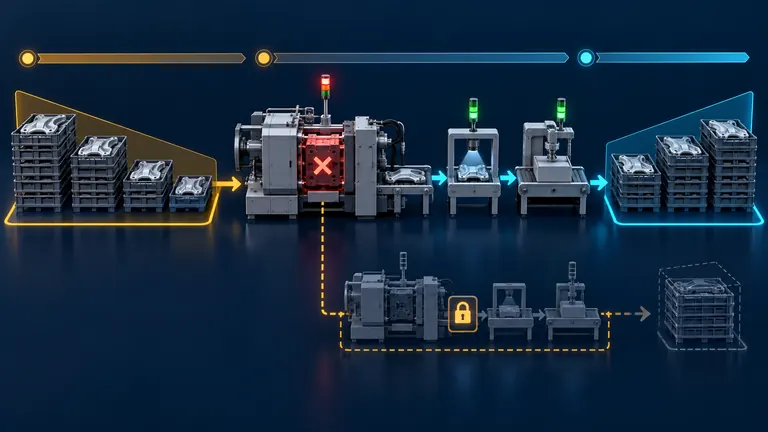
Conceptual illustration; not to scale.
When molded-part deliveries slip, pressure builds faster than reliable information. Buyers may expedite every order, production may change priorities hourly, and the supplier may promise dates that assume the original problem is already solved. Those reactions consume capacity while the customer still lacks a credible path to stable supply.
Run recovery on two connected tracks: protect the customer now and remove the capacity or quality constraint that caused the miss. Establish one demand-and-inventory picture, control shipment promises, identify the true bottleneck, execute a time-phased plan with named owners, and verify sustained output before removing containment. Tool transfer or second sourcing should be evaluated early when the recovery horizon cannot protect customer demand.
Stabilize facts and command structure in the first response
The first recovery objective is a shared, time-stamped operating picture. Competing spreadsheets and informal promises create allocation errors. Set one accountable lead and one source for demand, inventory, production, quality hold, and shipment status.
Confirm customer demand by part number, revision, delivery location, due date, quantity, packaging, and priority. Separate firm requirements from forecast and avoid silently pulling future demand into the current shortage. Reconcile good finished goods at the supplier, stock in transit, customer inventory where available, work in process, quarantined material, raw material, and recoverable scrap. State inspection and release status; physically present parts are not available supply if they cannot be shipped.
Calculate projected coverage using the agreed demand sequence and realistic transportation time. Show assumptions and update time on every version. Establish a fixed meeting cadence proportional to severity, with purchasing, supplier operations, quality, logistics, engineering, and customer contacts as needed. Keep an action log with owner, deadline, evidence, and decision.
Freeze uncontrolled schedule changes. One authorized channel should issue priorities and shipment commitments. This does not prevent urgent decisions; it prevents different people from directing the same press, tool, material, and carrier in incompatible ways. Record customer notifications and required escalation under the applicable contract or customer-specific process.
Publish the next update time even when no new promise is available. Predictable, evidence-based communication is more useful to assembly planning than frequent unverified optimism.
Protect assembly without creating a hidden quality escape
Continuity actions must preserve product conformity. Expedited production, alternate inspection, rework, mixed lots, substitute packaging, or process changes can introduce a second crisis if they bypass approval.
Rank demand by actual customer consequence and agreed priority. Allocate confirmed conforming stock first. Consider partial shipments, revised carrier routes, direct delivery, extended receiving hours, and packaging turns when those actions are approved and traceable. Use premium freight deliberately and record why it was necessary; transport cannot compensate for an unconfirmed production plan.
If quality containment caused the shortage, define the suspect population, traceability boundary, inspection method, acceptance criteria, disposition authority, throughput, and evidence. Validate any sorting or rework method before relying on its yield. Do not use an unverified optimistic sort rate in the recovery forecast.
Changes to material, machine, cavity use, cycle, inspection, packaging, plant, or source may require customer notification, deviation, or submission. Confirm the route before shipping. Emergency does not convert an unapproved change into an approved product. Where an interim deviation is permitted, document scope, quantity, expiration, traceability, and return-to-standard condition.
Maintain a separate line for service parts, launch builds, or safety-related demand if their consequences and approval paths differ. The recovery schedule should make such decisions visible rather than embedding them in a total quantity.
Track every exceptional control with a start, owner, maximum quantity or duration, and exit condition. This prevents temporary sorting, overtime, or packaging changes from surviving after the immediate shortage.
Find the real constraint, not the loudest symptom
A missed truck is an outcome. The constraint may be mold damage, low cavity yield, press downtime, hot-runner faults, material shortage, labor, inspection capacity, packaging, planning, or an unstable process. Recovery dates are unreliable until the bottleneck is measured.
Map the flow from raw material availability through drying, molding, secondary operation, inspection, packing, release, staging, and transportation. For each step, record demonstrated hourly output, planned hours, downtime, yield, queue, changeover, and limiting resource. Use actual recent data and separate steady production from startup and interruptions.
Check mold status by cavity, maintenance condition, cooling, ejection, hot runner, sensors, and available spares. Check machine fit and usable availability, not only nominal tonnage. Verify material on hand by approved grade and lot, drying capacity, and replenishment lead time. Confirm gages, inspectors, fixtures, packaging, labels, and release authority. A press running faster does not improve shipments if inspection or packaging is the constraint.
Use a capacity bridge: demonstrated good pieces per hour × scheduled productive hours, reduced by realistic changeover, maintenance, and yield assumptions. Avoid double counting overtime and added shifts before staffing, material, maintenance, and downstream capacity are confirmed. If the calculated output still misses the demand curve, the plan needs another structural action rather than a better-looking date.
Build a time-phased recovery plan with decision gates
The plan should show how inventory position changes by day or shift and which evidence permits each capacity increase. A list of actions without an output bridge is not a recovery forecast.
| Time horizon | Primary objective | Evidence required | Typical actions |
|---|---|---|---|
| Immediate | Stop customer depletion | Confirmed stock, demand, quality status, transport | Allocation, controlled sorting, partial and premium shipments |
| Short term | Raise conforming output | Demonstrated cycle, cavities, yield, hours and downstream capacity | Overtime, added shift, repair, approved alternate machine, focused maintenance |
| Medium term | Remove structural constraint | Trial and approval evidence, trained resources, material and tooling readiness | Duplicate components, tool transfer, second source, automation or process correction |
| Exit | Return to normal governance | Backlog cleared, target stock restored, stable quality and delivery | Remove containment, close actions, update continuity plan |
For every action, state incremental good pieces by date, prerequisites, owner, cost authority, quality approval, and fallback. Use low/base/high scenarios when repair time or yield is uncertain. Link promises to milestones such as “insert installed and trial accepted,” not simply “supplier expects recovery Friday.”
Add explicit gates. Examples include approval to run an alternate press, completion of a mold repair trial, release of sorted stock, arrival of approved resin, validation of a second cavity, or customer authorization of an alternate source. If a gate fails, activate the named contingency and revise the demand bridge immediately.
Keep the previous forecast versions so the team can see which assumption failed. That record improves the next estimate and distinguishes real progress from moving a date.
Decide early among repair, transfer, and second-source options
Structural alternatives take time, so waiting until inventory reaches zero can eliminate them. Evaluate parallel paths as soon as the initial capacity bridge shows a sustained gap.
A focused mold repair may be fastest when the failure is understood, components and skill are available, and the existing process can be restored. A tool transfer may help when another plant has compatible equipment, people, material, auxiliaries, and customer approval, but transport alone does not create a qualified process. A duplicate tool or second source can address long-term exposure but normally requires design reconciliation, build or transfer, trials, measurement, validation, logistics, and approval.
Assess options against time to first approved shipment, daily sustainable output, technical risk, customer-change requirements, asset rights, material availability, cost, and reversibility. Preserve the current tool and data before rushing a move. The mold transfer checklist and second-source cost model provide the detailed inputs.
Do not count overlapping capacity twice. If an alternate plant needs the same mold that is being repaired, the paths are sequential, not additive. Likewise, an unapproved second source belongs in the future scenario until its release conditions are complete.
Verify sustained recovery before closing containment
Clearing one late shipment does not prove recovery. Exit should depend on stable conforming output, restored inventory, controlled backlog, and closure of the causes that made delivery unreliable.
Define exit criteria at the beginning. They may include a specified sequence of on-time shipments, restored minimum inventory, demonstrated output over planned shifts, stable scrap and downtime, completion of repair or corrective action, customer acceptance of required submissions, and removal of temporary deviation or inspection. Tailor the period and evidence to risk.
Review actual versus plan daily. Explain differences in demand, uptime, cycle, cavities, yield, inspection, packing, and transport. Update the forecast without erasing prior versions. A plan that repeatedly shifts dates without retaining assumptions cannot support learning or accountability.
Complete root-cause and corrective-action work separately from the shipment bridge but connect their milestones. Verify effectiveness under normal operating conditions. Update preventive maintenance, spare parts, process controls, capacity assumptions, escalation rules, and the business-continuity plan. If the event exposed a single-tool or single-material vulnerability, document the sourcing decision rather than closing the incident with an informal promise.
Illustrative example: a tool failure during a demand peak
This illustrative example is not a customer case. A six-cavity mold loses two cavities after an ejector-related failure while scheduled demand is rising. The supplier initially promises recovery through overtime, but the capacity bridge shows that four cavities at the demonstrated cycle cannot protect the next customer requirement.
The team reconciles conforming inventory, in-transit stock, demand, and quarantine by lot. It confirms that inspection is not the bottleneck and allocates stock to the earliest assembly need. Tooling prepares a repair with a defined trial gate while production proves a controlled four-cavity process. Purchasing checks spare component availability, and logistics books conditional premium capacity rather than dispatching empty trucks.
In parallel, engineering reviews an alternate press and a possible tool move. The machine interface is compatible, but customer notification and a receiving trial would extend the first approved shipment beyond the repair forecast. The move remains a fallback, not counted capacity.
The repair trial succeeds, each cavity is identified and inspected, and output is demonstrated across planned shifts. Containment remains until backlog is cleared, inventory reaches the agreed level, and repeat output is stable. The final corrective action adds critical ejector spares and a maintenance trigger; it does not claim that overtime solved the cause.
Recovery data to request from the supplier
- demand, backlog, inventory, work-in-process, quarantine and shipment reconciliation by part and status;
- mold, machine, cavity, material, labor, quality, packaging and logistics constraint evidence;
- demonstrated cycle, uptime, yield and good-output data by shift;
- repair scope, components, trial plan, risks, responsible owners and completion evidence;
- daily action and capacity bridge with assumptions and contingency triggers;
- customer notifications, deviations, submissions and traceability controls;
- premium freight and exceptional cost record;
- exit criteria, corrective action, effectiveness verification and continuity-plan updates.
Ask for timestamps and evidence sources. “Running better” is not enough to update an assembly protection plan.
Conclusion
Recover delivery by protecting demand with verified stock while removing the measured constraint. Send AutoMoldingPro the part requirements, demand and inventory bridge, mold and machine status, material position, quality holds, current output, approval constraints, and required recovery date to evaluate molding, transfer, or second-source options.