
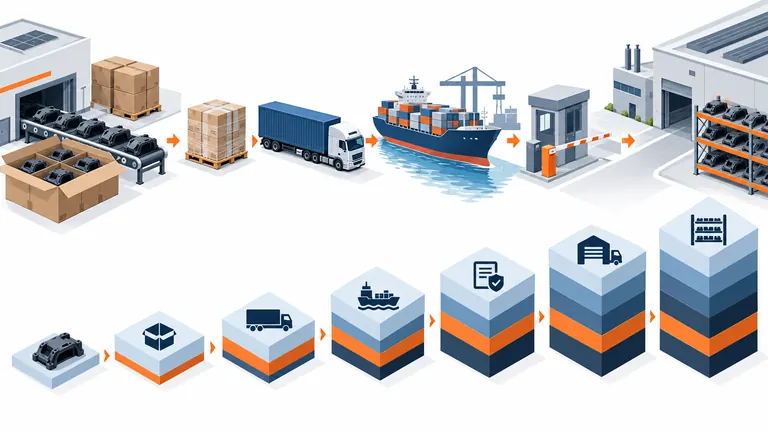
A supplier’s ex-works piece price is not the cost of having acceptable parts available at the receiving plant. Packaging, inland and international transport, customs, inspection, inventory time, damage, and administrative work can change the sourcing comparison. Using a percentage uplift hides the conditions that actually drive those costs.
Build total landed cost for one accepted part at a named destination, over a stated demand and shipment scenario. Keep purchase price, logistics, border charges, inventory, quality-related allowances, and one-time launch costs separate. Use the current product classification, origin, destination rules, and Incoterms® rule; do not copy a duty rate from a previous part or treat recoverable tax as permanent cost without finance review.
Fix the commercial and physical boundary first
“Delivered price” is incomplete unless the named place and responsibilities are stated. Before calculating, define where the supplier’s quoted responsibility ends, who arranges each transport leg, who bears risk at each point, who completes export and import formalities, and who pays each fee.
Incoterms® rules allocate specified obligations, risks, and costs between seller and buyer, but they do not replace the sale contract or settle every operational issue. The ICC explains that the rules address who organizes carriage or insurance, the point of delivery and risk transfer, and allocation of specified costs and customs responsibilities (ICC explanation). Record the exact rule, named place or port, and “Incoterms® 2020” in the scenario. “FOB China” or “DDP customer” without a location is not enough for a reproducible comparison.
Map the shipment physically: supplier plant, export consolidation, port or airport, international movement, import entry, destination terminal, domestic freight, receiving inspection, and point of use. For each leg, identify packaging format, pieces per box and pallet, dimensions, gross weight, expected frequency, lead time, and ownership of returnable packaging. A low part price can be offset by poor cube utilization or packaging that requires repacking at destination.
Use the same service level for competing scenarios. Air freight for one supplier and ocean freight for another is not a sourcing comparison unless the timeline requires those modes. Likewise, compare the same delivery frequency and destination. Consolidating monthly may reduce freight per part but increases transit and cycle inventory; weekly deliveries may improve responsiveness while raising handling and transport cost.
Keep one-time costs outside the recurring landed-piece figure unless the decision specifically amortizes them. Tooling, gauges, launch validation, first-article activity, packaging development, and supplier qualification should be visible in a separate cash-flow view. This prevents a long forecast from making a major launch cost appear artificially insignificant.
Build the landed-cost stack from auditable inputs
Calculate each layer from an identifiable source rather than applying a generic multiplier. The buyer should be able to update freight, exchange rate, duty, shipment quantity, or defect assumption without rebuilding the whole model.
| Cost layer | Typical inputs | Evidence owner | Common error |
|---|---|---|---|
| Purchase price | Revision, resin grade, color, volume, order quantity, inspection, packaging boundary | Purchasing/supplier | Comparing different technical scopes |
| Export and international logistics | Pack density, weight, volume, lane, mode, surcharges, insurance | Logistics/forwarder | Using a rate without validity dates or minimum charges |
| Import charges | Classification, origin, customs value, destination measures | Importer/customs specialist | Reusing a rate from a similar-looking part |
| Destination handling | Brokerage, terminal, inland freight, receiving, repacking | Logistics/plant | Omitting fixed shipment fees |
| Inventory carrying | Cash value, transit and safety-stock time, finance policy | Finance/planning | Treating all inventory as free or using an arbitrary percentage |
| Quality exposure | Receiving inspection, containment scenario, damage, replacement lead time | SQE/quality | Counting hypothetical risk as a proven supplier defect rate |
| One-time costs | Tooling, launch, validation, packaging development | Program/finance | Hiding them in the recurring unit price |
Freight should use chargeable weight or volume rules from the selected provider and lane. Capture fixed and variable elements, minimums, fuel or security surcharges, origin and destination handling, and rate validity. Divide shipment-level cost by the expected accepted quantity in that shipment, not annual volume. If pallet utilization depends on part orientation or surface protection, validate the pack concept before assuming density.
Border calculations must be country- and product-specific. The European Commission’s Access2Markets guidance explains that product classification is the first step for identifying tariffs and that customs value and origin affect applicable duties (EU tariff guidance). Its import guide also notes that import VAT treatment varies and may be reclaimable for VAT-registered firms; finance should determine whether it is a cash-timing item or a true cost in the buyer’s situation (EU import guide). For U.S. imports, use current CBP and broker guidance for the actual transaction. This article does not assign a tariff code or rate.
Quality allowances need disciplined wording. Use verified receiving-inspection labor, approved containment plans, historical supplier-specific data where authorized, or clearly labeled scenarios. Do not invent a defect percentage to make one geography look better. A scenario can still quantify exposure: for example, the cost to sort one shipment plus premium replacement freight if a lot is rejected.
Calculate one accepted part under named scenarios
The model should show how cost changes when shipment quantity, mode, duty, exchange rate, or inventory policy changes. Avoid a single precise answer built on uncertain inputs; use a base case and sensitivities.
Illustrative example—hypothetical, not an AutoMoldingPro quotation or a current tariff calculation. Assume 20,000 parts per ocean shipment. The supplier price is USD 1.20 per part at the agreed handover point. Export/international logistics are USD 4,600 per shipment, destination handling and inland freight are USD 1,400, and receiving inspection is USD 600. The importer’s specialist has calculated USD 2,400 of applicable import duty for this exact scenario. No import VAT is included because its accounting treatment must be decided separately.
- Purchase value:
20,000 × USD 1.20 = USD 24,000 - Listed shipment-level additions:
4,600 + 1,400 + 600 + 2,400 = USD 9,000 - Landed cost before inventory and risk scenarios:
(24,000 + 9,000) ÷ 20,000 = USD 1.65 per part
Now assume the planner requires an average of 45 days of additional pipeline and safety inventory attributable to the lane. If finance applies a 12% annual carrying-rate assumption to the USD 1.65 landed value, the analytical carrying cost is approximately 1.65 × 12% × 45 ÷ 365 = USD 0.0244 per part. This is not an invoice; it is a planning value using stated assumptions. The resulting analytical cost is about USD 1.674 per part before any separately modeled disruption or quality scenario.
Test at least four sensitivities: shipment quantity, freight mode, exchange rate, and demand variation. Smaller shipments spread fixed handling across fewer parts. Air freight changes both transportation cost and pipeline time. Currency movement affects the purchase-price layer if the contract currency differs from the buyer’s reporting currency. Demand below forecast can leave excess inventory; demand above forecast may trigger premium freight.
Use the result as a range and decision map. It is more useful to know that supplier A wins under full-container ocean shipments but loses under frequent low-volume releases than to publish one false-precision total.
Add time, quality, and continuity without double counting
Total landed cost should illuminate risk, not convert every possible disruption into a permanent surcharge. Separate expected recurring costs, scenario exposure, and qualitative controls.
Lead time has several components: order processing, material availability, production queue, molding and downstream work, inspection, consolidation, export clearance, transit, import clearance, domestic transport, and receiving release. Map average and variability for the actual lane. The buffer decision should be tied to named uncertainties and customer demand signals, not a rule such as “always hold three months.” The forecast, release, and safety-stock guide explains how to separate non-binding forecasts, firm releases, and risk-specific inventory.
Quality costs require the same separation. Routine agreed inspection belongs in recurring cost. A temporary launch containment is a dated program cost. A supplier-caused nonconformance follows the applicable responsibility and recovery process; it should not be silently charged twice as both a risk premium and an actual debit. Receiving inspection does not replace process control or customer approval.
Continuity scenarios can include port delay, material shortage, mold repair, customs hold, rejected lot, or demand spike. For each, record detection point, available inventory, recovery action, decision owner, and potential premium cost. Then compare mitigation options: safety stock, alternate transport, spare components, duplicate tooling, qualified second source, or keeping the mold near the destination. Each option addresses different risks and has a different validation burden.
Do not assume China sourcing always requires more inventory or always costs less. A local supplier can have imported resin or subcomponents; an overseas supplier can hold approved finished goods near the customer. Model the actual proposed network, commercial responsibilities, and evidence.
Turn the model into an RFQ and award checklist
Give each bidder the inputs needed to quote the same delivery condition. Ask for the controlled part revision, exact resin grade and color, annual demand by year, release quantity and frequency, packaging requirements, inspection and validation scope, named delivery place, quotation currency, and validity period. Request piece price at relevant volume breaks and disclose whether freight quotations will be buyer-managed or supplier-managed.
Before award, close these questions:
- Is the Incoterms® rule, named place, and version explicit?
- Are packaging density, pallet dimensions, gross weight, and returnable-container assumptions verified?
- Are freight mode, lane, rate validity, fixed charges, and surcharges visible?
- Has an authorized customs specialist confirmed classification, origin, customs value, and current measures?
- Has finance determined treatment of duties, recoverable taxes, currency, and inventory carrying cost?
- Are receiving, inspection, repacking, and internal handling included once?
- Are tooling and launch costs shown separately from recurring landed cost?
- Are disruption and quality items labeled as scenarios rather than asserted history?
- Can the model be updated without changing its structure?
Keep the quotation date and data owner beside every volatile input. Freight rates, exchange rates, tariff measures, pack density, and release quantities can change on different schedules. Define who refreshes each field before a sourcing gate and which version was used for the award recommendation. Where a bidder cannot provide a value, use a buyer-controlled assumption and label it; do not let a blank cell become zero cost.
For a real project review, prepare the BOM or part list, STEP and drawing revision, resin and color requirements, annual demand and release pattern, target destination, proposed packaging, inspection scope, and requested delivery rule. Those inputs allow a supplier and logistics provider to return a cost stack that purchasing can audit rather than a vague “delivered” price.
Conclusion
Compare sourcing locations with an auditable landed-cost stack, not a percentage added to piece price. Fix the technical scope and delivery boundary, calculate shipment-level costs per accepted part, obtain current customs treatment, and test volume, mode, exchange-rate, inventory, and disruption scenarios before award.