
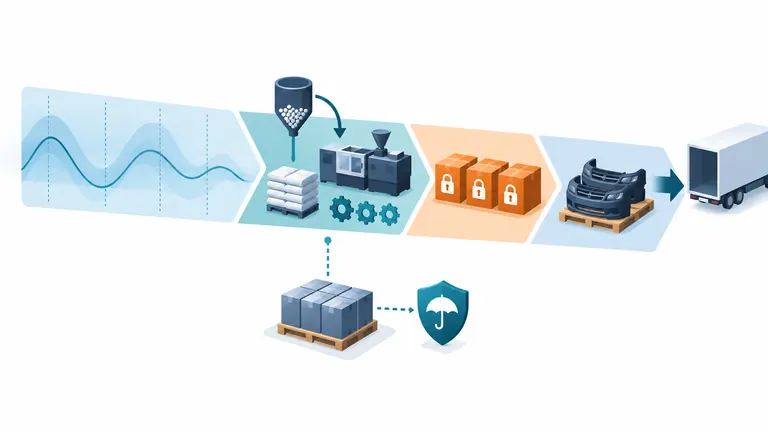
An annual forecast can justify a mold and reserve capacity, but it does not tell the molder exactly what to ship next Tuesday. When forecasts, firm releases, resin lead times, mold capacity, and inventory ownership are not separated, one party expects flexibility while the other builds stock that may become obsolete — and neither side can prove which signal it was following when a delivery is missed.
Use a layered supply agreement: long-range forecasts for capacity and material planning, defined firm and flexible horizons for production commitment, release orders for authorized quantities and dates, and an agreed buffer policy for specific named risks. State which signal is binding, how changes are handled, and who owns each inventory layer — then test the whole chain with a sample release before launch.
What job should each demand signal do?
The annual forecast supports tooling cavitation, press capacity, labor planning, resin agreements, packaging assets, and supplier readiness. It should show expected program life, annual volume, seasonality, ramp, peak weeks, regional or part variants, and known launch or shutdown periods.
Give every demand signal exactly one job, name the controlling document for each job, and write down which version wins when two systems disagree. A forecast informs planning; only a release authorizes production and shipment.
A rolling forecast updates the planning view. It should identify time buckets, update frequency, version, and the difference between information and commitment. Volvo Group’s EDI guidance describes a DELFOR message that can carry firm and forecast delivery requirements with quantities, dates, and locations in a single transmission — firm quantities and forecast quantities are distinguished inside the message, not left to interpretation. That is one customer system; other buyers use portals, blanket orders, schedules, or emailed releases, and the parties must define the controlling document for their relationship. The Volvo Group DELFOR D04A implementation guideline shows how one OEM separates firm delivery dates from forecast delivery dates.
A firm release or purchase order authorizes specific quantities, ship or delivery dates, destinations, packaging, and commercial terms. Ford’s published Production Purchasing Global Terms and Conditions keep quantity and volume projections in distinct sections, and state that volume projections are provided for informational purposes only and are not a commitment to purchase the quantities shown. A projection should not be casually treated as an order, and a release should not be treated as a forecast. The actual contract, purchase order, releases, and customer terms govern; this article does not create a universal legal interpretation. See the Ford Production Purchasing Global Terms and Conditions for how one OEM frames that separation.
Create a signal hierarchy and write it into the operating matrix: contract or blanket order first, then the latest valid release, then the forecast, then the supplier acknowledgement, then the shipment authorization, then the exception message. State which version wins when systems disagree — for example, that the latest dated release in the customer portal governs over an emailed spreadsheet, or the reverse, whichever the parties actually use. Record cumulative quantities where the customer uses them, and reconcile receipts, in-transit stock, and rejected quantities against that cumulative position, so a quantity dispute is settled from a shared count rather than from two different spreadsheets. A technically capable molder can still miss deliveries if both parties plan from different demand versions, and the miss will look like a capacity failure when it was really a version-control failure.
How do you set firm and flexible horizons from real lead times?
A horizon only works if it is longer than the actions it is meant to authorize. Map the replenishment chain from order signal to customer receipt before any horizon is agreed: resin and insert procurement, color or compounding, production scheduling, mold setup, drying, startup approval, molding, secondary operations, inspection, packaging, export documentation, pickup, transit, customs, and receiving. Identify which lead times are fixed, which vary, and which are affected by minimum purchase quantities. The firm horizon should be compatible with actions that cannot be reversed without cost — once resin is compounded in a customer-specific color, or inserts are bought for one part number, that spend is committed whether or not the release that follows matches the forecast.
Set each horizon from the measured lead time of the action it authorizes, not from a round number of weeks, and review the horizons whenever cycle time, yield, packaging, or transport changes.
Capacity planning must use good-part output, not press hours on paper. State the production-intent cycle time, the effective number of cavities, shifts, uptime, scrap rate, planned maintenance, changeovers, inspection and secondary-operation constraints, and available machine windows. Compare average demand and peak releases against that demonstrated output, not against nameplate capacity.
Use a time fence table to make the horizons explicit, and treat the lengths as program-specific values to be filled in from evidence, not as universal rules:
| Horizon | Typical planning use | Changes to define contractually |
|---|---|---|
| Long range | Tooling, press, labor, resin source, packaging assets | Forecast update and capacity escalation |
| Flexible | Material reservation and provisional schedule | Permitted quantity and date movement and cost exposure |
| Firm | Production and committed purchased inputs | Authorization, cancellation, and expedite rules |
| Shipping | Pack, labels, documents, carrier, and destination | Shipment release and change cutoff |
The lengths cannot be universal. A locally stocked commodity resin, a customer-supplied insert, an imported engineered grade, a returnable packaging loop, or an overseas lane each creates a different constraint, and the same part number can have a different firm horizon in January than in a launch month. Set horizons from evidence and review them when cycle time, yield, packaging, or transport changes.
AIAG and Odette’s MMOG/LE is an automotive supply-chain self-assessment framework covering areas such as capacity planning and crisis management. The Global MMOG/LE Introduction and Instructions (Version 5.0) describes the framework’s six chapters, its Full and Basic assessment profiles, and its alignment with IATF 16949. AutoMoldingPro is operated by C.K. MOLD & ENGINEERING LIMITED, which is IATF 16949 certified and ISO 9001 Certified; the IATF 16949:2016 overview and the ISO 9001 explained page describe those frameworks.
How do you size safety stock for a named risk?
Safety stock is not a substitute for insufficient capacity or an undefined forecast. Name the uncertainty it covers before any number is calculated: demand variation inside the replenishment lead time, transit variation, resin lead-time variability, yield variation, a planned mold-maintenance event, or a launch ramp.
Size the buffer from an agreed service objective and a stated variability model where sufficient data exist, or start with a clearly labeled temporary policy during launch — and never present one "weeks of stock" value as a universal automotive rule.
Choose where the buffer sits, because location changes what the buffer can and cannot do. Raw resin can support several part variants but still requires machine time, so it protects against a material delay and not against a press breakdown. Work in process shortens some operations but can become obsolete if the part changes. Finished goods respond fastest but carry the highest design-change and storage exposure, and they tie up the most cash per unit of protection. Capacity reserve avoids physical inventory altogether but requires an available press, people, material, and packaging at the moment the surge arrives. A second approved tool or source addresses a different continuity risk and has its own validation burden.
The statistical method takes a service-level factor, the variability of demand, and the replenishment lead time: safety stock equals the service factor Z multiplied by the standard deviation of demand per period, multiplied by the square root of the lead time in the same periods. When lead time itself varies, the fuller form includes both demand variability and lead-time variability under the square root. Common service factors are 1.28 for a 90 percent service level, 1.65 for 95 percent, and 2.33 for 99 percent — and the jump from 95 to 99 percent is expensive, which is why the service level should be a commercial decision tied to the cost of a stockout, not a default.
Define ownership and disposition in the same document. Who buys resin held for the customer? When does finished stock transfer economically? What happens after an engineering change, a forecast reduction, a canceled release, a quality hold, or the end of a program? Are customer-specific inserts or a custom-colored resin usable elsewhere? The answer belongs in the commercial agreement, because physical stock without ownership rules can turn a delivery buffer into a dispute. Review actual consumption and reset the buffer when demand or lead time changes, and put an expiry date on any temporary launch buffer — otherwise it can become permanent inventory without a current risk justification.
How does a release order actually flow from receipt to shipment?
A release is not a single event; it is a short chain of translations, and a failure at any link produces the same missed delivery as a failure at the press. The flow below is a sample sequence the two parties can adapt to their own system — EDI, portal, or emailed schedule — and test with a real release before launch.
Run every release through the same ten steps, acknowledge it in writing with what can be met and what cannot, and reconcile the cumulative position before the truck leaves.
- Receive the release in the agreed channel and format, and log its version, date, and time zone. A release in a second channel does not supersede the controlling one until the agreement says so.
- Validate the part number and revision, the ship-to location, the packaging instruction, and the cumulative quantity against the previous release. Flag any part-number or revision change immediately; a release for a superseded revision is an engineering-change question, not a scheduling question.
- Translate quantities and dates into a production requirement: good parts needed, by date, net of on-hand finished stock, work in process, and stock already in transit.
- Check the requirement against demonstrated good-part capacity in the firm horizon, against resin and insert availability, and against packaging and returnable-container availability. Name the constraining operation if the requirement cannot be met.
- Send a written acknowledgement that states what is accepted, what is short, and by how much, with the revised date or quantity for anything that cannot be met. An acknowledgement that only says "received" is not an acknowledgement.
- Reserve the press window, the material, and the packaging, and place the production order with the release reference on it, so the shop floor can trace a run back to the authorizing release.
- Produce, inspect, and pack to the release revision and packaging instruction, and hold any quantity that fails inspection out of the shippable count.
- Confirm the shipment authorization, the carrier, the pickup window, and the export documentation where applicable, and check the change cutoff — a shipment change after the cutoff is an exception, not a routine update.
- Ship with the advance shipping notice or equivalent, referencing the release and cumulative quantity, so the customer can match the delivery to the authorization without a phone call.
- Reconcile the cumulative position after shipment: released to date, shipped to date, received, in transit, and rejected. Carry any discrepancy into the next release cycle as an explicit line, not as a silent adjustment.
Where the flow breaks, the exception process in the next section takes over. Test the flow with a sample release before launch, including one release that arrives inside the lead time and one that changes a quantity inside the firm horizon, so the exception path is exercised before it is needed for real.
How do you handle exceptions, engineering changes, and end-of-program exposure?
A good plan expects signals to move. Compare the newest forecast and release with the previous version by part, date, and quantity, and highlight changes inside each horizon. The supplier should acknowledge what can be met, identify the constraining operation, and quantify inventory and material exposure. The buyer should confirm priority, approved substitutions or dates, and commercial responsibility.
Treat every change inside the firm horizon as a commercial event with a named owner, and never let a forecast reduction silently convert committed material into the supplier’s problem.
Create triggers for escalation and write them into the matrix: peak demand above demonstrated capacity, a release inside the agreed lead time, a forecast drop that leaves committed material, a cavity loss, a yield decline, a resin shortage, delayed returnable packaging, an export disruption, or an engineering change. Assign contacts in purchasing, planning, production, quality, and logistics on both sides, with a response time for acknowledgements and a contact path for when an EDI or portal message fails. If deliveries are already late, the recovery work — reconciling usable stock, bottleneck output, and shipment commitments — is covered in When an Automotive Molding Supplier Misses Deliveries: A Recovery Plan.
Engineering changes deserve their own rule because they can strand every inventory layer at once. State what happens to raw resin, work in process, and finished stock at each revision, who authorizes the use-up or scrap of old-revision stock, and how the buffer is rebuilt for the new revision. The same discipline applies at the end of a program: agree the last-release date, the final-buy quantity, the disposition of remaining customer-specific material and packaging, and the date after which the supplier is released from holding the buffer.
This article is deliberately not about how large an order should be for production economics. The size of a production lot, the minimum order quantity, and the trade-off between annual volume and order quantity are lot-economics decisions, and they are covered in Automotive Injection Molding MOQ: Annual Volume vs. Order Quantity. That article answers how many parts to make at once; this article answers when a quantity is authorized, which signal controls, and what buffer covers the gap between authorization and delivery. Likewise, a one-off buffer built ahead of a mold move is a different instrument from the recurring safety stock in this article: the transfer buffer is sized around the source-stop-to-receiving-approval window of a single event, and it is covered in Building a Production Buffer Before an Automotive Mold Transfer.
How do you measure whether the forecast-release system is working?
A forecast policy that is never measured becomes a permanent argument about whose numbers were wrong. Measure forecast accuracy by horizon, not as a single annual percentage: a forecast that is accurate at twelve months and wrong at four weeks is failing exactly where the firm horizon needs it. Track release volatility — how often quantities and dates move inside the firm and flexible horizons, and by how much — because volatility inside the firm horizon is a cost the supplier absorbs in overtime, expedites, or obsolete stock. Track schedule adherence, fill rate, premium freight, obsolete stock, and inventory age alongside them, and review the measures with both parties present.
Use the measures to change the agreement, not to assign blame: a consistently biased forecast needs a capacity or commercial correction, while a stable forecast with repeated misses points to a production constraint.
Preserve the latest valid release and the acknowledgements so the parties can distinguish a demand change from an execution failure; without that record, every miss becomes a debate about what was asked for. Review the matrix at launch, after a material or lane change, and whenever forecast error or expedite frequency crosses the agreed trigger.
For the control plan that carries these decisions into production, see Control Plans for Automotive Molded Parts; for the submission evidence that proves the part and process were qualified before serial supply, see PPAP for Automotive Molded Parts; and for the pilot run that validates the process before the forecast-release system has to carry real volume, see Planning a Pilot Production Run for Automotive Plastic Parts.
Annual Forecasts, Release Orders, and Safety Stock Review
| Review area | What to confirm before serial supply |
|---|---|
| Demand signals | One job per signal; controlling document named; signal hierarchy written down; version that wins when systems disagree |
| Horizons | Firm and flexible horizons set from measured lead times; good-part capacity stated; protected capacity where a press is shared |
| Safety stock | Named risk; service level and variability model agreed; buffer location chosen for that risk; min, max, trigger, age limit, and rotation defined |
| Release flow | Ten-step flow from receipt to cumulative reconciliation; written acknowledgement with commit or exception; sample release tested before launch |
| Exceptions and changes | Escalation triggers and contacts named; engineering-change disposition for every inventory layer; end-of-program and final-buy rules |
| Ownership | Who buys held resin, when finished stock transfers, and what happens to obsolete stock after a change, a reduction, or a quality hold |
| Measurement | Forecast accuracy by horizon, release volatility, schedule adherence, fill rate, premium freight, obsolete stock, and inventory age reviewed jointly |
| Decision boundaries | Lot size and MOQ in the MOQ article; delivery recovery in the recovery article; transfer buffer in the mold-transfer article — not repeated here |
Worked Decision Scenario (Illustrative)
An illustrative scenario, with all assumptions stated and no company data implied: a Tier 2 buyer is setting up serial supply of an interior trim clip. The agreed planning inputs are an average weekly demand of 5,000 pieces, a standard deviation of weekly demand of 800 pieces measured over the last 26 weeks, a replenishment lead time of 3 weeks from release to receipt, and a target service level of 95 percent, which uses a service factor Z of 1.65. Demand is assumed steady and approximately normally distributed, and the lead time is assumed constant for this first calculation.
Safety stock equals Z multiplied by the standard deviation of weekly demand, multiplied by the square root of the lead time in weeks: 1.65 × 800 × √3 = 1.65 × 800 × 1.732 = 2,287 pieces, rounded up. The reorder point equals average demand during the lead time plus safety stock: (5,000 × 3) + 2,287 = 17,287 pieces.
Then the parties test the assumption that lead time is constant. The resin supplier’s lead time has a standard deviation of 0.5 weeks, so the fuller form is used: safety stock equals Z multiplied by the square root of (lead time × demand variance + average demand squared × lead-time variance), which is 1.65 × √(3 × 800² + 5,000² × 0.5²) = 1.65 × √(1,920,000 + 6,250,000) = 1.65 × 2,858 = 4,717 pieces, rounded up. Lead-time variability more than doubles the buffer, which tells the parties that the cheapest improvement is not more finished stock but a firmer resin commitment or a second qualified resin source. The 4,717-piece figure is agreed as a finished-goods buffer, with the service level, the inputs, and the review date recorded.
Questions to Ask the Supplier
- Which document controls when the forecast, the release, and the acknowledgement disagree, and which version is current?
- How were the firm and flexible horizons set, and which lead times and capacity figures support them?
- What service level and variability model sizes the safety stock, and where does the buffer sit — resin, work in process, finished goods, or reserved capacity?
- Who owns each inventory layer, and what happens to it after an engineering change, a forecast reduction, or the end of the program?
- What is the demonstrated good-part capacity per week, and what is the constraining operation when a peak release arrives?
- How is a release acknowledged, what does the acknowledgement commit to, and how fast is it sent?
- What are the escalation triggers and contacts in purchasing, planning, production, quality, and logistics?
- How is the cumulative quantity reconciled, and how are receipts, in-transit stock, and rejected quantities handled?
- How is forecast accuracy measured by horizon, and when was the buffer last reset?
Information to Submit for a Project-Specific Review
- Annual forecast with program life, ramp, seasonality, peak weeks, variants, and shutdown periods
- Release pattern: bucket size, update frequency, format (EDI, portal, or schedule), and cumulative-quantity logic
- Demand variability: average and peak demand by week, and forecast error history where it exists
- Replenishment lead time by stage: resin, inserts, molding, secondary operations, inspection, packaging, transit, and customs
- Service level target and the stockout cost or consequence that justifies it
- Buffer preference: location, ownership, and disposition rules for obsolete or superseded stock
- Part CAD and drawing with revision, material and color requirements, and packaging and labeling instructions
- Annual volume, order pattern, and the production and service life the part must support
For the wider RFQ inputs that sit around a demand profile — files, volumes, and validation requirements — see the Automotive Injection Molding RFQ Checklist.
Conclusion
Separate the signals, set the horizons from real lead times, size the buffer for one named risk with a stated service level, run every release through the same flow, and measure the system by horizon so the agreement improves. Then submit the forecast, the release pattern, and the demand variability with the RFQ, so the supply agreement is built on the buyer’s real demand shape instead of an annual total.
Request a forecast and release review — send the annual forecast, release pattern, demand variability, lead time, and service level target. Contact: jerry@ckmold.com, +86 19854763925.
References
- Odette / AIAG, Global MMOG/LE Introduction and Instructions, Version 5.0 — https://www.odette.org/mmognp/mmog_introduction.pdf
- Volvo Group, Volvo’s subset of DELFOR D 04A: Guidelines and message examples — https://www.edi.volvogroup.com/content/dam/volvo-group/markets/edi/specifications-and-guidelines/delivery-schedule-and-mrl/volvo-delfor-d04a-2-2-implementation-guideline.pdf
- Ford Motor Company, Production Purchasing Global Terms and Conditions — https://corporate.ford.com/operations/governance-and-policies/production-purchasing-global-terms-and-conditions/
- IATF Global Oversight, About IATF 16949:2016 — https://www.iatfglobaloversight.org/iatf-169492016/about/
- ISO, ISO 9001 explained — https://www.iso.org/cms/live/live/en/sites/isoorg/home/insights-news/resources/iso-9001-explained.html