
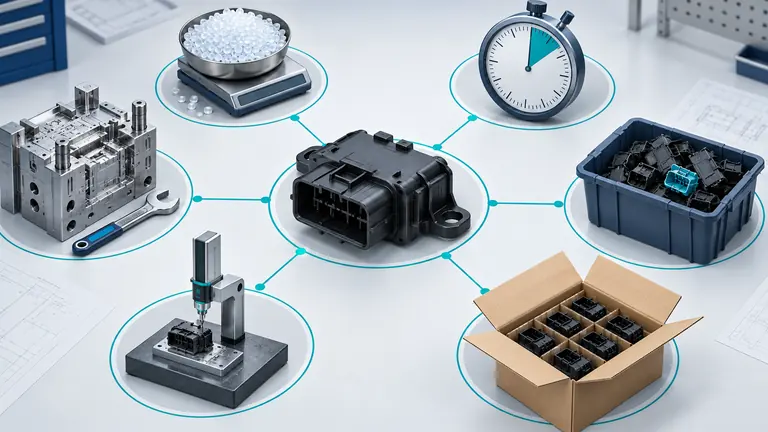
A mature molded-part program may carry avoidable cost, but an unstructured cost-down request can destabilize an approved material, process, tool, or inspection plan. The apparent saving then returns as scrap, downtime, requalification work, or supply risk.
Start with a verified cost and loss baseline, rank opportunities by evidence and implementation risk, and change one controlled system at a time. Protect customer approvals, function, appearance, traceability, and capacity. A credible plan states the current condition, proposed mechanism, validation cost, recurring saving basis, owner, and effective point.
Build a loss baseline before asking for a percentage reduction
A blanket target such as “reduce price by five percent” does not identify where cost exists or whether the supplier can remove it safely. The first task is to separate purchased cost from technical loss and to verify which party controls each lever.
Request a current-state model with resin grade and purchase basis, part and runner weight, approved regrind policy, cycle time, cavitation, uptime, scrap and rework categories, inspection labor, secondary operations, packaging, freight, maintenance, and overhead assumptions relevant to the commercial model. Do not demand confidential factory-wide rates; ask for enough structure to test the mechanism behind a proposal. Reconcile the model to recent accepted production, not an old quotation.
Measure losses by cause and time period. “Scrap” should identify defect, cavity, machine, shift, material lot, and disposition where available. “Downtime” should distinguish planned maintenance, mold repair, material shortage, machine failure, changeover, and waiting for approval. Cycle-time opportunity needs a recorded stable process and quality result, not the fastest isolated shot. Material use should separate finished-part mass, runner, purge, startup loss, rejected parts, and any approved recycle stream.
Normalize demand and mix. Unit cost at a low release quantity may reflect setup and inspection effort differently from a full campaign. A family of colors or variants can create changeover and inventory cost even when the geometry is identical. Confirm whether tooling amortization is still being recovered, whether it should end at a defined quantity, and whether maintenance or packaging charges are fixed, variable, or event-based.
AIAG’s CQI-23 describes a common approach to molding-system control and improvement with emphasis on defect prevention, variation, and waste, but it does not justify a specific saving for a particular program (AIAG CQI-23). Use the program’s own verified data. The baseline should show both financial value and product/process evidence so procurement and engineering are solving the same problem.
Rank opportunities by mechanism, value, and approval risk
Cost-down ideas are not interchangeable. Some remove waste without changing the approved product; others alter material, tooling, process, inspection, or logistics and may require customer authorization. Rank them before launching trials.
Create an opportunity register with current loss, proposed mechanism, annualized value formula, implementation cost, technical risk, customer approval need, lead time, reversibility, and evidence owner. Use ranges or scenarios when demand, scrap, or price is uncertain. Give preference to actions that correct a known loss with strong data and limited product risk, but do not ignore a larger structural opportunity simply because it requires more validation.
| Opportunity | Saving mechanism | Main risk to verify |
|---|---|---|
| Reduce unplanned downtime | More usable machine hours, fewer emergency repairs | Maintenance change does not defer necessary work |
| Stabilize a defect | Less scrap, sorting, and rework | Root cause and control are demonstrated |
| Shorten cycle | More output and lower machine time per part | Dimensions, appearance, and material state remain acceptable |
| Reduce runner or purge loss | Less resin consumed per shipped part | Fill, pack, gate, and recycled-material rules remain valid |
| Simplify inspection | Less routine labor | Detection capability and customer plan remain adequate |
| Change packaging density | Lower packaging/freight per part | No deformation, scuffing, mixing, or handling risk |
| Change resin or source | Lower purchase cost | Grade, approvals, processing, function, and traceability are revalidated |
Separate “no product/process change” from “controlled change” rather than assuming the first category is risk-free. A maintenance interval change can affect flash. A new sampling frequency can reduce detection. A shipping-pack change can deform warm parts. Conversely, an approved insert modification may produce a robust, measurable long-term saving.
Use a weighted decision score only as a discussion aid. Keep the underlying evidence visible. Finance should validate the saving equation; engineering and quality should set release criteria; operations should confirm feasibility; the customer approval authority should decide any required submission. This governance prevents a high theoretical return from bypassing essential controls.
Validate cycle, material, and process changes under production-relevant conditions
Cycle time and material are usually prominent in a molded-part cost model, which makes them tempting targets. Both affect the physical history of the part, so they need disciplined trials.
For cycle reduction, decompose fill, pack/hold, cooling, mold opening, ejection, robot handling, and interlock time. Identify the actual constraint. Reducing nominal cooling time is not useful if parts distort in packaging, dimensions drift after conditioning, or operators slow the cell to manage sticking. Trial the proposed process across every active cavity with production-intent resin, mold-temperature control, automation, and inspection. Record part weight, critical dimensions, appearance, ejection, and stable cycle distribution over an agreed run.
For material utilization, calculate input resin per accepted shipped part. A cold-runner redesign or hot-runner conversion may reduce runner waste but creates tooling cost, thermal-control risk, and requalification work. Approved regrind may reduce virgin consumption, yet percentage, contamination control, heat history, appearance, mechanical performance, and customer rules matter. A nominally equivalent resin is not automatically interchangeable; compare exact grades, supplier data, color package, processing window, environmental exposure, and customer approval.
Illustrative example—hypothetical, not an AutoMoldingPro project. A mature housing program reports a 42-second cycle. The team observes that robot motion and a conservative cooling delay overlap poorly. A sequence change removes two seconds without changing melt settings or cooling time. The saving model uses actual accepted pieces per hour, expected annual demand, implementation time, and validation cost. The trial checks all cavities, dimensions after the defined conditioning interval, ejection marks, robot faults, and a sustained run. The example does not assume the same saving is available elsewhere.
Do not convert a successful short trial directly into a price reduction. Establish the revised approved settings, control limits, reaction plan, training, and monitoring period. If the benefit depends on an equipment upgrade or tool modification, define who funds it, who owns it, and how the saving is shared after recovery.
Improve tooling, inspection, and secondary operations without moving risk downstream
Many mature-program costs occur outside the injection stroke: flash trimming, manual gate cutting, sorting, repeated measurements, assembly, labeling, packaging, and repair. These can be high-value targets when the team traces why the activity exists.
Begin with the purpose of each operation. Manual trimming may compensate for worn shutoffs rather than reflect the intended process. Sorting may be temporary containment that became permanent. High inspection frequency may respond to an unstable feature, weak gauge, or customer launch requirement that was never formally reviewed. An assembly fixture may add handling because the molded features are difficult to locate. Removing the activity without removing its cause transfers risk to the next station or customer.
For tool-related improvements, inspect cavity-specific wear, vents, gates, cooling, actions, ejection, and alignment. Quote restoration separately from product-design change. Confirm whether a repair returns the approved baseline or creates a new configuration. Verify dimensions and process after work, update the maintenance history, and keep replaced components where traceability requires it.
Inspection optimization should be evidence-led. Review requirement criticality, historical stability, measurement-system suitability, process controls, nonconformance history, and customer-specific requirements. The decision may be to improve the gauge, automate data capture, move detection upstream, change frequency, or retain the current control. Do not claim that process capability alone authorizes changing a customer control plan.
For secondary operations, map touches, queue time, defect creation, consumables, and ergonomics. Compare elimination, combination, poka-yoke, fixture improvement, or automation. A laser-marking or label change must preserve content, readability, adhesion, and traceability. A packaging change needs a transport and handling assessment. AIAG’s core-tools framework links control planning, measurement analysis, statistical control, and approval; apply the customer’s required versions and change process (AIAG Quality Core Tools).
The acceptance plan should prove that the removed cost did not merely reappear as warranty exposure, line disruption, or customer inspection.
Convert the approved improvement into an auditable commercial change
A technically successful improvement does not automatically create a fair or durable price change. The commercial record should show how the saving was calculated, when it begins, and which assumptions can change it.
Use a one-page cost-down charter with baseline period, affected part numbers and revisions, current and proposed conditions, required approvals, trial budget, expected annual volume, saving formula, one-time cost, payback treatment, ownership, effective date, and monitoring plan. State whether the benefit is fixed per part, varies with resin price or volume, or begins only after investment recovery. Avoid presenting an annual total without the demand assumption.
For a simple unit saving, show the arithmetic. If accepted output increases from process improvement, do not count the same benefit twice as both cycle saving and avoided overtime unless both effects are independently justified. If scrap declines, use net material and processing cost minus any recoverable value. Include additional maintenance, energy, inspection, packaging, or licensing cost introduced by the change.
Establish an effective point by production date, lot, serial range, purchase-order release, or shipment as the customer requires. Update the quotation, purchase order, process records, work instructions, FMEA/control plan, inspection plan, maintenance plan, and approved master samples where affected. Segregate old and new conditions during transition.
Monitor the promised mechanism after release. If a cycle improvement causes more stoppages, or a packaging change increases damage, the saving is not sustained. Define review measures and a response if the process falls outside the agreed condition. The goal is not to guarantee a percentage; it is to create a controlled improvement whose financial and technical results can both be audited.
For supplier discussions, send actual demand scenarios, release pattern, approved resin and change restrictions, recent quality and delivery data, known manual operations, and tooling status. Ask for an opportunity register with mechanism, evidence, validation, investment, risk, and commercial treatment. This produces better proposals than a price-only demand.
Conclusion
Reduce mature-program cost by exposing verified losses, ranking mechanisms, and validating changes under production-relevant conditions. Protect approvals and define the commercial effective point. Start with one auditable opportunity register, not an unsupported percentage target.