
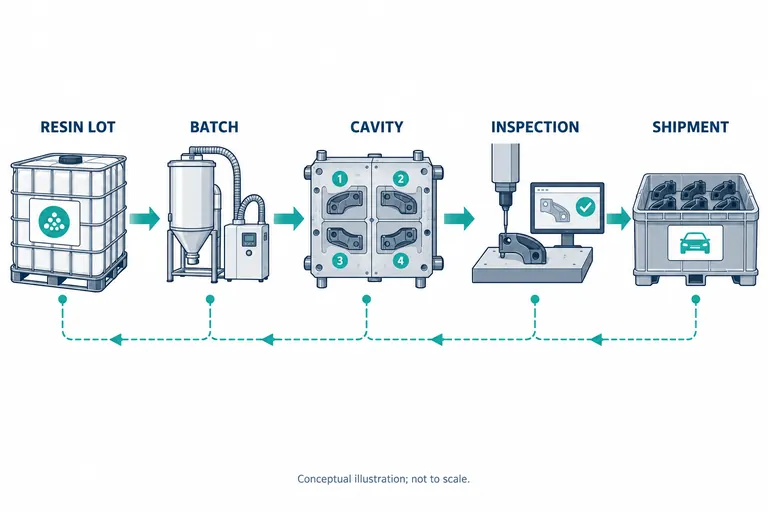
When a molded-part issue appears, “we know the production date” is rarely enough. Without a reliable link from shipment to molding batch, cavity, material lot, process revision, and inspection result, containment expands and evidence becomes harder to defend.
Design traceability backward from the decisions a customer may need to make. Define the smallest practical traceable unit, give every production event a stable batch identity, link consumed materials and cavities to that event, preserve inspection and disposition records, and carry a usable identifier onto packaging or the part as the program requires.
Decide what must be isolated before choosing labels or software
Traceability is a containment design problem, not a barcode project. Start by asking: if one resin lot, cavity, shift, process deviation, or inspection failure is suspect, which shipped parts must be found and which unaffected parts can be excluded with evidence?
Define the traceable unit. Depending on risk and customer requirements, it may be a serialized part, container, production batch, shift, time window, resin-lot run, or a combination. A unit that is too broad increases recall exposure; one that is too narrow may require marking and data infrastructure that the part, cycle, or commercial model cannot support. Document the rationale and obtain customer agreement where required.
Map both directions. Forward tracing begins with an incoming resin lot and identifies every molding batch, container, and shipment that consumed it. Backward tracing begins with a returned part or shipping label and identifies the production event, material, cavity, process revision, and acceptance records. Test both directions with sample queries before launch.
Consider mixing points. A dryer or material-handling system may contain material from more than one supplier lot during transition. Color concentrate, additives, regrind, inserts, labels, and purchased subcomponents can create additional genealogy. If a bin can mix material, the rule must state how the resulting batch is identified. Do not create a fictional one-to-one resin relationship where the process permits overlap.
Part marking is not always feasible. Small clips may carry only a cavity mark and date clock; shipment labels and container controls then hold the batch relationship. Larger safety- or compliance-related parts may require a data carrier defined by the customer. Marking content, permanence, readability after aging, and data ownership must be reviewed as product requirements.
The result should be a traceability specification that names triggers, unit of isolation, identifiers, retention period, systems of record, response time, and responsible functions.
Build one genealogy from receiving through shipment
Separate identifiers are useful only when they are linked. The material certificate, warehouse transaction, dryer record, molding log, cavity mark, inspection report, packing label, and advance shipping notice should form one chain.
| Record layer | Minimum useful fields | Link to next layer |
|---|---|---|
| Incoming material | Supplier, exact grade/color, supplier lot, quantity, receipt, certificate status | Internal material lot or container ID |
| Material preparation | Container, dryer, start/end time, settings, moisture result when required | Production batch/order |
| Molding event | Part, mold, machine, batch, start/end, process revision, operators, material lots | Cavity and container IDs |
| Cavity output | Mold/cavity identification, quantity, inspection sample IDs, nonconformance | Finished containers |
| Inspection/disposition | Characteristic, method, result, sample/batch/cavity, status, approver | Released quantity |
| Packing/shipping | Container/label ID, quantity, production batches, shipment and customer | Customer receipt |
Use immutable or controlled IDs, not free-text descriptions. Time stamps need a common time basis. Part and mold revisions must be explicit. If a cavity insert is exchanged or a cavity is blocked, record the configuration and effective batch. If process data are stored automatically, preserve the recipe revision and make sure clock synchronization and user permissions are controlled.
Resin genealogy deserves special attention. Record the manufacturer—not only the distributor—plus complete grade, color, supplier lot, internal receipt lot, and certificate disposition. Where more than one lot feeds a batch, store all contributing lots and transition times. Regrind, if authorized, requires a source and ratio rule; “house regrind” is not an adequate lineage description for a controlled automotive part.
Inspection records should not merely say “passed.” They need part and revision, batch and cavity where relevant, characteristic, method or gauge, measurement condition, actual result when required, status, and disposition. A customer complaint cannot be analyzed by linking to an unsigned generic checklist.
Define retention by contract, customer-specific requirement, regulation, and risk. Do not publish a universal number. Records also need readable export and backup arrangements so a system migration does not erase genealogy.
Connect cavity identity to meaningful product evidence
Cavity traceability is valuable because cavities can differ in filling, cooling, venting, ejection, steel condition, and local maintenance. A mold number without cavity identity can hide a persistent cavity-specific issue.
Use durable cavity identification on the tool and, where product design permits, a molded mark on the part. The drawing should define location, readability, orientation, and allowed update method. Date wheels and interchangeable inserts can help, but they must not damage appearance, sealing, or functional surfaces. If the part cannot carry a cavity mark, maintain controlled segregation from ejection through packing or use approved automated tracking.
Sample inspection by cavity during setup and production. The frequency and characteristics should come from the control plan and risk analysis. Preserve cavity-specific data for dimensions, appearance, weight, functional tests, and process signals when they support diagnosis. Pooling all cavities into one average can conceal an outlier.
Maintenance changes the configuration. Record cavity insert replacement, polishing, welding, gate or vent work, shutoff repair, sensor replacement, and the first batch after maintenance. Link the post-maintenance verification. When multiple interchangeable inserts exist, give each an identity if its condition can affect product.
Illustrative example—hypothetical, not an AutoMoldingPro project. A four-cavity harness clip is packed in containers identified by production batch. Each clip has a small cavity numeral; the label carries part revision, batch, and quantity. A retention test trend falls for cavity 3. The team queries all containers from cavity 3 since the last verified maintenance, contains those quantities, and confirms the other cavities with defined evidence. The example shows how cavity identity can narrow containment; actual disposition remains customer-specific.
Do not overpromise precision. If parts from different cavities are mixed before the first identifier is applied, container-level records cannot recreate exact cavity genealogy. State the limitation, improve the process if justified, or accept the broader containment boundary through formal risk review.
Make traceability survive nonconformance, rework, and split lots
Clean production is the easy case. The traceability system is proved by unusual events: partial containers, material transitions, re-inspection, rework, deviation, hold and release, mixed pallets, label replacement, and returned stock.
Every status change should preserve the original identity. A reworked or re-inspected batch receives a linked transaction, not a new label that breaks history. Record quantity in, quantity out, scrap, method, authorization, results, and operator. When one batch is split, child containers retain a parent relationship. When batches are combined on a pallet, the pallet record lists its children.
Control label generation and replacement. Prevent duplicate active labels, record voided labels, limit permissions, and verify scanners against the correct part and revision. A readable barcode is not proof that the underlying database relationship is correct. Periodically reconcile physical stock to system quantities and challenge the process with a mock trace.
Define escalation. If a certificate is missing, a material lot is ambiguous, or a scan fails, the default should be hold and investigation rather than manual guessing. The reaction plan names who can release material, how evidence is corrected, and whether the customer must be notified.
Traceability also supports change control. Link first and last batches for a resin change, tool repair, process revision, supplier transfer, or approved deviation. Preserve authorization and expiration. This creates a defensible boundary when evaluating a later complaint.
AIAG’s current Control Plan manual emphasizes development and effective use of control plans, including updated guidance and safe-launch concepts (AIAG Control Plan, 1st Edition). The precise traceability fields and reaction rules still need to reflect the part, risk, and customer requirements.
Audit the system with timed forward and backward exercises
A traceability diagram can look complete while actual queries fail. Test the operating process using a released shipment and an incoming material lot.
For a backward exercise, scan a customer-facing label and retrieve part/revision, production batches, cavities, mold and machine, resin and colorant lots, process revision, inspection, deviations, packing, and release. For a forward exercise, select one resin lot and identify all work in process, finished containers, shipments, customers, and remaining stock that may contain it. Reconcile quantities and record exclusions with evidence.
Time the exercise, but do not invent a universal target. Customer manuals may specify response times. More important, record missing links, ambiguous transitions, inaccessible systems, and manual dependencies. Repeat after corrections. Include a physical-floor check to prove labels match actual material and containers.
Ask these RFQ questions:
- What is the required traceable unit and marking method?
- Must cavity identity reach the part, container, or electronic record?
- Which material components, inserts, colorants, and regrind require lot lineage?
- What process and inspection records must be linked?
- What retention, response-time, label, and data-format requirements apply?
- How are splits, merges, transitions, rework, deviation, and returns controlled?
- Which mock-trace evidence is needed before production release?
Provide the drawing, BOM, annual volume, pack quantity, required data carrier, customer label specification, control characteristics, record retention, and EDI or portal requirements. A molder can then design the genealogy before tooling and packaging are frozen. For a feasibility discussion, send AutoMoldingPro the part, marking, packaging, and customer traceability inputs.
Conclusion
Effective traceability links material lots, preparation, molding batches, cavity configuration, inspection, disposition, containers, and shipments in both directions. Define the containment decision first, preserve lineage through exceptions, and prove the system with timed physical and data-based exercises before release.