
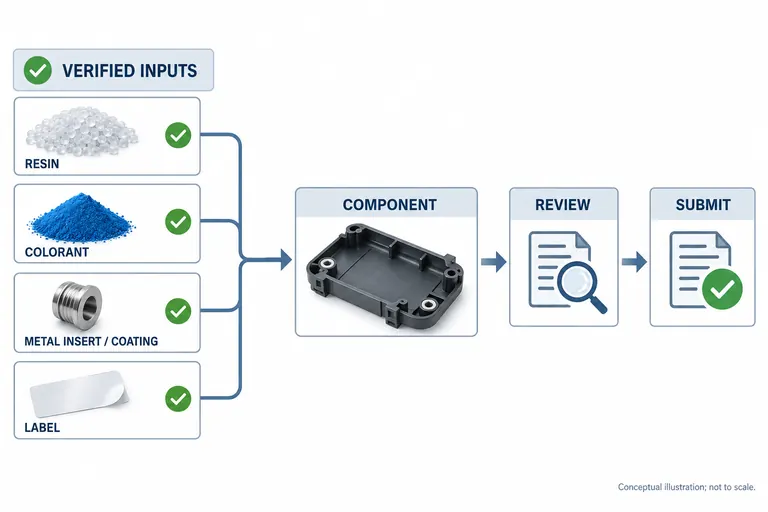
An IMDS request often arrives near PPAP with a short deadline, yet the entry depends on controlled information from resin, colorant, insert, label, and process owners. Treating it as a clerical form can create rejected submissions, inconsistent part mass, or declarations that no longer match production.
Prepare the material declaration from the released BOM and verified supplier data. Assign ownership for each node, confirm the customer’s IMDS rules and recipient identity, reconcile masses and part revisions, submit early enough for correction, and control later material or supplier changes. IMDS communicates material composition; it does not replace product testing, certification, or customer approval.
Define the submission object and customer rule before building data
The first question is not “who has an IMDS login?” It is which part, drawing revision, customer part number, manufacturing scope, and supply-chain level must be represented. A molder may ship one plastic component, an insert-molded component, or a finished assembly. Each creates a different material tree.
Collect the purchase order or program requirement, customer part number and name, supplier part number, released drawing and BOM revisions, measured or controlled part mass, destination customer organization and IMDS company ID, required submission timing, and any OEM-specific instructions. IMDS’s public help pages warn that OEMs can publish specific supplier information and that customers may send newer instructions directly, so generic guidance cannot override the receiving customer’s current rule (IMDS Help and OEM-specific information).
Clarify who is the reporting supplier. If the molder buys a resin compound and molds a component, the resin producer or authorized supplier should normally provide reliable material information, while the molder builds or references that material in the component structure. For an insert-molded part, the metal insert, coating, resin, masterbatch, adhesive, label, or other delivered constituents need controlled inputs. A contract processor cannot invent confidential formulation details.
Record exclusions carefully. Processing aids that remain in the delivered part are different from substances that do not remain. Packaging may be handled separately according to customer instructions. Regrind or recycled-content information requires the applicable IMDS recommendation and customer rule; do not guess a percentage from a plant-wide practice.
Create an IMDS submission brief with part identity, scope, recipients, due date, required MDS references, data owners, customer rules, and approval status. This prevents two teams from creating inconsistent submissions for the same part.
Build the material tree from controlled supplier evidence
Start with the product BOM and physical construction, then map every delivered material to an approved source. Do not start from a similar historic MDS simply because the part name looks familiar.
| Input | Preferred evidence | Owner | Common failure |
|---|---|---|---|
| Base resin/compound | Supplier-published or supplier-sent MDS, exact grade and source | Material supplier with molder verification | Referencing a generic family instead of the approved grade |
| Color/masterbatch | Controlled MDS and addition rate or precolored grade | Colorant supplier and process owner | Omitting colorant or double-counting precolor |
| Metal insert/coating | Insert supplier MDS and released specification | Insert supplier and component engineer | Representing plated metal as uncoated base metal |
| Adhesive/label/ink | Supplier MDS and actual usage | Component owner | Ignoring small retained materials without checking rules |
| Component mass | Controlled measurement method and representative samples | Molder quality | Copying nominal CAD mass without reconciliation |
| Recipient data | Customer IMDS company/organization and requirements | Customer/program owner | Sending to the wrong recipient or part number |
Verify the MDS is current, released for use, and refers to the exact grade and manufacturing source where that distinction matters. Check classifications, application codes, standard material numbers where applicable, substance ranges, recyclate information, and warnings against the current IMDS rules. Some Recommendations are available only after login; IMDS directs new users especially to Recommendation 001 for general structure and change management (IMDS New to IMDS).
Mass reconciliation is a control, not a cosmetic field. Define whether the component weight is drawing nominal, measured average, or another customer-approved basis. Account for inserts and other retained constituents. Investigate discrepancies rather than altering percentages merely to make a total pass. Preserve the sample, cavity, conditioning, and measurement basis for variable molded parts.
Do not substitute a laboratory screening report for composition data. XRF or other tests may support compliance investigations but generally cannot reconstruct the complete intentional formulation, polymers, or all regulated substances. Likewise, an IMDS acceptance does not prove dimensions, mechanical performance, flammability, electrical safety, or durability.
Assign responsibilities through creation, checking, submission, and acceptance
Material declarations cross company boundaries, so a RACI-style checklist is more useful than telling one coordinator to “handle IMDS.”
The design or customer program owner confirms the released part and recipient requirement. Purchasing obtains current supplier MDS references and change-notification commitments. Materials or product-compliance staff evaluate structure and applicable rules. Manufacturing confirms the actual production BOM, color route, regrind authorization, and component mass. Quality checks revision alignment and release status. An authorized IMDS user creates, internally reviews, and sends the MDS. The customer accepts, rejects, or requests correction.
Set an internal due date before PPAP submission. Supplier data can be rejected, superseded, or unavailable; recipients may require correction. Treat “sent” and “accepted” as different statuses. Save the MDS ID/version, recipient, send date, customer response, rejection reason, correction, and final acceptance.
Use a four-gate review:
- Identity gate: part, revision, mass, customer number, and recipient match controlled program data.
- Composition gate: every delivered constituent maps to a verified MDS or permitted material construction.
- Rule gate: current IMDS checks, recommendations, and customer-specific instructions are addressed.
- Release gate: internal approval, submission evidence, customer response, and PPAP linkage are recorded.
Illustrative example—hypothetical, not an AutoMoldingPro project. An insert-molded cover includes a stamped plated terminal, black precolored PBT, and a small retained label. The resin supplier MDS is available, but the terminal supplier initially provides only base-metal chemistry. The declaration is held until coating data and the complete terminal MDS arrive. The component mass is then reconciled to representative samples and sent to the specified customer recipient. The example illustrates responsibility; it does not claim acceptance by any OEM.
If confidential information prevents direct disclosure to the molder, use legitimate supplier-to-customer or referenced MDS mechanisms supported by IMDS, not invented placeholder substances.
Control revisions, corrections, and production changes after acceptance
An accepted MDS describes an approved product state. It must remain linked to what production actually buys and molds.
Define change triggers: resin grade or manufacturer, colorant, additive, formulation update, insert material or coating, supplier source, recycled content, component mass beyond allowed handling, part revision, new legal reporting field, or customer instruction. Purchasing and engineering-change workflows should route these events to the material-declaration owner before shipment.
IMDS Recommendation 001 includes general structure and change-management guidance, and current system notices can revise recommendations and checks. The IMDS news page, for example, publishes release plans and Recommendation updates; this makes periodic rule review necessary rather than relying on an old training slide (IMDS News).
When data changes, determine whether a new MDS version, new component, correction, or fresh customer submission is required. Preserve old versions and their effective production lots. Link the accepted MDS to the drawing/BOM revision, PPAP record, approved material list, and first production batch. If a temporary resin substitution is authorized, define whether the declaration must be revised and how shipments are segregated.
Rejected entries deserve root-cause treatment. Categorize the reason—wrong recipient, identity mismatch, excessive substance range, missing application code, outdated referenced MDS, mass discrepancy, customer-specific rule, or unsupported data. Correct the source process as well as the single record.
Maintain account governance: named active users, appropriate access, backup coverage, current company contact information, and controlled departure of users. The IMDS public guidance explicitly places responsibility on companies to manage their users and contact information. Never share personal credentials to meet a deadline.
Send a complete declaration input pack with the RFQ
An RFQ should reveal declaration duties before supplier selection because data availability and responsibility can affect timing and source feasibility.
Include:
- Customer and destination OEM, when disclosure is permitted.
- Customer part number, supplier part number, drawing and BOM revision.
- Exact resin, color, additive, insert, coating, label, and other retained materials.
- Approved suppliers and whether published or supplier MDS records already exist.
- Nominal or measured mass requirement and allowed tolerance method.
- Customer IMDS company/organization ID and specific instructions.
- Required submission and acceptance timing relative to PPAP.
- Recycled-content, substance, marking, or application-code information.
- Responsibility for creating component, semi-component, and assembly nodes.
- Change-notification and resubmission route.
Ask the prospective molder to identify missing supplier data, the person responsible for preparation and checking, planned submission date, and evidence that will be returned. Do not accept “IMDS included” without defining scope and recipient.
For AutoMoldingPro to evaluate a molded-part declaration workflow, provide the released BOM, grade and color, inserts or coatings, customer instructions, mass basis, and required date through the project contact page. The review can identify missing inputs, but the customer remains responsible for its acceptance criteria and the submitting companies remain responsible for accurate source data.
Conclusion
Build IMDS data from the released product and verified supplier records, not from a similar old declaration. Define recipients and rules, assign each data owner, reconcile mass, distinguish submission from acceptance, and route every production change back through declaration control. IMDS is composition communication—not product certification.