
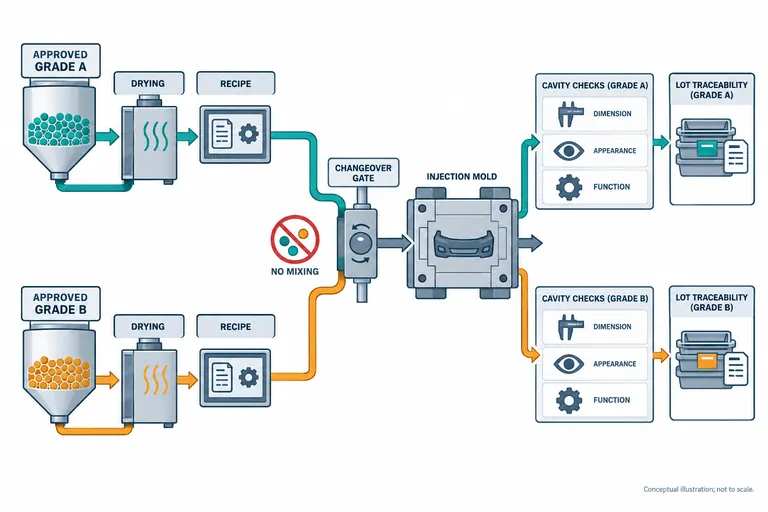
Approving two resin grades can reduce supply risk, but “both materials pass the drawing” does not prove they can share one mold and one process. Different shrinkage, viscosity, drying, crystallization, filler orientation, color, and aging behavior can change dimensions, appearance, pressure, cycle, and assembly.
Two grades can run in one automotive mold only when each exact grade is approved, the tool has a feasible dimensional window, each material has a validated process and conditioning state, changeover prevents contamination, production records identify the grade and lot, and customer change/submission rules are satisfied. The recipes may need to remain separate.
Define what dual approval means for the program
Clarify whether the second grade is a temporary deviation, permanent alternate, regional source, or customer-directed equivalent. Record manufacturer, full grade, reinforcement, color/additive package, production site where relevant, and approval document. Polymer family or nominal filler percentage is not sufficient identity.
Ask whether either grade may be selected for each order, whether the customer must authorize every switch, whether both can appear in one shipment, and whether labels or part marks must identify them. Define first and last production lots for every change. “Approved alternate” can still carry commercial or notification conditions.
Freeze the product and process baseline: drawing, mold revision and cavities, existing tool corrections, machine range, hot runner, process sheet, conditioning, control plan, IMDS records, packaging, and assembly tests. Determine which evidence originally approved each grade. One grade may have only material-data approval while the other completed production-intent validation.
Use a dual-grade requirement matrix with product functions, current evidence, differences, open tests, customer decision, and operational control. If the customer specification names one source, do not convert a supplier comparison into production authorization.
Material substitution and dual sourcing are change-control questions. IATF’s public minimum automotive QMS requirements state that effects of changes should be assessed and verification/validation defined to ensure customer requirements (IATF minimum automotive QMS requirements). Apply actual contractual and customer-specific rules.
Compare tool fit and process windows with exact-grade data
Collect current TDS and processing guides for both grades, then compare test conditions and application relevance. Focus on shrinkage direction and range, flow, moisture/drying, melt and mold temperature, crystallization or cooling, filler, ejection, degradation sensitivity, color/gloss, and long-term properties.
Shrinkage is critical because the same cavity geometry must serve both materials. Data-sheet shrinkage is a screening input, not a direct prediction of every feature. Gate, flow orientation, wall thickness, packing, cooling, and part restraint create local results. Glass-filled grades may differ directionally even with similar nominal values.
Check the dimensional margin. Features near one side of tolerance on grade A may cross the limit on grade B. Steel-safe correction may help one material while harming the other. Model separate expected distributions and confirm with cavity-specific trials before changing steel.
| Comparison | Tool/process question | Required evidence |
|---|---|---|
| Shrinkage/warpage | Can one cavity satisfy both grade distributions? | Production-intent dimensional layouts by cavity |
| Flow/pressure | Can both fill without exceeding machine/tool limits? | Process-window and pressure data |
| Drying/moisture | Can handling prevent degradation and mixed conditions? | Supplier guide, dryer verification, moisture records |
| Cooling/ejection | Are cycle and release stable for both? | Trial cycle, part temperature and ejection results |
| Appearance | Do color, gloss, weld and gate meet boundaries? | Controlled samples after conditioning |
| Function/aging | Does each grade meet part/assembly duty? | Program-defined component and system tests |
Do not create one compromised recipe unless data proves it is robust for both. Separate recipes, limits, alarms, and startup checks are usually clearer. Confirm machine plasticizing capacity, residence time, hot-runner compatibility, and purge behavior for each exact grade.
Validate each grade and the transition between them
Run production-intent trials with controlled lots of each grade in the same mold and representative machine. Record certificates, drying and moisture where relevant, purge, process revision, cavity, sample timing, and measurement condition.
Establish a process window for each grade. Measure fill, pressure, transfer, cushion, recovery, cooling, part weight, appearance, ejection, dimensions, and functional characteristics. Include all active cavities and more than one lot where risk requires. Condition parts according to the drawing or test method before comparing.
Validate assembly and environmental duty independently for each grade. Similar initial dimensions do not close creep, fatigue, fluid, thermal cycling, clip retention, sealing, or electrical requirements. Use customer-approved tests and acceptance values; do not borrow generic resin numbers.
Then validate changeover. Define removal of old material from storage, dryer, loader, hose, hopper, barrel, nozzle, hot runner, granulator, work in process, and packaging area. Determine purge material, quantity or observable endpoint, first-off hold, label change, and mixed-material disposition. Never blend grades unless the blend itself is specifically approved.
Illustrative example—hypothetical, not an AutoMoldingPro project. Two approved PBT grades fill a sensor cover, but grade B produces a slightly different connector-flatness pattern and needs a different mold-temperature window. Both pass after separate recipes and conditioning. The changeover plan quarantines transition shots and releases the first container only after cavity-specific dimension and assembly checks. The example does not claim that any two PBT grades are interchangeable.
Operate separate configurations with traceable release controls
Create a material-specific configuration: approved grade and source, recipe, drying, color route, startup checklist, inspection condition, master samples, expected process signature, and packaging/label rules. Protect recipe selection and verify barcode or order-to-material matching.
Production planning should schedule transitions deliberately. Campaign runs may reduce purge and mix risk, but inventory and shelf-life constraints matter. At each switch, close the previous order, reconcile remaining material, clean or purge per instruction, change labels, load the authorized grade, hold first-off parts, and obtain release.
Link resin lot and grade to molding batch, cavities, process record, inspection, container, and shipment. If both grades can be in one customer delivery, preserve container-level identity and confirm permission. Update IMDS or other declarations as required; acceptance of one MDS does not automatically cover another grade.
Define reaction rules for wrong material, ambiguous lot, recipe mismatch, mixed transition material, dimensional shift, or failed function. Hold back to the last known conforming point, quantify affected stock, inform authorized roles, and obtain disposition. Do not relabel uncertain material as an approved grade.
Trend both grades separately. Combining capability data can hide grade-specific centering or variation. Review cavity effects, scrap, pressure, cycle, dimensions, appearance, assembly, and complaints by grade and lot. Tool wear or maintenance can narrow the shared window over time, so repeat comparison after relevant repairs.
Make the commercial and approval rules explicit in the RFQ
Dual sourcing has commercial value only when operational responsibilities are priced. Include exact approved grades and sources, projected split, order and annual demand, switch frequency, material ownership, safety stock, purge and transition scrap, separate validation, declarations, labeling, traceability, and customer submission requirements.
Ask the molder to return tooling feasibility for both shrinkage behaviors, machine and dryer needs, recipe strategy, trials and tests, changeover procedure, minimum campaign assumptions, scrap treatment, material certificates, first-off release, data segregation, and change-notification route.
Clarify who pays for second-grade trials, tool correction, extra gauges, PPAP or customer submissions, excess resin, and obsolescence. A lower resin price can be offset by validation, purge, lower campaign efficiency, or inventory complexity. Avoid unsupported savings percentages.
Provide the drawing, CAD, exact grade data, original approval evidence, annual demand, critical characteristics, assembly and environmental tests, mold details, current process, and customer rules to AutoMoldingPro. The feasibility review should identify whether one mold has a shared dimensional and processing envelope and what remains subject to customer approval.
Govern end-of-life and emergency use as carefully as routine switching. If one grade is discontinued, preserve the last approved lot, supplier notice, shelf-life limits, open orders, and replacement decision. If an emergency shortage occurs, do not consume the alternate before confirming that its approval and declarations remain current. Define who can authorize a temporary campaign, the maximum quantity, the affected customer releases, the validation that must precede shipment, and the expiry. Afterward, reconcile unused material and close the deviation so emergency logic does not become an uncontrolled standing practice.
Review color and appearance separately even when both grades use the same color code. Base polymer, filler, surface replication, process temperature, and colorant route can change gloss or visual match. Maintain grade-specific boundary samples if the customer accepts both but they are visibly different, and confirm whether mixed shipments are permitted. A spectrophotometer result alone may not address grain, flow marks, weld lines, or perceived assembly mismatch; combine instrumental and controlled visual criteria as the program requires.
Conclusion
Two approved grades may share one mold, but approval must cover each exact material, its process, the molded product, and the transition. Prove the common tooling window, keep recipes and data distinct, prevent mixing, trace every lot, and obtain the customer authorizations required for each production state.