
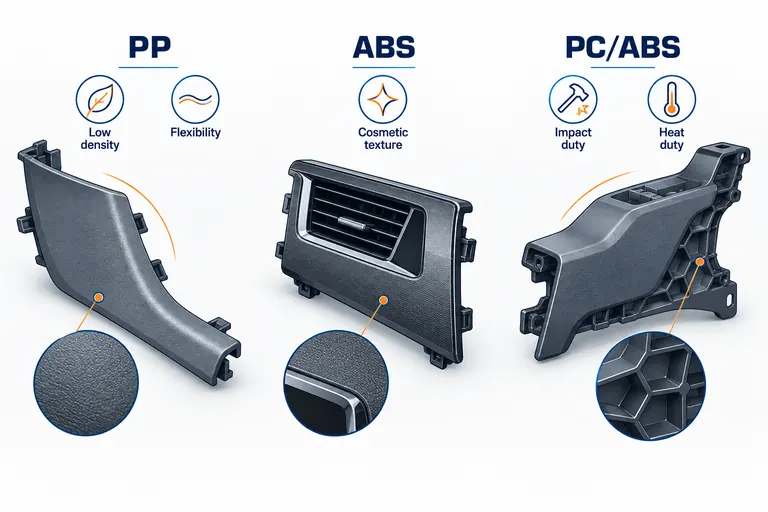
Choosing an interior resin by family name alone creates false confidence. PP, ABS, and PC/ABS can all appear in cabin components, yet the grade, part geometry, finish, assembly load, temperature exposure, emissions requirement, and customer specification determine whether any one of them is suitable.
The useful question is not “Which plastic is best?” It is “Which qualified grade meets this part’s complete requirement set with an acceptable molding and validation plan?” Begin with duty and appearance, screen exact grades, review the tool and assembly consequences, and validate the molded part in its intended condition.
Define the interior part before comparing polymers
Start with the component’s location and job. A large door-carrier, a textured decorative bezel, a hidden HVAC duct, a screw boss around an electronic module, and a trim clip do not ask the material to do the same work. The design record should identify the visible surfaces, load paths, attachment method, neighboring materials, cabin zone, abuse modes, and customer material or substance requirements.
Translate those facts into measurable requirements. Record the highest and lowest part temperatures, duration at temperature, impact conditions, allowed permanent deformation, dimensional datums, surface texture, gloss and color controls, scratch or mar expectations, chemical cleaning agents, UV exposure, odor or VOC rules, flammability requirements where applicable, and recycling or marking instructions. A generic “automotive interior grade” does not close any of these items.
Separate must-have requirements from preferences. A console side panel may need a controlled grained surface and clip retention but carry little structural load. An instrument-panel support may prioritize stiffness, impact behavior, creep, and dimensional control while remaining hidden. A switch bezel can add paint, plating, laser marking, or tight interfaces. The same polymer family can be compounded differently for each.
Also define the condition in which acceptance applies. Temperature, aging, moisture, and assembly can change stiffness and dimensions. If a report compares room-temperature bars while the part is accepted after thermal cycling in an assembly, the comparison is incomplete. A concise requirement map prevents teams from choosing a resin first and rationalizing it later.
Use PP, ABS, and PC/ABS as starting families, not final specifications
Polypropylene often earns consideration for low density, chemical resistance, toughness, and cost-sensitive large trim, but unfilled, impact-modified, talc-filled, glass-reinforced, low-emission, scratch-resistant, and UV-stabilized PP compounds behave differently. Filler can raise stiffness and alter shrinkage, warpage, surface appearance, weld-line behavior, and tool wear. A flexible PP part is not evidence that every PP grade is flexible, nor that a filled PP will reproduce an ABS tool’s dimensions.
ABS is frequently screened where surface quality, coloring, texturing, painting, plating, and dimensional behavior are important. Heat-resistant or low-emission variants may be needed in the cabin. The butadiene phase that helps toughness also means aging, heat, and UV requirements must be checked on the exact grade. A good molded surface cannot compensate for inadequate temperature or impact performance.
PC/ABS blends can extend heat and impact capability while retaining useful processability and appearance. The balance changes with blend ratio, impact modification, flame-retardant package, and recycled-content route. Higher material price may be justified for a demanding housing or load-bearing feature, but it is not automatically justified for a large noncritical panel. Processing temperature, drying, residual stress, paint or cleaner compatibility, and mold-temperature control require attention.
SAE’s comparison of PP and ABS interior-trim resins makes the correct framing explicit: compare properties relevant to the application, not labels alone (SAE 940707). An automotive material-positioning guide likewise shows multiple polymer families against different cabin functions rather than one universal winner (Entec Automotive Material Positioning Guide). These are screening inputs; current producer data and customer approval govern the final grade.
Compare exact grades with a requirement-to-evidence matrix
Ask suppliers for the current technical data sheet, processing guide, regulatory declarations, color information, and the precise test conditions behind important values. Compare conditioned state, specimen thickness, temperature, speed, and test method. A high impact value from one method cannot be ranked directly against another method, and heat-deflection data at different loads do not establish a common service-temperature limit.
Use a matrix like this before requesting a molding trial:
| Decision area | Required input | Evidence to compare | Part-level question |
|---|---|---|---|
| Heat and load | temperature profile, load and duration | grade data at relevant condition; creep or aging data where available | Does the assembled feature retain position and clamp load? |
| Impact | location, direction, temperature and energy requirement | exact-grade impact data and customer test method | Do critical ribs, bosses and clips survive? |
| Appearance | texture, color, gloss, scratch, paint or plating | color/finish process evidence and representative plaques | Can the specified surface be produced consistently? |
| Dimensions | datums, tolerances, assembly stack | shrinkage, anisotropy, conditioning and molded-part study | Will the existing geometry and tool strategy hold the interface? |
| Cabin requirements | odor, VOC, substances, flammability | current declarations and specified test reports | Is the grade approved for the customer and location? |
| Manufacturing | wall, flow length, gate, weld lines, regrind rule | processing window and mold-flow inputs | Can a stable process be established without degrading resin? |
Score only against released needs. A grade that exceeds one requirement but creates unacceptable appearance, mass, processing, or cost is not a better choice. Record gaps as open evidence rather than assigning optimistic scores. Where the producer offers multiple variants, compare the orderable grade and color package, not a family brochure.
Include tooling, molding, and assembly effects in the decision
Changing polymer family can change shrinkage, stiffness, draft behavior, ejection force, gate freeze, packing response, weld-line location, warpage, and surface replication. An existing tool built around ABS dimensions may not produce an acceptable PP part simply because the nominal CAD is unchanged. Filled PP can show flow-direction effects; PC/ABS generally demands controlled drying and a different thermal window; surface-sensitive ABS can expose gate blush, splay, or stress.
Review wall transitions, ribs, bosses, snaps, living hinges, texture depth, draft, gate position, flow length, venting, and cooling. Ask the molder to identify where the candidate needs a different gate, larger gate, steel-safe correction, cooling change, or process window. Do not hide these costs inside a material comparison.
Assembly method can reverse an apparent advantage. A low-modulus panel may absorb abuse but allow buzz, squeak, or interface movement. A stiff blend may retain geometry but concentrate snap stress. Screw-boss design, heat staking, ultrasonic welding, adhesive bonding, paint, and plating each have grade-specific constraints. Cleaner compatibility also matters when residual molding or assembly stress is present.
If a PP candidate saves material cost but requires a thicker wall, larger rib package, new surface treatment, and a tool rebuild, compare total system cost. Conversely, a premium PC/ABS should not be selected merely to avoid clarifying the real load. Make the geometry, process, secondary operations, inspection, and scrap assumptions visible in the quote.
Plan molded-part validation around the actual failure modes
First screen material evidence, then mold representative parts using a documented process window. Identify resin lot, colorant route, drying where required, cavity, machine, mold temperature, melt condition, sample timing, and any regrind rule. Inspect more than the most favorable parts from one setting.
Measure the functional datums and interfaces in the defined condition. Run assembly checks for clips, screws, bezels, gaps, flushness, and mating parts. Evaluate visible surfaces under the customer’s lighting and viewing rules. Apply relevant heat aging, thermal cycling, impact, scratch, cleaner, sunscreen, UV, odor, VOC, and flammability tests only where the design record or customer requirement calls for them. A standard name does not prove the supplier owns that test capability; establish the responsible laboratory and report format.
For a center-console bezel with a grained class-A surface, snap attachments, and a nearby display, the decision sequence might eliminate a PP grade because the specified finish process is not demonstrated, then compare two ABS and PC/ABS grades for heat, impact, cleaner exposure, warpage, and snap retention. If PC/ABS passes the thermal requirement but shows residual-stress cracking after the specified cleaner exposure, the team should adjust grade, process, geometry, or exposure requirement rather than average the results.
Release criteria should state which tests apply, sample quantity, lots and cavities, conditioning, measurement method, acceptance limit, and approver. Keep deviations visible. A material is not approved because a trial “looked good.”
Build an RFQ package that produces comparable proposals
Send suppliers the released 3D model and 2D drawing, visible-surface definition, texture and color standard, mating-part information, assembly method, annual demand and order pattern, target launch, customer material specification, required declarations, environmental profile, validation matrix, and PPAP scope. Identify whether the tool is new, transferred, or already cut for another material.
Ask each supplier to return the exact proposed manufacturer, grade, filler or modifier, color route, production location, evidence gaps, processing assumptions, tool implications, validation exclusions, and commercial effects. Require alternatives to be clearly separated. “Equivalent PC/ABS” is not a quoteable specification.
The automotive injection molding RFQ checklist helps organize common files, volumes, and validation inputs. For an interior-resin review, add the appearance and cabin-specific requirements above. Then compare proposals on the same scope using the quote comparison framework.
Conclusion
Select PP, ABS, or PC/ABS only after converting the component’s duty, appearance, assembly, customer, and manufacturing constraints into evidence requirements. Send AutoMoldingPro the CAD, drawing, current grade, mating details, annual volume, finish definition, and validation requirements through the contact page for a manufacturability and quotation review.