
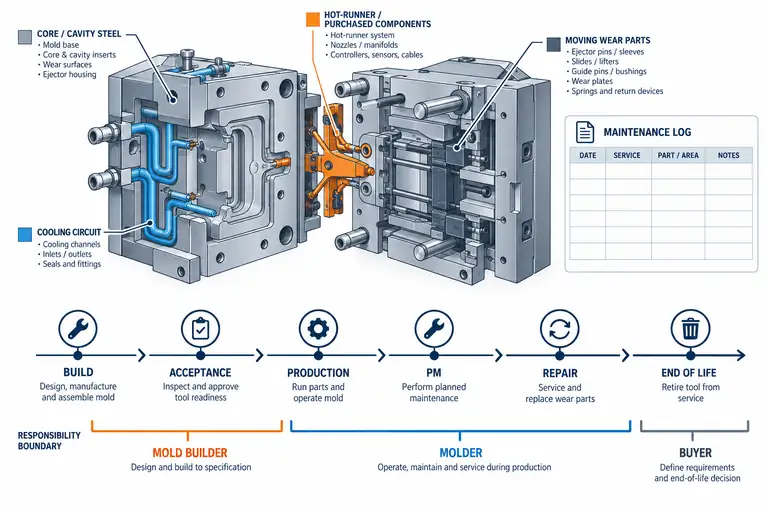
A quote promising a “million-shot mold” or a multi-year warranty sounds precise, but it can be meaningless without the covered configuration, resin, cycle definition, maintenance, operating limits, wear exclusions, acceptance baseline, repair location, and remedy. Service life and warranty are related, not identical.
Specify the tool’s production duty and design-life target, then negotiate a written warranty with objective coverage, exclusions, maintenance and records, response, parts, transport, and remedy. Do not treat an industry mold class or steel grade as a guaranteed cycle count. Acceptance proves the agreed starting condition; disciplined operation and maintenance preserve it.
Separate design life, useful life, and warranty
Design life is the duty the mold is engineered to support under stated assumptions. Useful life is how long it actually produces acceptable parts and process performance. Warranty is a contractual remedy for defined defects during a defined time or usage window. A tool can outlive its warranty, and a warranty does not erase normal wear.
Define what counts as a cycle or shot, especially for family molds, stack molds, multi-component tools, sampling, and short shots. Record expected annual parts, cavity count, operating days, cycle time, resin, fillers, color changes, insert handling, molding location, machine interface, storage, and expected program duration. Translate part demand into estimated mold cycles with capacity and scrap assumptions visible.
Describe end-of-life criteria by function: inability to hold approved dimensions or appearance, recurring flash, unstable filling, cooling degradation, repeated component failure, unrepairable steel damage, or repair cost/downtime beyond an agreed threshold. “Still opens and closes” is not sufficient.
Legacy SPI mold classifications can help align construction expectations, but published guidance itself warns that mold life varies with part design and molding conditions and is not guaranteed by classification alone (SPI specifications reproduction). Use the customer’s current mold standard and contract where applicable.
Specify the covered mold configuration
Attach the approved mold specification, design, bill of materials, steel certificates where required, hardness and heat-treatment records, purchased-component list, hot-runner and controller details, cooling layout, wiring, hydraulic/pneumatic circuits, spare parts, and as-built drawings. Warranty disputes grow when nobody can prove what was delivered.
Identify boundaries: mold base, core/cavity inserts, slides, lifters, ejectors, wear plates, leader components, seals, springs, cylinders, sensors, connectors, hot runner, heaters, thermocouples, manifolds, nozzles, controllers, and customer-supplied items. Purchased components may carry their manufacturer’s warranty rather than the toolmaker’s. Define who coordinates a claim.
Tie coverage to the accepted product and process baseline. State approved part revision, resin and reinforcement, cavity status, machine, water quality and temperature, pressure limits, cycle window, lubrication, and handling. A later abrasive resin, corrosive additive, excessive clamp force, crash, or unauthorized repair may legitimately alter responsibility, but exclusions should be specific and evidence-based.
Use a coverage schedule:
| Area | Define before order | Typical evidence at handover | Warranty question |
|---|---|---|---|
| core/cavity steel | grade, hardness, inserts, finish, duty | certificates, as-built dimensions, photos | defects in material/workmanship versus normal wear |
| moving components | design load, lubrication, replaceable wear items | BOM, spare list, fit/function check | covered failure and replacement responsibility |
| hot runner/purchased items | exact supplier/model and controls | manuals, serials, supplier warranty | who troubleshoots and pays transport/labor? |
| cooling and services | circuit design, water quality, fittings | flow/pressure test and layout | blockage, corrosion, leaks and misuse boundaries |
| part/process result | accepted sample and window | dimensional, appearance and run records | what loss of function triggers remedy? |
Make acceptance the starting evidence
Agree design-review, mold-trial, dimensional, appearance, functional, material, cycle, balance, process-window, and capacity requirements. Define sample lots, cavities, conditioning, inspection methods, run duration, acceptable downtime, and open-item closure. Final payment should be tied to stated deliverables and status, not merely sample shipment.
Document mold condition at handover: cavity and parting surfaces, shutoffs, vents, texture, gate, ejector system, moving fits, cooling flow, leak tests, wiring, sensors, hot runner, safety features, identification, cycle counter, preservation, and spare inventory. Capture as-built changes and unresolved concessions.
If the tool will be exported, run it at the receiving molder and define requalification. A successful trial at the builder does not prove the receiving machine, water, resin handling, utilities, controller, robot, and people reproduce the same state. Assign cost and responsibility for installation, debugging, and transport damage.
Keep T1 improvement, customer product changes, and warranty correction separate. If the tool was built to approved data but product engineering later changes a feature, that is normally a change order rather than a defect. If the tool cannot meet an agreed requirement because construction differs from the approved design, the warranty route may apply.
Link maintenance obligations to condition and records
Preventive maintenance should reflect resin abrasiveness/corrosiveness, cycle, moving mechanisms, hot runner, venting, lubrication, water, storage, and observed wear. Fixed intervals can start the plan, but inspection findings should refine them. Assign daily/shift, end-of-run, periodic, and major service tasks.
Records should include shot count, date, symptoms, parts inspected, measurements, cleaning, lubrication, replacements, repairs, person, photos, and return-to-service approval. Preserve removed components when a claim may follow. A cycle counter without service history cannot distinguish design failure from neglected wear.
Published toolmaker warranties illustrate contractual variability. Standard Tool and Mold, for example, states specific time/cycle limits and makes maintenance documentation a condition of its published warranty (Standard Tool and Mold warranty). Those terms are that company’s policy, not a universal benchmark. Buyers should negotiate terms suitable for their tool and legal agreement.
Define authorized repair. Emergency work may be necessary to protect production, but unapproved welding, grinding, component substitution, or parameter changes can destroy evidence or worsen damage. Establish notification, remote diagnosis, permission thresholds, approved service providers, and how emergency containment affects the claim.
Define claim evidence, response, and remedy
A claim notice should identify tool, cavity, shot count, part and resin revision, machine, process record, failure time, symptoms, affected lots, maintenance history, photographs, measurements, and immediate containment. State whether production stopped and what safe access is available.
Agree response levels: acknowledgment, technical triage, on-site or return decision, temporary containment, repair plan, parts availability, and target restoration. Avoid unconditional uptime promises unless backed by capacity, spares, geography, and a service contract. Time-zone and customs realities belong in the plan.
Specify remedies: repair, replacement of a defective component, rework, supplier labor, approved third-party work, freight, travel, sample rerun, or other negotiated relief. Define exclusions for normal wear, consumables, collision, poor water, improper storage, unauthorized change, out-of-window molding, and use with unapproved resin. Require evidence rather than automatic blame.
For an ejector seizure, maintenance records may show correct lubrication and increasing measured drag before failure. Inspection may identify an alignment or material defect attributable to build. For another tool, the same symptom may follow heavy flash and an undocumented crash. The warranty system should drive diagnosis from evidence, not assign every failure to one party.
Plan spares, ownership, transfer, and end of life
List critical and long-lead spares: ejector and core pins, inserts, seals, heaters, thermocouples, nozzles, springs, sensors, connectors, and proprietary items. State quantities, storage, preservation, drawing availability, and replenishment responsibility. Standard components reduce replacement risk only if the exact specification is documented.
Clarify mold ownership, custody, insurance, movement approval, maintenance access, intellectual-property and drawing rights, scrap authority, and return condition. A buyer-owned tool at a supplier still needs a custody and service agreement. Tool transfer requires condition audit, records, spares, controllers, programs, approved process, and open-issue history.
Track life consumption against forecast demand and condition. Plan refurbishment or replacement before the remaining margin threatens service production. End-of-life decisions should consider repair feasibility, steel condition, obsolete purchased systems, dimensional history, future volume, and product revision—not the counter alone.
For export-tool quotes, include receiving standards, machine platen and interfaces, connectors, water fittings, lifting, transport preservation, documentation language, and local service. Compare total lifecycle support, not only build cost. The quote comparison guide helps normalize differing commercial boundaries.
Review the agreement when production assumptions change. Higher demand, shorter cycles, new filled resin, added cavities, unfamiliar cooling water, or transfer to another press can consume life differently from the original duty. Document the revised forecast, inspect the tool, and agree whether design-life, spare, maintenance, and warranty terms remain valid before the new condition begins.
Conclusion
Write mold life as a duty-based design target and warranty as a specific remedy backed by acceptance and maintenance evidence. Send AutoMoldingPro the part CAD, resin, annual demand, target life, receiving-machine standard, validation, and service expectations through the contact page for a tooling quotation review.