
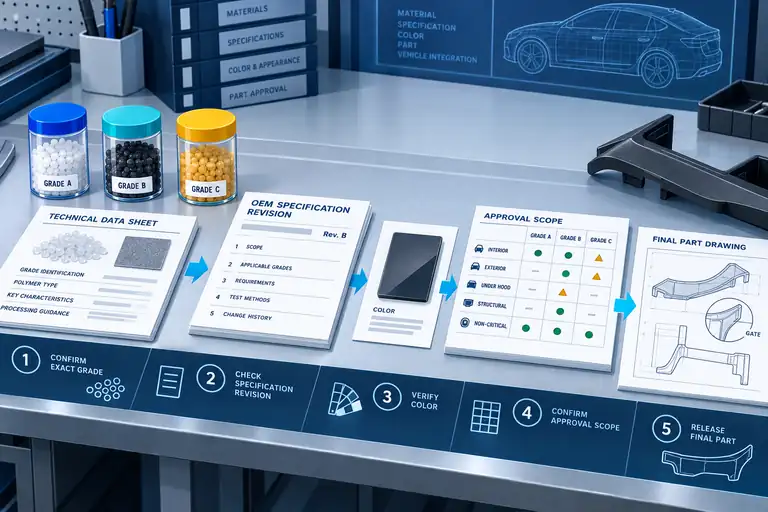
A drawing that says only “PA66-GF30, black” can still leave several commercially different resins in play. Heat stabilization, hydrolysis package, impact modification, laser marking, color formulation, recycled content, regional supply and an OEM specification revision may all change whether a grade is acceptable. If these details remain open, bidders can price different materials while appearing to answer the same RFQ.
The buyer should release a material identity package, not a polymer family. It must connect the manufacturer and exact commercial grade to the current customer specification, approved application and site scope, color or additive variant, required material reporting, processing condition and finished-part validation. A database listing or supplier statement is supporting evidence; it does not by itself approve a molded part for every customer, plant, color or duty.
Start with the controlling requirement, not a familiar resin name
Separate four layers that are often collapsed into “approved material”: the part drawing, the customer or OEM material specification, the resin producer’s exact grade documentation, and the program’s approval record. Record the document number, revision or effective date, owner and applicable vehicle or component scope. If the drawing references a controlled customer document that the molder cannot access, the customer must provide the applicable requirements or a formally approved interpretation. A supplier cannot reliably quote unseen obligations.
A family description is useful for screening but weak for release. Two PA66 compounds with the same nominal glass content can use different stabilizers, impact modifiers, pigments and processing windows. Likewise, a color suffix can identify a formulation with a different approval or supply status. Ask the resin producer or authorized channel for the current technical data sheet, processing guidance, safety information and declared product identity. Check region and production site when the customer approval is site-specific. Do not infer equivalence from similar data-sheet values.
Map what an approval actually covers
Build an approval-scope matrix with rows for exact grade, color, supplying resin site, molding supplier site, part family, specification revision and intended service environment. Mark each item confirmed, conditional, not applicable or open, and attach the evidence reference. BASF’s public automotive specification database, for example, distinguishes material, color and paint approvals. That structure is a useful reminder that one approval label may not cover every variant, though the customer remains the authority for the project.
Treat IMDS and material compliance as another linked scope rather than a substitute for engineering suitability. The IMDS public guidance states that creators and receivers share data-quality responsibility and that system checks still require human investigation. Confirm who creates the material data sheet, which company ID receives it, what deadline applies, and whether the exact supplied grade and color formulation are represented. A successfully accepted MDS does not demonstrate dimensional stability, assembly strength or environmental performance of the finished component.
Write an RFQ material line that bidders cannot reinterpret
State manufacturer, complete commercial designation, color code, customer specification and revision, required approval evidence, permitted supply sites, virgin or permitted regrind status, moisture/packaging expectations, and change-notification rule. If equivalents may be proposed, keep the required grade as the compliant base and request alternatives on a separate line with a difference statement and approval route. “Or equivalent” without evaluation criteria transfers a product decision to the bidder.
For customer-directed grades, clarify commercial responsibility: who nominates the source, who buys it, who owns minimum-order or aged-stock risk, and what happens if the approved grade is unavailable. Ask for quotation validity tied to the named material basis. If the resin price or color masterbatch is provisional, label the affected cost rather than silently substituting a commodity family. The automotive RFQ checklist can carry these inputs with the CAD, volumes and validation package.
Verify incoming material and molded-part identity
Receiving controls should connect purchase order, supplier batch, packaging label, certificate or shipment record, dryer or handling record, machine lot traceability and molded-part batch. The evidence depth depends on the customer and risk; a certificate of analysis may be requested for defined characteristics, but it should not be treated as proof of every part requirement. Define how mixed, damaged or unidentified bags are segregated and who can disposition them.
Part validation must reproduce the intended material condition. Moisture-sensitive resins may show different dimensions or properties depending on conditioning, while pigments and additives can affect appearance, flow or joining. Record specimen state, molding condition, cavity, time and test method. Grade approval establishes permission to use a material within a scope; drawing, assembly and environmental evidence establish whether the actual part is acceptable.
Control changes without freezing an obsolete material forever
Require notification for changes that matter to the approved identity: commercial grade, formulation or color code, manufacturing site, compliance status, declared substances, key process guidance, packaging or an obsolete specification revision. The exact notification threshold must follow the customer agreement. On receipt, classify whether the change is documentary, requires material-data resubmission, needs molding trials, or requires part revalidation and customer approval.
Maintain an approved-material register linked to active part revisions and alternate states. It should show effective dates, stock disposition and the first production batch after a change. Do not delete superseded evidence; archive it so field or inventory questions can be traced to the applicable state. If the customer grants a temporary material deviation, limit it by grade, quantity or period, affected parts and validation obligations rather than editing the permanent drawing informally.
Evidence worksheet for the sourcing or release review
Use the worksheet as a traceability index, not a box-ticking score. For every line, record the source document, revision, owner, result, open action and approval authority. A missing item should remain visibly open until the responsible function decides whether it blocks quotation, tooling, sampling or production.
| Evidence line | What the reviewer should be able to verify |
|---|---|
| 1. released part drawing and specification revision | The record identifies the applicable product and process state, shows who created or accepted it, and supports the decision without relying on an undocumented conversation. |
| 2. complete resin manufacturer and commercial grade | The record identifies the applicable product and process state, shows who created or accepted it, and supports the decision without relying on an undocumented conversation. |
| 3. color, additive and modifier designation | The record identifies the applicable product and process state, shows who created or accepted it, and supports the decision without relying on an undocumented conversation. |
| 4. approved resin production and molding sites | The record identifies the applicable product and process state, shows who created or accepted it, and supports the decision without relying on an undocumented conversation. |
| 5. current TDS and processing guidance | The record identifies the applicable product and process state, shows who created or accepted it, and supports the decision without relying on an undocumented conversation. |
| 6. IMDS or required compliance-data responsibility | The record identifies the applicable product and process state, shows who created or accepted it, and supports the decision without relying on an undocumented conversation. |
| 7. part-level validation plan and sample condition | The record identifies the applicable product and process state, shows who created or accepted it, and supports the decision without relying on an undocumented conversation. |
| 8. change-notification and stock-disposition rule | The record identifies the applicable product and process state, shows who created or accepted it, and supports the decision without relying on an undocumented conversation. |
How to challenge the evidence rather than merely collect it
- released part drawing and specification revision: Confirm the controlling revision, scope and owner. Compare the record with the current CAD, drawing and purchase baseline; a technically correct document from an obsolete state cannot support release. Record discrepancies as actions rather than silently choosing one source.
- complete resin manufacturer and commercial grade: Check how the item was produced and whether the conditions match the quoted or released process. Identify substitutions, missing lots, different sites and temporary settings. Decide whether each difference is irrelevant, needs analysis, or requires new physical confirmation.
- color, additive and modifier designation: Verify that the evidence represents every relevant cavity, variant and time period. A convenient sample may demonstrate possibility but not production coverage. Preserve identifiers so a later failure can be traced without reconstructing the population from memory.
- approved resin production and molding sites: Review the measurement or observation method. The fixture, conditioning, instrument, software, operator rule and acceptance boundary must be suitable for the decision. Calibration alone does not prove that the method measures the intended feature without bias.
- current TDS and processing guidance: Look for interactions with assembly and downstream operations. A result that passes on a loose molding can change after fastening, welding, potting, conditioning, packaging or transport. Include those interfaces when they are part of the requirement.
- IMDS or required compliance-data responsibility: Ask what happens when the input moves toward a credible limit. Evidence only at a favorable nominal condition may hide fragility. Use planned boundary checks where justified, while respecting machine, material, tool and safety constraints.
- part-level validation plan and sample condition: Define the disposition authority and the next gate. Supplier engineering may recommend an action, but customer approval, product engineering or quality may control release. The record should say what is accepted, what remains open and what blocks shipment.
- change-notification and stock-disposition rule: Carry the conclusion into production documents. Update the setup, inspection, traceability, maintenance and change-control records that operators actually use. Retain the underlying evidence so future changes can be assessed against the same baseline.
Read the rows in sequence. The first items establish what is being judged; the middle items show how the product or process was created and measured; the final items connect evidence to release and future control. If two records conflict, resolve the revision and scope before averaging data or accepting the more convenient statement. Keep assumptions separate from verified facts, and convert accepted assumptions into controlled project inputs before irreversible tooling or shipment.
Questions that expose weak assumptions
| Question | A useful supplier answer should include |
|---|---|
| Which exact document and revision controls the material? | A specific condition, responsible owner, supporting record, exception path and the evidence required before the next gate. |
| Does the evidence cover this grade, color, source site and application? | A specific condition, responsible owner, supporting record, exception path and the evidence required before the next gate. |
| Who submits and receives the required material data? | A specific condition, responsible owner, supporting record, exception path and the evidence required before the next gate. |
| What must be revalidated if the grade or site changes? | A specific condition, responsible owner, supporting record, exception path and the evidence required before the next gate. |
| How will each molded batch retain resin-lot identity? | A specific condition, responsible owner, supporting record, exception path and the evidence required before the next gate. |
| Which commercial risks follow a customer-directed material? | A specific condition, responsible owner, supporting record, exception path and the evidence required before the next gate. |
Ask these questions in a joint engineering, quality and purchasing review. A technically detailed answer is still incomplete if it does not identify the controlled revision or who may authorize an exception. Likewise, a certificate or test report is weak if its samples, conditions and product state cannot be connected to the quoted or released part. Record the disposition beside the affected requirement so later teams do not have to reconstruct intent from email.
How the framework changes a real decision
A buyer receives two quotations for an under-hood housing. Both say PA66-GF30, yet one assumes a general heat-stabilized black grade and the other uses a customer-listed hydrolysis-resistant color formulation. The prices cannot be compared until the buyer identifies the controlling customer specification, exact commercial grade, approved color and supply site. If the first material is proposed as an alternate, it needs a documented gap review and customer approval route; matching polymer and filler labels are not enough.
The important step is to preserve the chain from requirement to evidence to disposition. If a condition changes—material, cavity, fixture, supplier, site, software, environment or customer scope—review which link in that chain is no longer valid. Do not restart every activity automatically, but do not assume the old conclusion transfers. State the delta, assess its mechanism, and agree the proportionate confirmation before release.
What to send for a project-specific review
Send the current STEP file and drawing, applicable material and customer specifications, annual and release quantities, assembly interfaces, identified critical or cosmetic characteristics, validation requirements, and any existing issue evidence. Use the AutoMoldingPro automotive project RFQ to keep the files and decisions tied to one revision. The review should identify missing inputs and acceptance responsibilities before tooling or production commitment; it cannot replace customer approval.
Resolve alternates and shortages without losing the approved baseline
When the named grade is constrained, begin with the duty and approval gap, not a search for a similar generic designation. Compare manufacturer, full commercial grade, polymer and reinforcement, stabilization package, color, processing guidance, declared substances, source site and every characteristic tied to the customer specification. A side-by-side TDS comparison is only a screen because values may use different specimens, conditioning and methods.
Keep commercial urgency separate from technical authorization. Purchasing can evaluate lead time, minimum order, regional availability and price while engineering and quality evaluate suitability and approval. State whether the alternate would be temporary, second-source approved or a permanent drawing change. Preserve the original grade as the baseline until an authorized record says otherwise.
Use production-intent samples to confirm processability, appearance, dimensions, joining and applicable environmental or functional results. Record whether the mold or process needed adjustment; a substitute that passes only after an irreversible steel change may not remain interchangeable. Define stock segregation and the cut-in or cut-back batch.
The decision is complete only when the part drawing, customer material requirement, supplier grade data, material reporting record and supply agreement identify the same state. Archive superseded evidence so later inventory and field questions can be connected to the material actually molded.
Resolve alternates and shortages without losing the approved baseline
When the named grade is constrained, begin with the duty and approval gap, not a search for a similar generic designation. Compare manufacturer, full commercial grade, polymer and reinforcement, stabilization package, color, processing guidance, declared substances, source site and every characteristic tied to the customer specification. A side-by-side TDS comparison is only a screen because values may use different specimens, conditioning and methods.
Keep commercial urgency separate from technical authorization. Purchasing can evaluate lead time, minimum order, regional availability and price while engineering and quality evaluate suitability and approval. State whether the alternate would be temporary, second-source approved or a permanent drawing change. Preserve the original grade as the baseline until an authorized record says otherwise.
Use production-intent samples to confirm processability, appearance, dimensions, joining and applicable environmental or functional results. Record whether the mold or process needed adjustment; a substitute that passes only after an irreversible steel change may not remain interchangeable. Define stock segregation and the cut-in or cut-back batch.
The decision is complete only when the part drawing, customer material requirement, supplier grade data, material reporting record and supply agreement identify the same state. Archive superseded evidence so later inventory and field questions can be connected to the material actually molded.
Resolve alternates and shortages without losing the approved baseline
When the named grade is constrained, begin with the duty and approval gap, not a search for a similar generic designation. Compare manufacturer, full commercial grade, polymer and reinforcement, stabilization package, color, processing guidance, declared substances, source site and every characteristic tied to the customer specification. A side-by-side TDS comparison is only a screen because values may use different specimens, conditioning and methods.
Keep commercial urgency separate from technical authorization. Purchasing can evaluate lead time, minimum order, regional availability and price while engineering and quality evaluate suitability and approval. State whether the alternate would be temporary, second-source approved or a permanent drawing change. Preserve the original grade as the baseline until an authorized record says otherwise.
Use production-intent samples to confirm processability, appearance, dimensions, joining and applicable environmental or functional results. Record whether the mold or process needed adjustment; a substitute that passes only after an irreversible steel change may not remain interchangeable. Define stock segregation and the cut-in or cut-back batch.
The decision is complete only when the part drawing, customer material requirement, supplier grade data, material reporting record and supply agreement identify the same state. Archive superseded evidence so later inventory and field questions can be connected to the material actually molded.
Conclusion
Base the decision on a defined product state, controlled inputs, traceable evidence and an explicit release authority. Keep exceptions visible, preserve the conditions behind every result, and require the supplier to explain how the conclusion will remain valid in production. That approach turns a broad technical request into an auditable manufacturing decision.