
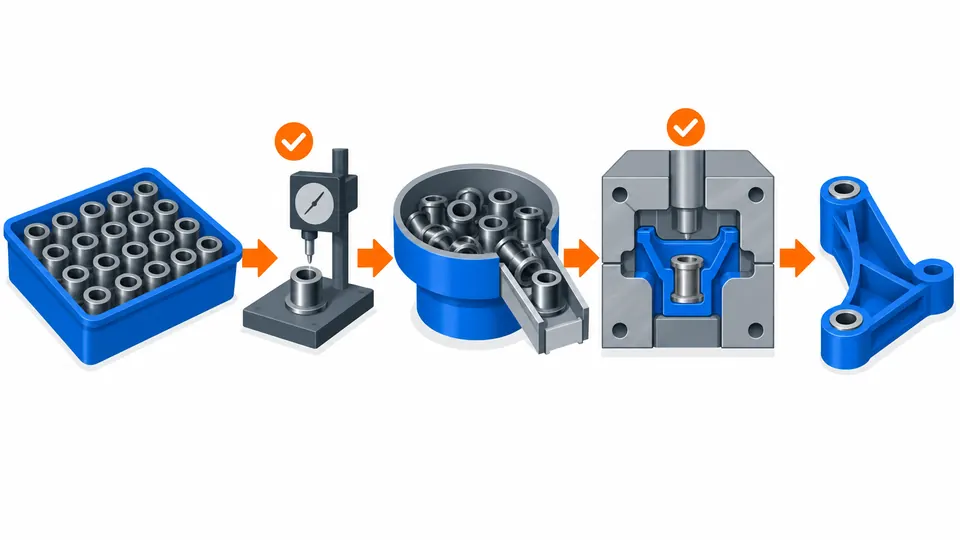
Customer-supplied inserts can appear to remove a purchasing item from the molder’s quote, yet they add an interface that can stop production or blur responsibility. A wrong plating lot, damaged thread, contamination, short shipment or unplanned process loss may not be discovered until the mold is running. Without written rules, both parties can believe the other owns inspection, replenishment and scrap.
Before the run, agree the exact insert specification and revision, approved sources, shipment and packaging condition, incoming checks, lot traceability, usable quantity, expected process allowance, line-side controls, nonconformance route, reconciliation and ownership of each loss category. The agreement must also say which evidence permits production and who authorizes a deviation. Customer ownership of the insert does not remove the molder’s process-control duties.
Freeze the insert identity and mating requirements
The supply package should identify the part number, revision, drawing or supplier specification, material, heat treatment or strength where applicable, finish or plating, thread, key dimensions, orientation features, cleanliness limits, packaging and approved manufacturing source. If a commercial insert is used, include the complete manufacturer designation rather than a shortened description. For a customer-designed stamping or machined insert, connect the 2D requirements to the assembly and overmolding datums.
Also identify which characteristics affect molding and finished function. Burr direction can change loading or plastic sealing; plating buildup can affect fit; oil may contaminate adhesion; a thread protector can interfere with automation; magnetic response can affect feed equipment. Carry those inputs in the automotive injection molding RFQ checklist with the molded-part CAD and validation requirements. For the current run, do not let “customer supplied” substitute for an executable product definition.
Agree what incoming inspection can and cannot establish
Incoming inspection should be risk-based and practical. Verify shipping identity, quantity, packaging, certificate or lot documents, visible damage, mixed variants and selected dimensions or gauges that can block safe molding. Define sample size and acceptance from the project’s quality plan rather than copying a generic level. Some properties—plating adhesion, material chemistry or heat treatment—may require supplier records or laboratory methods beyond routine receiving. State the evidence needed and the party responsible for obtaining it.
Receipt does not transfer design approval to the molder. Conversely, using customer-supplied parts does not justify ignoring obvious damage or identity problems. Define the quarantine and notification route, whether the molder may sort, who approves rework, how urgent replacements are shipped and whether production may proceed with a documented deviation. Historical SPI plastics-molder practices discuss customer-furnished inserts, incoming inspection and extra quantity, but the actual purchase agreement and customer requirements control the project.
Plan quantity around the real manufacturing flow
Start with the finished quantity and map every point where an insert can be consumed: feeder setup, bowl tuning, robot trials, cavity startup, destructive inspection, insert presence rejects, molding scrap, downstream assembly, retention samples and approved overrun. Separate expected setup allowance from abnormal loss. A single percentage without a process map can hide whether inserts are lost before molding, trapped in scrapped plastic or damaged after molding.
Agree the shipment unit, count method and reconciliation tolerance. Weight-counting can be efficient but needs a controlled unit-weight basis; sealed reels or trays may support direct counts. Define minimum line-start quantity and a replenishment trigger that accounts for transport lead time. If ten molded cavities require one insert each, an incomplete feed set can create short shots, empty features or deliberate cavity shutdown; the resulting schedule and validation effects must be addressed before the last usable insert reaches the cell.
Control inserts from warehouse to cavity
Preserve supplier lot and customer batch identity through receiving, storage, staging and line-side use. If lots are combined in one production run, define whether the final product can retain that genealogy and whether customer approval is required. Protect threads and finishes from corrosion, dust, oil migration and handling damage. First-in/first-out may be appropriate, but it does not replace shelf-life or finish-condition controls where those exist.
At the machine, mistake-proof variant, orientation and presence. The method can include keyed trays, feeder sensors, vision, part-weight checks, cavity interlocks or finished inspection, but its adequacy depends on the failure mode. Validate that an insert is not only present but correctly seated and undamaged after molding. A sensor that sees metal can miss a reversed insert; a post-mold thread gauge can miss weak retention. Link detection to the risk and retain rejects for cause classification.
Whether the insert then stays in place under load is a retention-design question, not an incoming-inspection question: how the metal-to-plastic interface holds — mechanical locking or qualified adhesion — is covered in Mechanical Locking vs. Adhesion in Metal-to-Plastic Insert Molding.
Assign responsibility for each nonconformance and loss
Create categories that distinguish incoming insert nonconformance, customer shortage, transit damage, normal documented setup consumption, molder process scrap, tool-related insert damage, mixed identity, finished-part failure and downstream loss. For each, name containment, evidence, disposition, replacement, schedule and commercial owners. This is not about assigning blame before investigation; it prevents the production team from improvising while the line waits.
When a defect is discovered, preserve both the insert and molded-part evidence. Record insert lot, mold/cavity, time, feeder station, process state and defect mode. Do not automatically charge every scrap unit to the insert supplier or every shortage to the molder. A burr may jam a feeder; excessive insert temperature or incorrect seating may crack plastic; a tool locator may damage otherwise conforming plating. The mechanism and agreement determine the disposition.
Close the run with a quantity and evidence reconciliation
At completion, reconcile received, returned unused, quarantined, consumed in accepted product, consumed in approved samples, and scrapped by reason. Explain variance rather than balancing the numbers with an untraceable adjustment. Identify customer-owned material remaining at the molder, storage condition, lot, future-use authorization and return or disposal instruction.
Review whether the agreed allowance was realistic and whether repeated loss justifies feeder, packaging, insert or mold changes. Feed the result into the next release quantity and quote. Retain certificates, incoming results, deviation approvals and scrap evidence with the molded batch according to the customer’s retention requirements. This turns a customer-supplied input into a controlled production interface instead of an informal box of parts.
Customer-supplied insert agreement matrix
Use the agreement matrix before accepting the first insert shipment. Reconcile the supplied revision, incoming checks, usable quantity and lot mapping with the responsibilities for rejected or reworked inserts.
| Review line | Required input or evidence | Decision test |
|---|---|---|
| Identity | Part/revision, source, material, finish, thread and packaging | Customer releases the input; molder verifies receipt against the release |
| Incoming evidence | Lot documents, visual/dimensional checks, count and quarantine criteria | Roles follow the agreed plan; specialized tests are not assumed |
| Production allowance | Setup, samples, normal loss and abnormal loss categories | Allowance is explicit; abnormal loss needs cause evidence |
| Line-side control | Storage, staging, orientation, presence and seating detection | Molder controls handling and insertion process |
| Shortage response | Trigger, notification, replacement transport and cavity/line decision | Named buyer and production contacts own timing decisions |
| Reconciliation | Accepted product, unused stock, quarantine and scrap by reason | Both parties approve unresolved variance and future stock status |
Customer-supplied insert supply form — complete before the first shipment
The agreement matrix above is a review table. Use this form to record the agreed values: complete the right-hand column before the first insert shipment is accepted. A blank cell means the point is not yet agreed, not that it does not apply. Do not enter a single percentage as the allowance — the article requires setup consumption, destructive samples and normal loss to be stated separately.
| Supply item | Agreed value / owner — buyer to complete |
|---|---|
| Insert part number, revision, and complete manufacturer designation | |
| Approved manufacturing source(s) | |
| Material, heat treatment or strength, finish or plating, thread | |
| Key dimensions, orientation features, cleanliness limits, packaging | |
| Shipment unit, count method, and reconciliation tolerance | |
| Incoming checks, sample size, and acceptance (from the project quality plan) | |
| Evidence still needed before release (supplier records / laboratory tests) | |
| Setup allowance, in units (feeder setup, bowl tuning, robot trials, cavity startup) | |
| Destructive-sample allowance, in units | |
| Normal process-loss allowance, in units — separate from abnormal loss | |
| Minimum line-start quantity and replenishment trigger, including transport lead time | |
| Lot traceability rule and mixed-lot rule (including whether mixing is permitted) | |
| Quarantine and notification route, with named buyer and production contacts | |
| Reconciliation owner and timing; unused-stock return or disposal instruction |
Illustrative example
A customer sends plated bushings in bulk cartons for a scheduled bracket run. Receiving count is adequate, but the feeder jams after several cycles because some bushings carry an outward burr. The team quarantines the affected lot, retains jammed examples, reports the remaining usable count and agrees a sorted replacement shipment. It does not classify all lost molding as normal allowance or change the locator without approval. The final reconciliation separates incoming burr rejects from parts scrapped during feeder recovery.
If the supplied part is a bushing or compression limiter in a bracket joint rather than a threaded insert, the clamp path, worst-case stack and thermal-movement design for that joint is covered in Metal Bushings in Automotive Plastic Brackets: Clamp Loads and Thermal Expansion.
Questions to ask the supplier before the next gate
Which insert characteristics can stop molding or change finished function?
Identify the drawing limits for feed and locator fit, burr direction, plating, threads, orientation and cleanliness. Show how incoming checks and the molding process detect each critical condition; detecting metal presence alone does not confirm seating or retention.
What inspection evidence is available before the mold is scheduled?
Provide receiving identity and count, packaging condition, lot documents, the agreed visual and dimensional results, and the usable versus quarantined quantity. Identify any material or finish property that still needs supplier evidence or laboratory testing before release.
How is usable quantity calculated across setup, samples and expected process loss?
Convert the finished-part requirement to insert units, then add separately agreed setup consumption, destructive samples and normal loss. Show available conforming stock, the replenishment trigger and who handles an abnormal loss; do not hide shortage or unexplained scrap in a standard percentage.
How will lot identity survive staging and overmolding?
Show the receiving lot mapped to each staged batch, molding run and relevant cavity/time range, finished batch and shipment. Keep unused returns, rejects and reworked parts attached to that history. Define the permitted mixed-lot rule before combining stock; customer requirements may prohibit mixing. Bosch’s supplier quality requirements, for example, explicitly connect component and production records with traceability.
Who authorizes sorting, rework, substitution or a temporary deviation?
Name the quality and production owners who release a sorting instruction, the technical authority who approves a rework method and its verification, and the customer authority responsible for a changed insert or concession. Record the affected lots, quantity and validity period. Bosch’s rework guidance illustrates the need for controlled instructions, risk review and defined approvals; the applicable customer procedure governs this project. Use bounded temporary deviation authorization when an exception is needed. Arranging replacement transport does not authorize a substitution or rework.
What to provide for a project-specific review
Send the insert drawing or complete commercial designation, annual and release quantity, packaging format, approved source, expected validation and the molded-part CAD. These inputs allow the insert supply interface and overmolding plan to be reviewed before capacity is committed. Include the proposed incoming-inspection and quantity-allowance agreement in the AutoMoldingPro request form.