
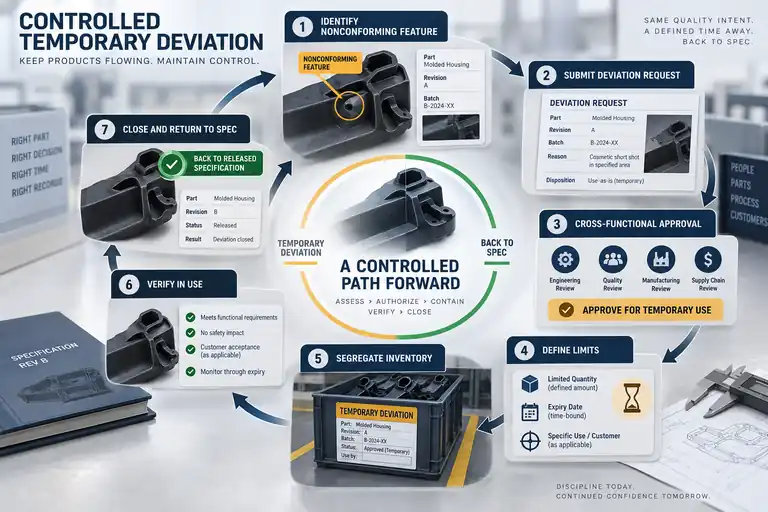
A temporary deviation can protect supply while a defined nonconformity is evaluated or corrected. It can also become an uncontrolled second specification if the affected characteristic, quantity, destination, expiry, identification and approval are vague. Parts may continue to ship after the authorization ends, or a concession for one use may be applied to another.
Treat a deviation as a bounded product disposition, not a drawing change.
A deviation and a waiver are not the same permission. Under ISO 9000:2015, a deviation permit is permission to depart from the originally specified requirements before realization, while a concession is permission to use or release a product that does not conform to specified requirements — in other words, a waiver is requested after the parts exist. File a deviation request when the supplier knows, before the parts are made, that it cannot meet a requirement; file for a waiver only when parts have already been made and inspection has found them outside the drawing. Only the design authority — in practice the customer’s responsible engineer plus quality, not the buyer and never the supplier alone — can accept a departure from the design. (Definitions per ISO 9000:2015 as explained in the Saola deviation-request guide, linked in References.)
Identify the exact nonconformity and risk, contain the population, obtain the customer authority required by the contract, limit the authorization by part/revision/site/batch/quantity or time, define verification and labeling, and close it by returning to the released requirement or processing a permanent engineering change. Customer acceptance is not implied by internal supplier approval. The PPAP guide explains when a deviation or interim approval permits shipment and under what quantity or expiry.
Contain first, then decide whether a request is appropriate
Stop uncontrolled movement of the suspect population. Identify part number and revision, production site, mold and cavity where relevant, material and batch, manufacturing dates, inventory locations, shipped quantities and downstream use. Preserve conforming and suspect stock separately. A deviation request should not be used to avoid determining the extent of condition.
Screen the characteristic for function, safety, regulatory, assembly, appearance, durability and traceability impact with the responsible product and quality owners. Some requirements cannot be relaxed by the supplier, and some customer contracts require formal authorization before shipment. If the evidence is insufficient to judge risk, the immediate action is more containment or testing—not optimistic wording in a deviation form. As a customer-specific example, section 7.2 of the Volvo Group supply-partner manual requires deviation approval before shipment and review by its designated functions. Use the procedure applicable to the actual customer.
Write the nonconformity so another site can identify it
Reference the released requirement verbatim by drawing feature, specification and revision, then state the actual condition, measurement method and observed range or defect boundary. Attach clear location images or marked drawings and original results. Avoid phrases such as “slightly out” or “no effect expected.” They provide neither a sorting rule nor a technical basis.
Explain suspected cause and corrective-action status without presenting an unverified cause as fact. State whether the process is stable, whether all cavities behave alike and whether the condition can worsen. Define how parts covered by the request will be inspected and identified. If the nonconformity is visual, use an approved boundary sample or image set with viewing conditions rather than relying on adjectives.
Bound the authorization by product, place, quantity and time
A workable authorization lists part number, drawing revision, manufacturing and ship-from site, customer receiving location, vehicle or program scope where applicable, affected batches, maximum quantity, earliest and latest manufacture or shipment, and an unambiguous expiry event. Use whichever limits prevent overrun; quantity and date can both apply. State whether material already at the customer is included.
The expiry should create action. Before the limit is reached, production must either return to the released specification, receive an extension through the same authority, or implement an approved permanent change. Configure the planning or shipping system to block unauthorized continuation. A deviation number printed on paperwork is weak control if production, warehouse and dispatch teams cannot see the remaining quantity and valid destinations.
Define verification, identification and downstream communication
List the checks applied to every covered lot and the records retained. These may include sort results, dimensional data, assembly trial, functional testing, traceability labels or enhanced inspection; the selection follows the assessed risk. Identify who releases each lot and which customer contact receives the records. A concession does not remove the need to meet every unaffected requirement.
Mark containers or documents in the manner the customer authorizes, without obscuring normal labels. ZF’s quality-document index, for example, lists a deviation request and a separate identification form; obtain the current documents for the receiving site. Keep deviation stock physically or electronically segregated from conforming stock. If the affected part feeds multiple assemblies or plants, block destinations outside the approval scope. Communicate the status to sub-suppliers when their process or stock is involved, but do not disclose customer-controlled information beyond the permitted chain.
Close the deviation and prove the return to normal
Closure requires evidence that the authorized population is exhausted or dispositioned and that subsequent production meets the released requirement. Record the last covered batch and first conforming batch, verify corrective action under the planned conditions, remove temporary inspection or labeling only with authorization, and reconcile remaining stock.
If the long-term solution changes product definition, tooling, material or the validated process, use the formal engineering-change and reapproval route. The revision-control guide explains how the changed baseline is recorded once the deviation closes. The existing engineering change control guide explains that permanent path. Do not repeatedly extend a deviation to avoid updating the product baseline; repeated requests are evidence that cause, capacity or specification alignment needs management review.
Deviation authorization form and quantity balance
Copy this form into the request. Every field must be filled before shipment; a blank field is a missing authorization, not a detail to confirm later. The form follows the same fields a customer quality manual requires — MACI’s QA-SM-14, for example, requires the specification, the requested deviation, approval signatures from QA, and the conditions for approval before any nonconforming product ships — and the Universal Avionics supplier deviation form, which records whether the request is product- or process-related, first-time or repeat, permanent or temporary with duration, plus corrective and preventive action.
| Field | Entry |
|---|---|
| Deviation number | [ ] |
| Part number and drawing revision | [ ] |
| Released requirement (verbatim) | [ ] |
| Actual condition and measurement method | [ ] |
| Affected lots, cavities and manufacturing dates | [ ] |
| Maximum quantity authorized | [ ] |
| Receiving plant(s) and vehicle/program scope | [ ] |
| Expiry event (date, quantity, or first conforming batch) | [ ] |
| Verification and identification per lot | [ ] |
| Customer approver (name, function, date) | [ ] |
| Closure: last deviated batch / first conforming batch | [ ] |
Track the balance live. The table below is a worked example built on this article’s own illustrative bracket case — an appearance mark outside the approved visual boundary, with fit and load features still within drawing requirements. All numbers are assumed for illustration only; replace them with the authorized figures from the real approval.
| Balance line | Parts |
|---|---|
| Maximum quantity authorized | 5,000 |
| Shipped under the deviation | 3,200 |
| Held at plant, still covered | 1,650 |
| Scrapped (counted against the authorization) | 150 |
| Reconciled total (3,200 + 1,650 + 150) | 5,000 |
| Remaining shippable allowance (5,000 − 3,200 − 150) | 1,650 |
The reconciliation must close: shipped plus held plus scrapped equals the authorized quantity. When the remaining allowance reaches zero, or the expiry event arrives, shipment stops — expiry does not convert remaining stock into conforming product.
Evidence worksheet for the sourcing or release review
Attach the affected drawing requirement, measured departure, identified stock and proposed expiry to the request. Use the matrix to distinguish the requested concession from evidence of customer authorization.
| Evidence line | What the reviewer should be able to verify |
|---|---|
| 1. released requirement and exact nonconforming condition | The request identifies the drawing/specification revision, affected feature and actual measured range or visual boundary. |
| 2. extent-of-condition and inventory reconciliation | Counts reconcile suspect work-in-process, finished stock, shipped lots and customer locations; conforming material remains distinguishable. |
| 3. risk review by authorized functions | Product and quality owners assess function, assembly, durability, safety and other affected requirements, identifying tests and non-deviable conditions. |
| 4. customer-specific approval authority | The customer’s required approval record names the authorized decision and scope; a supplier signature or unanswered request is not acceptance. |
| 5. part, revision, site and destination scope | Part/revision, manufacturing site, covered lots and receiving destinations match the written authorization; other uses remain blocked. |
| 6. quantity and time expiry controls | The authorization states the controlling quantity and expiry event; dispatch checks remaining allowance and valid dates before release. |
| 7. lot verification and identification records | Lot results meet the authorized deviation boundary and unaffected requirements; agreed labels and records identify each covered shipment. |
| 8. closure and first-conforming-batch evidence | Residual stock is dispositioned, corrective action is verified, and the last deviated and first conforming lots are identified before temporary controls are withdrawn. |
Questions that expose weak assumptions
| Question | A useful supplier answer should include |
|---|---|
| Who has contractual authority to accept this condition? | The current customer procedure and written approval from its designated authority for this specific condition and scope. |
| Can each affected unit and destination be identified? | A lot/location reconciliation linking held and shipped quantities to every receiving plant covered by the request. |
| What evidence supports continued use during the limited period? | Risk review, measured defect limits and relevant assembly/function results, with a defined inspection rule for every covered lot. |
| Which quantity and date controls will stop overrun? | A live quantity balance and an unambiguous expiry event, enforced by production planning and dispatch blocks. |
| What happens to stock when the deviation expires? | Continued hold pending authorized rework, scrap, return or a new approval; expiry does not convert remaining stock into conforming product. |
| Does the permanent fix require formal engineering change and reapproval? | A documented comparison with the released product/process baseline and the customer’s decision on change notification and reapproval. |
Illustrative example
A molded bracket has an appearance mark outside the customer-approved visual boundary, while fit and load features remain within drawing requirements. The customer still controls appearance acceptance. The supplier segregates the affected cavities and batches, submits images under agreed viewing conditions, identifies the requested quantity and one receiving plant, and proposes enhanced visual inspection through a fixed shipment date. Approval, if granted, applies only to that bounded population. The next production lot must meet the released boundary or follow a separately authorized extension or change.
What to send for a project-specific review
For a deviation review, provide the released requirement, actual nonconformity data, affected-lot inventory, requested quantity/destinations, expiry event and proposed containment through the project RFQ. Keep the customer’s authorization record with the request; an engineering review does not grant shipment approval.
Manage extensions, recurring deviations and final closure
An extension is a new decision. Reconcile the original authorized quantity, shipped and remaining stock, explain the corrective-action delay, update risk and validation, and obtain authorization before expiry. Never edit the date on an approved form or reuse it for a new population.
Track recurrence by part, feature, cavity, cause category and action owner. Repetition may indicate an ineffective fix, capacity assumption, unstable process, worn tool, incoming-material issue or requirement needing formal review. Trend information supports escalation but does not create permanent acceptance.
Make the expiry operational. Define whether manufacture, shipment, receipt or use is the controlling event. Count the unit named in the approval, including treatment of scrap and returns. Align physical segregation, ERP blocks, labels and dispatch checks across every authorized destination.
Closure communication must reach production, warehouse, logistics, the customer and affected sub-suppliers. Record the last covered batch, first conforming batch, residual-stock disposition and removal of temporary controls. Later complaints can then be traced to a conforming unit, a legitimately deviated unit or an out-of-scope shipment.
References
- Volvo Group Supply Partner Quality Assurance Manual, section 7.2
- ZF supplier quality guidelines and deviation forms index
- AutoMoldingPro engineering change control guide
- MACI Quality Assurance Manual for Suppliers, QA-SM-14 — Supplier Request for Deviation: https://www.michauto.com/wp-content/uploads/2018/09/QA-SM-14.pdf
- Saola — Supplier Deviation Request Form: Deviation vs Waiver: https://saolamfg.com/guides/supplier-deviation-request
- Universal Avionics — Supplier Deviation Request Form (FRM-ADM-08.12): https://universalavionics.com/hubfs/Vendor/FRM-ADM-08.12%20Rev%2000%20Supplier%20Deviation%20Request.pdf?hsLang=en