
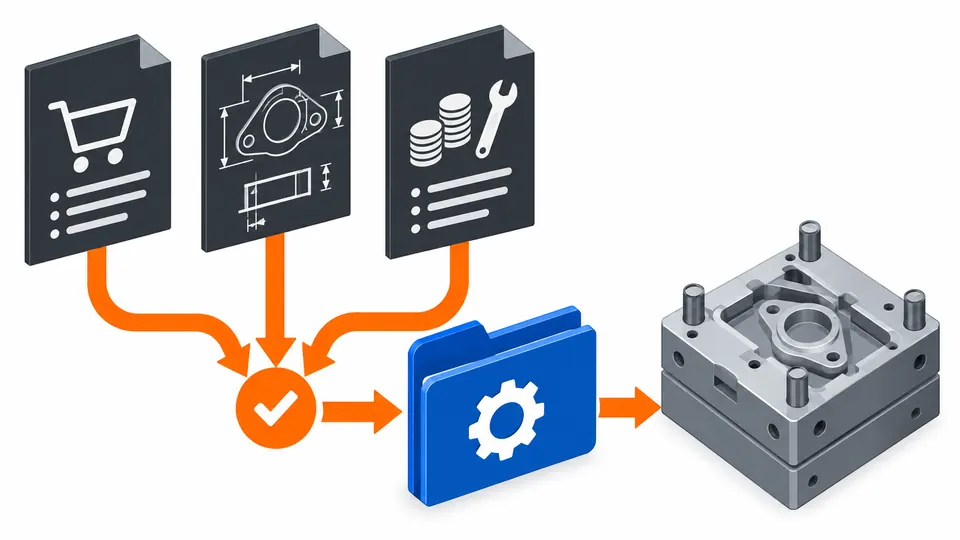
A supplier can receive a purchase order that references one drawing revision, a quotation based on another material, and an email promising validation work absent from both. Starting steel or ordering resin may feel urgent, but it converts an unresolved document conflict into cost, delay and approval risk. The conflict is an engineering and purchasing control problem before it becomes a production problem.
Create one written conflict register, stop the affected irreversible work, and reconcile part/revision, CAD, material, quantity, tooling ownership, validation deliverables, acceptance, schedule and commercial assumptions with authorized owners. Issue a revised order, drawing, quotation/acknowledgment or formal clarification that establishes one baseline. Which document legally prevails depends on the agreement and jurisdiction; this article does not provide that legal conclusion.
Build a five-document baseline
Collect the purchase order and referenced terms, supplier quotation and assumptions, drawing/CAD/specifications, technical review or DFM decisions, and approved change/clarification records. Record number, revision, date, issuer and recipients. Add customer-specific quality documents and sourcing nominations where they are explicitly incorporated. Do not rely on an email attachment without confirming it is the released file.
Compare the documents field by field: part number and revision, material/grade/color, tool scope, cavities, life/maintenance assumptions, annual and order quantity, price basis, delivery location, packaging, validation, samples, inspection, capacity, change control and acceptance. The automotive RFQ checklist can supply the initial input set, but the conflict review must show which source currently controls each line and where authority is missing.
Classify conflicts by consequence and reversibility
Mark each mismatch as blocking, conditional or documentary. A different material grade, geometry revision, cavity count, validation obligation or destination machine can change steel, process and approval; it normally blocks affected irreversible work. A contact-name typo may be documentary. A provisional forecast can allow design work but not material commitment if the commercial rule is unclear. State the consequence instead of assigning every mismatch the same urgency.
For each item, identify the earliest commitment it can affect: quotation, design freeze, steel order, tool cutting, resin buy, sample molding, validation, packaging or shipment. Define a safe stop point. Work that is independent of the conflict can continue if documented, but do not let “schedule pressure” become blanket authorization. Record cost and date exposure using supported supplier inputs, not speculative penalties.
Find the authorized owner without making a legal assumption
The project team should identify who can release engineering requirements, who can modify the purchase order, who can approve a deviation and who accepts validation. Supplier sales, tool design, buyer, customer engineering and quality may each own different decisions. Ask the contracting/procurement function or legal counsel when document precedence is uncertain. Engineering staff should not declare legal precedence based on a familiar slogan.
One buyer’s supplier clauses can illustrate a control without making it universal. Glenair’s supplier quality clauses, for example, apply Q01 when invoked on the purchase order. Q01 routes deviation or clarification requests to the buyer for review and approval before completion of work or delivery, and requires written confirmation of deviation approval. The applicable AutoMoldingPro project must follow its own signed agreement and customer documents. The useful general practice is to expose the discrepancy, identify authority and obtain a traceable disposition before affected work proceeds.
Write clarification so it closes the actual gap
A good request quotes the conflicting fields, attaches or links the controlled documents, states the proposed baseline and explains effect on design, price, schedule, validation and inventory. Ask a binary or bounded question where possible: “Confirm drawing revision C and grade X are the order baseline; revision B quotation assumptions will be reissued.” Avoid “please confirm everything is okay,” which can be answered without resolving the mismatch.
The response should identify the authorized person, decision, effective date, affected part/tool/order and follow-up documents. Meeting minutes can capture agreement but may not replace a revised PO or drawing when the system requires one. Track interim permissions by scope and expiry. If the customer asks the supplier to proceed at risk, record exactly which work, cost exposure and later approval remain open; do not silently convert it into final product acceptance.
Reprice and reschedule only the affected delta
Once the technical baseline is clear, compare it with the quoted assumptions. Explain cost and time by mechanism: extra steel movement, different hot runner, resin price or MOQ, added fixture, laboratory test, sample quantity, packaging, transport or capacity. For the piece-price drivers behind the repriced delta — material, cycle time and inspection — see What Drives Automotive Molded Part Pricing? Material, Cycle Time, and Inspection (ID 368). Use it to check that the revised quote prices the same drivers, not to re-open agreed items. Preserve the original quote and issue a revision or change response that links to the decision.
Avoid reopening unrelated agreed items as leverage, but do not hide coupled effects. A material change can alter shrinkage and require tool or validation review; a quantity change can change cavity economics and machine allocation; a CAD change can alter mold size and destination compatibility. The quote-comparison guide helps normalize bids, while the conflict register explains why one supplier’s original basis is no longer comparable.
Release one auditable project baseline
Before cutting steel or another agreed gate, issue a baseline index listing current order/change number, drawing and CAD revision, material specification, tool specification, DFM approvals, validation/sampling plan, delivery and acceptance, quote revision and open items. Every owner should know which document to update; the register itself should not become an unofficial drawing.
Apply revision control to supplier and customer systems, remove superseded shop copies, and identify work or material created under the old state. Decide disposition before mixing it into the new baseline. Future changes should enter through the same mechanism. A clean record does not eliminate commercial disagreement, but it prevents the plant from producing to one assumption while purchasing and quality evaluate another.
Scope-freeze decision record (fill in one row per disputed field)
Copy this table into the project file and complete it before the affected gate. Leave a row open — do not fill it with an assumption — until the named owner has decided it.
| Disputed field | PO states | Drawing / CAD states | Quote states | Agreed baseline | Owner | Decision and date | Work released or held |
|---|---|---|---|---|---|---|---|
A row is closed only when the "Agreed baseline" cell names one controlling document and revision, the "Owner" cell names the person or function that decided it, and the "Decision and date" cell records the traceable decision. Until then the affected work stays in the "held" column, even if unrelated work continues.
PO–drawing–quote conflict register
Enter each conflicting field with its document revision and the authority needed to resolve it. Release affected work only after the agreed interpretation and any cost or validation change are recorded.
| Review line | Required input or evidence | Decision test |
|---|---|---|
| Product definition | Part/revision, CAD, drawing and specifications | Engineering owner releases one technical state |
| Material | Manufacturer/grade/color, approvals and alternatives | Material decision and commercial effect are both closed |
| Tool scope | Cavities, hot/cold runner, ownership, life and destination machine | Irreversible steel assumptions are explicit |
| Demand/commercial | Quantity, releases, price basis, currency, logistics and packaging | Quote and PO use comparable demand and delivery terms |
| Validation/acceptance | Samples, PPAP/FAI, tests, gauges, criteria and authority | Deliverables and release gate are funded and owned |
| Change record | Clarification, revised document, effective date and old-state disposition | Decision is traceable beyond email memory |
A conditional example
A PO references drawing revision C, while the accepted quotation names revision B and a general PA66-GF30. The new drawing adds a customer-specified stabilized grade and a validation report. Rather than begin steel on the common geometry, the supplier logs the material, shrinkage and deliverable conflicts, identifies what design work is reversible, and requests an authorized baseline. A revised quote and PO acknowledgment then connect revision C, exact grade, sampling scope and schedule before steel release.
This illustrative scenario is not a customer case.
Questions to ask the supplier before the next gate
Which controlled document and revision defines each disputed field?
For each disputed field, list the document number, revision, issuer and proposed controlling value. Include the drawing, CAD, specifications, quotation and order references; route unresolved precedence to the authorized procurement or contracting function.
What irreversible work or purchase does the conflict affect?
Identify the first affected commitment: steel purchase or cutting, resin order, sample production, validation, packaging or shipment. Define the stop point and separate any documented independent work that can continue without assuming the disputed requirement is approved.
Who is authorized to release engineering, commercial and quality decisions?
Name the engineering owner for the product definition, the buyer or contracting owner for the order and price, and the quality/customer authority for deviations and validation. A response should state which of those decisions it actually authorizes.
Does the clarification state cost, schedule and old-state disposition?
Compare the agreed baseline with the quoted assumptions and identify the affected tooling, material, validation, quantity and delivery costs or dates. State what happens to tooling work, resin and finished stock made under the superseded state, and issue the required revised documents.
Have all operating teams received the same final baseline?
Distribute the same baseline index to customer and supplier teams, including design, purchasing, tooling, production and quality. Confirm receipt of the current revisions, remove superseded shop copies and identify the cut-in point and disposition of old-state material.
What to provide for a project-specific review
For a scope reconciliation, provide the current PO, quotation and assumptions, released CAD/drawing, material specification, validation list, quantities and existing clarification records. AutoMoldingPro can map the manufacturing deltas and open decisions before tooling commitment; contractual precedence should be confirmed by the authorized commercial or legal owner. Submit these inputs through the AutoMoldingPro request form, with open assumptions clearly marked.