
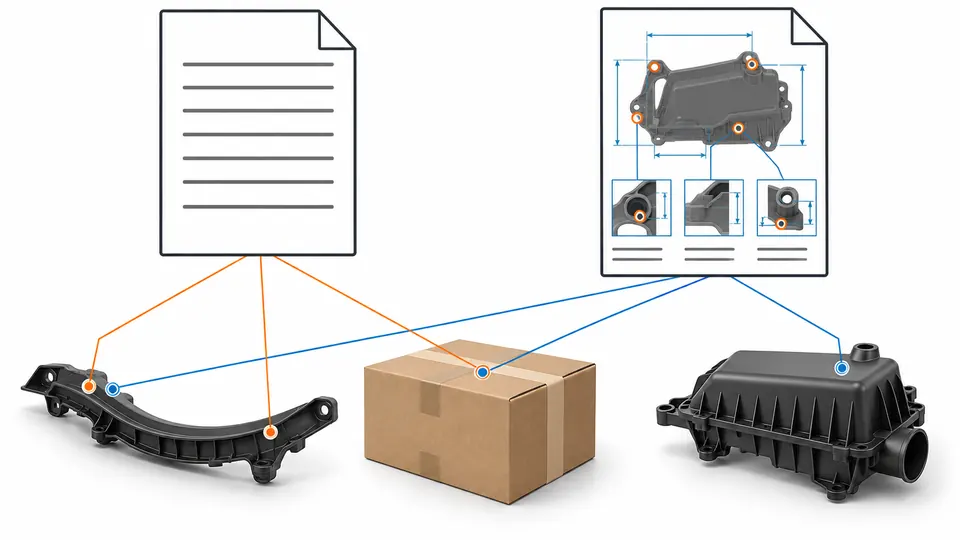
A certificate of conformance can state that a shipment meets specified requirements without listing every measured value. An inspection report can contain measurements yet omit the authority, population or full requirement set needed for a conformity declaration. Treating them as substitutes creates false assurance.
Define the object, requirements, issuer and traceability for the certificate, and separately define characteristics, sample, method, original readings and decision rules for inspection data. Require both where the customer or risk needs a supplier declaration plus objective shipment evidence. Neither document replaces PPAP, material records or finished-part validation outside its scope.
Identify the object and requirements of the declaration
A certificate is ambiguous if it says “parts conform” without part, revision, lot, order and requirement references.
Specify part number and revision, quantity/lot or shipment, purchase order, applicable drawing/specifications and any authorized deviations. Name the issuing organization and authorized signatory or system.
ISO describes conformity assessment as demonstrating whether an object meets specified requirements. ISO/CASCO’s conformity assessment overview defines the field and its toolbox: ISO/CASCO — Conformity Assessment. A supplier declaration should let the recipient understand what is being attested and against which documents. Avoid broad language that implies certification by ISO or an independent body when the supplier is making a first-party declaration. Include date and location as required and link limitations. A management-system certificate is not a product certificate and should not appear as proof that the shipment dimensions passed.
Build the review around certificate template, object/lot identity, controlled requirement list, issuer authority and deviations. Keep the part number, drawing revision, material condition, lot or cavity identity, equipment state and observation method beside the result. The decision is whether the declaration clearly states who asserts conformity of what product to which requirements. A result from a different geometry, resin grade, production cell or conditioning state can be useful background, but it is not automatically transferable. Record the mismatch and decide whether a controlled comparison is required. A concise certificate is easy to process, but excessive brevity can make the statement impossible to audit or apply to the shipment. Set a named owner and an evidence-based closure condition before the next irreversible commitment.
Define what measured results must demonstrate
A table of values is not useful when characteristic numbers, units, tolerance, cavity, sample size or measurement state are missing.
Specify the ballooned characteristic reference, requirement and units, sample identity and selection, actual readings, method/fixture, conditioning, date and disposition. Preserve original values where requested.
A measured report is evidence from a defined sample at a point in time. It may cover critical dimensions, appearance, weight, force, leak or other checks. State whether results are individual or summarized and how cavities and time are represented. For flexible or moisture-sensitive parts, define measurement state. A material certificate cannot replace finished dimensions, and a dimensional report cannot declare resin identity without linked material traceability. Use the FAI, PPAP and T1 guide to distinguish broader submission purposes. Boundary: this article owns the shipment — what evidence travels with each lot. The FAI, PPAP and T1 guide owns the approval submission: FAI vs. PPAP vs. T1 Sample Report. The PPAP scope guide owns what each PPAP level contains: PPAP for Automotive Molded Parts: Scope and Responsibilities. The traceability guide owns the lot-to-shipment genealogy: Material Traceability for Automotive Molded Parts. A CoC never substitutes for any of the three.
The working record should contain ballooned drawing, sample/cavity plan, original readings, method/fixture and conditioning rather than a conclusion copied into email. Review the source, revision, units, sample selection and boundary conditions, then test whether inspection data are traceable, interpretable and representative of the defined shipment or approval sample. Preserve failed or marginal observations as well as passing ones; otherwise the team cannot see where the recommendation stops being reliable. Full individual data improve review and analysis; summary reports are smaller but can hide cavity or trend information. Translate the accepted condition into the drawing, purchase specification, setup sheet, inspection instruction or change record that production will actually use.
Keep declaration, determination and approval separate
Testing and inspection determine characteristics; review and attestation decide whether specified requirements are fulfilled.
Map who measures, who reviews, who issues the declaration and who grants customer product approval. Do not let one document imply a role its issuer does not hold.
ISO’s functional approach distinguishes determination evidence in reports from review and attestation. The attestation types — first-party, second-party and third-party, including the Supplier’s Declaration of Conformity — are set out here: ISO/CASCO — Attestations of Conformity. The four-stage functional approach (selection, determination, review and attestation, surveillance) is described in this 2014 CASCO draft, which cites ISO/IEC 17000:2004: Conformity Assessment — Functional Approach (CASCO Annex 1, 2014 draft). A supplier can declare its product conforms based on its controls; an accredited laboratory may report a test result; a customer may approve the part. These are different authorities. Accreditation applies to the laboratory’s scope and competence, not automatic approval of every part. PPAP is a customer-supplier production approval process and should not be replaced by a routine CoC. State whether third-party evidence is contractually required.
Ask the supplier to connect responsibility map, laboratory scope where relevant, review record, declaration and customer approval status to the proposed part and production state. The evidence is sufficient only when each document is used within the authority and scope of its issuer. If inspection cannot observe the mechanism directly, identify the proxy being used and how it was correlated. Do not average incompatible results or hide a trend by pooling cavities, lots, left/right versions or process stages. Independent evidence can increase confidence but adds cost and lead time; use it where requirement or risk justifies it. Define what change would invalidate the conclusion and route that trigger through normal change control.
Choose shipment evidence by characteristic risk
Requiring every dimension on every shipment is wasteful, while a generic certificate may be insufficient for unstable or critical features.
Create a risk- and customer-based matrix for CoC, material/lot documents, measured characteristics, sample frequency, capability or functional data and deviation records.
Stable characteristics controlled by a validated process may need periodic rather than shipment-level reports if the customer permits. New tools, changed cavities, temporary deviations or recent corrective actions may require enhanced data. Critical or regulatory characteristics follow the customer’s specific rules. Define whether the customer receives reports automatically or on request and how long records are retained. Link reaction plans to out-of-tolerance results; do not issue a clean certificate while an unresolved deviation exists.
Use customer requirement, characteristic risk, control plan, process history and shipment-document matrix to challenge the preferred option. Confirm who produced the record, what population it represents, and whether the current acceptance method could miss the relevant failure. The release test is whether the evidence package is proportionate and meets explicit customer obligations. More inspection can detect issues but does not create process control; excessive reporting may delay review without improving detection. Where evidence remains incomplete, authorize only bounded work at risk, with a quantity or activity limit, responsible owner and follow-up record. Commercial urgency does not turn an assumption into product approval.
Reconcile traceability across the documents
A correct certificate and correct report can still refer to different lots, revisions or quantities.
Use consistent part, revision, lot/batch, cavity where required, order, shipment and deviation identifiers across labels, CoC, inspection, material and test records. Perform a document-pack check before shipment.
The packing list quantity should match the declared shipment and explain partials. Inspection sample IDs should map to the production lot. Material lot and process records should link according to the traceability plan. If rework or sorting occurs, issue records for the final released population and preserve the prior status. Avoid manually retyping identifiers where controlled system links are available. A mock trace should retrieve underlying evidence from the certificate or shipment number.
Before closing this point, reconcile cross-document identifier map, shipment pack, rework/sort history and mock trace result with the controlled product definition. The reviewer should be able to show that the recipient can connect the declaration and measured evidence to the physical shipment. Check at least one credible boundary condition when the mechanism is sensitive to temperature, time, load, moisture, orientation or machine response. Fine cavity-level traceability narrows containment but adds label and transaction complexity; set the level from risk and requirement. Keep superseded data and mark the cut-in point of any correction so later complaints or deviations can be contained to the right population.
Handle discrepancies without rewriting history
If a measured result conflicts with a certificate, editing the certificate or deleting the report destroys the evidence needed for disposition.
Stop release, verify identity and method, investigate the nonconformance, obtain authorized deviation or correction, and issue controlled superseding documents that retain the audit trail.
Check units, revision, sample and transcription before concluding the part is nonconforming. If the result is valid, identify affected quantity and follow the customer’s notification and disposition process. A deviation should state scope and expiry; it does not make the original requirement disappear. Corrected documents should reference what they supersede and why. Preserve original readings and approvals. Review whether already shipped product is affected and update reaction controls.
Release from this stage should cite discrepancy record, method/identity verification, containment, authorized disposition and superseding-document trail and explain why conflicting evidence is resolved transparently before a conformity statement is relied upon. A polished report is not enough if it omits original readings, specimen state, cavity identity, units or the applicable requirement. Rapid document correction restores flow, but only after the physical product status and authority are established. Close the loop by defining the ongoing check, reaction threshold and escalation route. The purpose is not extra paperwork; it is to keep the validated condition recognizable when production, demand or supply circumstances change.
Shipment evidence matrix
Define deliverables by product and customer requirement rather than using one generic certificate package.
| Review line | Input or evidence | Decision or action |
|---|---|---|
| CoC | Object, requirements, lot/shipment, issuer and deviations | Declare within authority |
| Inspection | Characteristics, samples, actuals, methods and state | Show objective results |
| Material | Manufacturer, grade, lot and required certificate/declaration | Support input identity |
| Approval | PPAP/FAI/customer release status | Do not imply from CoC |
| Traceability | Part/revision/lot/cavity/order/shipment links | Connect documents to parts |
| Discrepancy | Hold, investigate, deviate or supersede | Preserve audit trail |
Put “not required,” “available on request” and “submit each shipment” explicitly in the matrix. Silence leads each supplier and receiving plant to build a different evidence package.
Shipment evidence pack — fillable template
Copy this table into the purchase order or quality agreement and complete one row per document. "Submit each shipment", "available on request" and "not required" must each be written explicitly — silence is not an answer.
| Document | Fields to complete | Issuer | Submit | Linked identifiers |
|---|---|---|---|---|
| Certificate of Conformance (CoC) | Part number and revision; quantity / lot / shipment; purchase order; applicable drawing and specifications; authorized deviations; signatory and date | Supplier (first-party declaration) | Each shipment / on request / not required: ___ | Lot, order, shipment |
| Inspection report | Ballooned characteristic reference, requirement and units; sample identity and selection; actual readings (not "passed"); method and fixture; conditioning; date; disposition | Supplier quality / laboratory | Each shipment / on request / not required: ___ | Sample IDs → production lot |
| Material certificate / declaration | Manufacturer (not only distributor); exact grade and color; supplier lot; internal receipt lot; certificate disposition | Material manufacturer via supplier | Each shipment / on request / not required: ___ | Resin lot → molding batch |
| PPAP / FAI status | Submission level; warrant; approval date; open actions | Customer (approval) | State status, do not imply from CoC: ___ | Part revision, approval record |
| Traceability record | Part / revision / lot / cavity where required / order / shipment links | Supplier | Per traceability plan: ___ | Container and label IDs |
| Deviation record (if any) | Scope, expiry, authorization, affected quantity | Authorized approver | With the shipment it covers: ___ | Superseded documents referenced |
Filled mini-example — from this article’s own revision-D scenario
A shipment certificate lists drawing revision D while its dimensional report references revision C. The completed pack for the corrected shipment reads: CoC declares revision D, lot [ ], PO [ ]; inspection report references revision D after re-measurement against D, with sample IDs mapped to the contained lot; the superseding report and certificate are linked to the investigation record; the original revision-C report is retained in the record, not deleted. The clean certificate is not treated as permission to ignore the mismatch.
Applying the method to a defined situation
A shipment certificate lists drawing revision D, while its dimensional report references revision C. The team stops release and confirms that parts were molded after the revision change but the inspection program was not updated. It measures the affected characteristics against D, contains the lot, updates the program through control, and issues a superseding report and certificate linked to the investigation. The original documents remain in the record; the clean certificate is not treated as permission to ignore the mismatch.
The conclusion in this situation depends on the stated inputs. Change the material, geometry, load, equipment, quantity, environment or customer requirement and the review must be reopened at the affected line. The value of the exercise is the visible path from input to decision, not the use of a convenient universal number.
Turn the worked review into a short decision record before the team acts. Identify the exact part family and revision, the decision owner, the supplier input date and the next commitment that would become expensive to reverse. Under “Identify the object and requirements of the declaration,” record the starting condition and the evidence that is already controlled. Under “Choose shipment evidence by characteristic risk,” identify the most credible alternative and the consequence of accepting it. Under “Handle discrepancies without rewriting history,” state the release condition and the event that would reopen the decision. The first review lines to complete are CoC, Inspection, Material. Do not mark a line closed merely because a document was received; record whether its revision, sample population, units and boundary conditions match the program being discussed.
Questions for the supplier review
- What exact object and requirements does the CoC declare?
- Who has authority to issue it?
- Which samples, cavities and methods produced the measured report?
- What customer approval is separate from the shipment declaration?
- Do all identifiers connect to the physical lot?
- How are conflicting or superseded documents controlled?
A useful response identifies the controlled source, explains assumptions and exceptions, and names the record that will close the issue. Ask for original evidence where the decision is material; a yes/no answer without part, process and revision context is not enough for tooling or production release.
Information to submit for a project-specific review
Provide the customer document requirements, part/drawing revision, purchase order, lot and shipment structure, control plan, characteristic list, sample and method rules, material documents and deviation process. Use the AutoMoldingPro request form to keep the current drawing, STEP file, material requirement, annual volume, order pattern and validation scope tied to one inquiry. Mark unresolved points as assumptions so they can be priced and closed before tooling or production commitment.
Conclusion
Use a certificate to make a scoped conformity declaration and inspection results to show defined objective evidence. Their value depends on authority, method and traceability—and they should agree before shipment.