
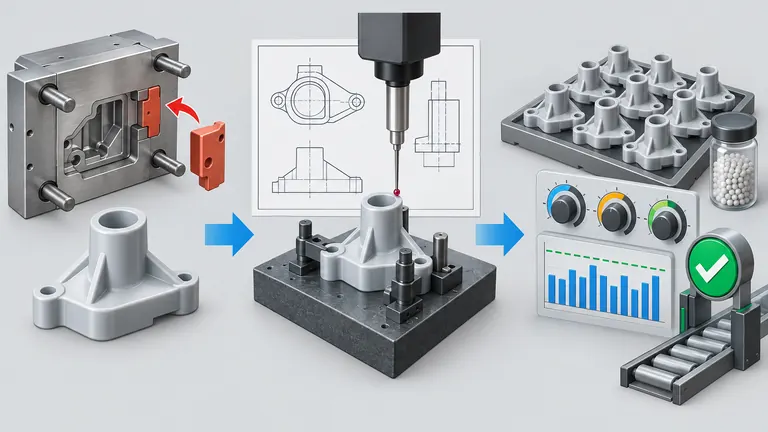
Conceptual illustration; not to scale.
Automotive buyers often receive a first-article inspection report, a PPAP package and a T1 sample report under the broad label “inspection documents.” The names sound interchangeable, but they answer different questions. If the buyer requests the wrong evidence for the project stage, a thick file can create false confidence while leaving production tooling, process or customer approval unresolved.
Request the report that matches the decision: a T1 sample report to understand what the new mold produced and what needs correction; FAI only when the customer or applicable industry process requires that first-article format; and PPAP or the customer’s equivalent submission when production readiness and approval evidence are required. Confirm the governing customer-specific requirement, sample source, revision, production conditions, open deviations and formal approval status. None of the document names alone proves that the product is released.
The terms below are compared for procurement use, not as a substitute for AIAG, VDA, OEM or contract documents.
Separate the three document purposes
Why this matters: The core problem is semantic. “First article,” “T1” and “PPAP” can describe different deliverables at different suppliers. A buyer needs to know what a document proves, what it does not prove, and who is authorized to accept it.
A T1 sample report is normally a tool-development output. It records the first or early trial from a mold, including trial conditions, sample observations, dimensional results and correction items. The exact format is project-specific. It can show whether the mold, material and process are producing a useful sample, but it may not represent a stable production run or the final customer-approved condition.
FAI is a first-article inspection concept and report format used by some organizations and industries. It is not automatically the same as automotive PPAP. The applicable FAI standard, customer requirement, product definition and scope must be identified before the buyer treats the report as mandatory. A report labelled FAI may show characteristic accountability but still omit automotive process evidence or customer-specific submission elements.
PPAP is an automotive production-part approval process. AIAG describes PPAP as part of the Quality Core Tools and says it is intended to ensure engineering design and product specification requirements are met. A PPAP submission can draw on dimensional results, material and performance records, process risk analysis, control plans, measurement-system evidence and the submission warrant, depending on the required level and customer rules. It is a submission and approval process, not merely a dimensional report.
The buyer should therefore ask for the document’s purpose and approval owner in the first line of the request. “Send PPAP” is incomplete if the part is still at tool T1 and no production process is frozen. “Send FAI” is incomplete if the customer requires AIAG PPAP or VDA PPA. The right request names the stage, the source of parts, the applicable requirement and the decision to be made.
A buyer should also check whether the document is a report, a submission or an approval record. A report describes results; a submission packages evidence for review; an approval record shows the authorized decision and any conditions. The three may be stored together, but they should not be treated as the same object. Ask the supplier to identify the status of each file and the document that controls the next gate.
Compare stage, content and approval value
Why this matters: The following table is a procurement decision tool. It does not create a universal customer requirement. Confirm the customer-specific manual, purchase order, drawing notes and quality agreement before finalizing the submission list.
Compare the documents by source, purpose, evidence and authorized disposition: use a T1 report for tool learning, an applicable FAI format for first-article accountability, and PPAP or VDA PPA for the customer-defined production approval decision.
| Document | Typical stage | Main question answered | What to request | What it does not prove by itself |
|---|---|---|---|---|
| T1 sample report | First mold trial or tool-debug phase | What did the new tool produce, under which conditions, and what remains open? | Trial date, tool revision, material, machine, cavity data, sample observations, dimensional findings, correction list and next trial plan | Stable production capability, complete PPAP or customer production release |
| FAI report | Customer-defined first-article stage | Does the first article account for the defined product characteristics against the released product definition? | Applicable FAI standard or customer form, drawing/model revision, characteristic ballooning, actual results, nonconformities and approval route | Automotive process readiness, production-rate evidence or PPAP approval unless explicitly integrated |
| PPAP submission | Production-part approval gate | Has the supplier assembled the required product and process evidence for production approval? | Customer-required submission level, production-run source, records, warrant, deviations, open actions and customer disposition | Permanent immunity from change control, future lot conformity or approval of an unapproved deviation |
| VDA PPA or customer equivalent | Customer-defined automotive approval route | Does the supplier meet the customer’s defined product and process approval package? | Applicable customer or VDA form, evidence list, revisions, sample source and sign-off roles | Automatic equivalence to AIAG PPAP in every program |
Use the table in sequence. At T1, request technical learning and correction control. Before launch, request the customer-defined approval package tied to production conditions. If the program uses both FAI and PPAP, map the overlapping characteristics and keep separate requirements visible instead of sending duplicated files with inconsistent values.
The buyer should read across the rows, not down one column. A T1 file can contain many dimensional pages but still come from a temporary process. A PPAP file can be complete in form but conditional in customer status. An FAI can account for every characteristic while leaving process capability or customer-specific requirements outside its scope. Record the overlap and the gap in an evidence index. Where the customer uses its own terminology, map it to the project gate without claiming that the customer’s process is identical to AIAG PPAP or a general FAI standard.
For each report, confirm the revision of the product definition and the identity of the parts measured. Then confirm the person or system that can accept the result. A supplier signature may attest to preparation; it does not necessarily constitute customer approval. The index should show whether the file is informational, submitted, approved, approved with conditions, rejected or superseded. That status is often more important to a launch decision than the report title.
Do not score the documents by page count. A concise T1 record with tool revision, sample source and open actions may be more useful for the next correction than a long report with no traceability. A production submission may need more evidence because it supports a different decision, but more pages do not change the approval authority. Ask the supplier to identify duplicate data and the single source of truth for each characteristic. If two reports contain different values, hold the decision until the discrepancy is explained and the obsolete value is clearly superseded.
Check the source and state of the parts
Why this matters: A report’s value depends on the parts and process behind it. A polished document built from hand-finished samples, a temporary mold insert or a laboratory machine can be appropriate for learning, but it is not automatically evidence for production approval.
Ask how the samples were produced: tool identity and revision, cavity or position, machine, material grade and lot, operators, cycle or process revision, inspection equipment and production site. For a PPAP submission, the customer’s requirement may specify a significant production run or other representative source. AIAG’s public materials explain that PPAP belongs to the automotive core-tool framework, while the precise submission content and sample expectations are controlled by the applicable manual and customer-specific requirements. Do not replace the customer’s official manual with a supplier’s summary.
For a T1 report, ask whether the mold was complete or intentionally soft, whether texture and surface treatment were final, and which dimensions were measured before or after correction. Record all inserts, temporary shutoffs, handwork and process deviations. A T1 result is valuable precisely because it reveals what is not yet stable; hiding those conditions defeats the report.
For FAI, confirm the product definition source. Is the report based on the released 2D drawing, a model-based definition, an interface drawing or a customer-specific characteristic list? Check that revision letters, units, tolerances, datum references, material and special characteristics match the current release. If the report contains “N/A,” ask why the characteristic is not applicable rather than assuming the supplier omitted a measurement.
For PPAP or VDA PPA, check the relationship between the submission record and the production process. A dimensional result can be correct while the process flow, control plan, material approval, gage validation or change status is incomplete. The customer approval is a decision about a defined package and source, not a reward for document volume.
Request a sample traceability line from the report to the parts and from the parts to the tool and process. For a multi-cavity mold, ask whether all cavities are represented or whether the customer approved a representative plan. For a conditioned or environmentally sensitive material, confirm the state at measurement. For a functional check, confirm the mating component revision. If the source cannot be demonstrated, downgrade the evidence to a development finding and request a new record from the required production source.
Ask what remains open and who can approve it
Why this matters: The most important field in a report is often the open-issue status. Buyers should not accept a signature page as proof that every technical risk is closed. An approval may be conditional, interim, customer-specific or limited to a sample stage.
Request an action list with owner, due date, containment, affected characteristics and approval authority. Distinguish a tool correction, a drawing deviation, a process change, a material substitution and a documentation error. Each has a different route. A supplier may be able to correct steel under an approved tool-debug plan, but cannot unilaterally change the product tolerance or resin grade.
Check whether the report records the customer’s disposition: approved, approved with conditions, rejected, interim approval, or another defined status. Use the exact customer vocabulary. If no customer disposition exists, state that the package is supplier-prepared or internally reviewed, not customer-approved.
Ask how changes after approval will be controlled. PPAP and customer quality agreements generally operate within change-control systems; an approved sample does not authorize later changes to mold inserts, process location, material, cavity balance or inspection method. The earlier article T1 sample approval vs. production release covers the distinction between an acceptable sample and production release; this article stays focused on what procurement should request from the supplier.
The approval owner also matters. A project engineer may accept a T1 observation, a quality representative may disposition a report, and the customer’s authorized representative may approve a production submission. Do not ask a supplier to “approve its own PPAP” when the customer’s system requires customer sign-off. Record who reviewed each package and under which requirement.
Use an evidence index with four status fields: complete, incomplete, conditional and not applicable. The supplier should explain every incomplete or not-applicable item and identify the approving role. A corrective-action list should link each open item to the affected characteristic and to the sample or report that will close it. This makes it possible for procurement to release the next purchase step without accidentally treating an interim technical decision as a permanent production approval.
Use a buyer request checklist
Why this matters: Before sending a request, prepare a short evidence brief. It should identify the part number and revision, project stage, customer and plant, delivery decision, applicable standard or customer manual, sample quantity, production source, required report format and due date. If a field is not required, say so rather than leaving suppliers to guess.
Request a stage-specific evidence pack with the product revision, sample source, applicable customer requirement, characteristic results, open issues, responsible owners and authorized disposition clearly identified.
Buyer checklist
- Released drawing, 3D model and all referenced specifications, with revisions.
- Customer-specific requirements and whether AIAG PPAP, VDA PPA, FAI or another format applies.
- Decision required now: tool correction, design feasibility, internal approval, customer submission or production release.
- Sample source: T1, pilot, significant production run, production site, cavity and process status.
- Material manufacturer, grade, color, reinforcement, lot and approved alternatives.
- Dimensional characteristics, datum scheme, measurement state, fixture and measurement method.
- Functional, material, performance or laboratory tests required by the customer.
- Open deviations, temporary conditions, containment and expiry of any interim approval.
- Report owner, customer approver and disposition vocabulary.
- Change-control trigger for any post-approval tooling, process, material or site change.
Send the list with the RFQ or project gate. It is narrower than a full RFQ checklist because this article deals with approval evidence. For broader RFQ inputs, use the published automotive injection molding RFQ checklist.
The checklist should be sent before the supplier prepares the report, because changing the format after inspection may require remeasurement or rework. Ask for a file naming and revision convention so a corrected report does not sit beside an obsolete one without a clear supersession mark. Keep the buyer’s request short enough that a supplier can answer each line with included, conditional, not applicable or excluded, together with the reason. If the project uses a customer portal, state whether the supplier is responsible for upload or only for preparing the evidence.
Illustrative procurement scenario
Why this matters: Illustrative example: a buyer is sourcing a new molded connector housing. The supplier offers a “FAI/PPAP/T1 report” after the first mold trial. The buyer’s first response should not be to reject the file because the title is mixed. Instead, ask for a document map: which pages describe T1 trial learning, which pages meet the customer’s FAI requirement, and which PPAP elements are complete, conditional or not yet applicable.
The buyer then checks the source. The dimensional pages use the released drawing and identify the cavity, but the parts were produced with a temporary gate insert and a non-production cycle. That is useful T1 evidence, but not production PPAP evidence. The open-issue list says the connector position needs a steel correction and the customer has not yet accepted the deviation. The correct purchasing status is “T1 review open; PPAP not submitted for production approval.”
At the next gate, the buyer requests a report from the corrected tool and approved process, plus the customer-required submission package. The FAI form may be retained for characteristic accountability if the customer requires it, but the approval decision is recorded against the applicable automotive process. This avoids paying for duplicate paperwork while preserving the evidence needed for each decision.
The buyer records the decision in the sourcing tracker: the mold is not yet released for production, the T1 evidence is accepted for continued tool correction, and the later PPAP or customer-equivalent submission remains due after the production-source run. The tracker links the open connector correction to the revised dimensional report and the functional fit check. This is a better commercial signal than “PPAP received,” because it tells engineering, quality and purchasing exactly what the document has earned at that stage.
The buyer records the decision in the sourcing tracker: the mold is not yet released for production, the T1 evidence is accepted for continued tool correction, and the later PPAP or customer-equivalent submission remains due after the production-source run. The tracker links the open connector correction to the revised dimensional report and the functional fit check. This is a better commercial signal than “PPAP received,” because it tells engineering, quality and purchasing exactly what the document has earned at that stage. The buyer also records the next evidence gate, the responsible supplier and customer contacts, and the condition that would change the status. If the connector correction affects a drawing revision, the tracker pauses production approval until the revised product definition is authorized.
Conclusion
Name the stage and decision before naming the document. Use T1 for tool learning, FAI only under its applicable requirement, and PPAP or VDA PPA for the customer-defined production approval route. Always verify sample source, revisions, open deviations and the authorized disposition. Request the automotive quality and validation review with the customer requirement attached.
References
- AIAG, Quality Core Tools — role of APQP, PPAP, FMEA, Control Plan, MSA and SPC in automotive quality work.
- AIAG, Helpful Documents in the APQP Process — APQP scope and supporting quality documents.
- VDA QMC — customer and VDA quality-management resources; verify the applicable VDA PPA document and customer requirement for each program.
- NIST, Conformity Assessment Basics — conformity as demonstration that specified requirements are fulfilled.