
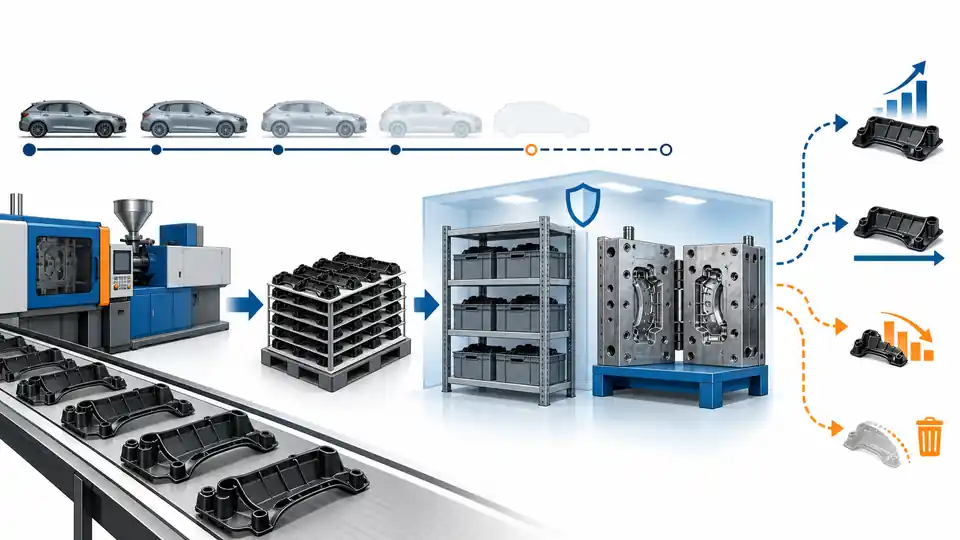
A last-time buy can avoid future tooling and setup cost, yet too much inventory may age, distort, become obsolete after a revision, or outlive usable packaging and labels. Too little can leave service obligations dependent on a dormant mold whose condition and supply chain are unknown.
Forecast service demand as a range, define the supply horizon and responsibility, then compare a final batch with controlled intermittent production, tool transfer, remanufacture or an approved alternative process. Include resin and component availability, tool condition, validation, packaging, storage, inspection and obsolescence before authorizing quantity.
Define the end-of-series event and obligations
Vehicle production end, supplier contract end, tool retirement and service supply end may occur on different dates.
List the formal milestones, required service horizon, responsible parties, ownership and location of tools/data, notice periods and customer-specific approval requirements. Obtain commercial or legal review where obligations are uncertain.
Do not copy a universal “ten-year” rule. Toyota’s public FAQ itself notes that supply duration is not uniform and varies by part. The controlling source is the applicable customer contract, service-parts manual and jurisdiction. Identify whether prices, minimum batches, packaging and PPAP status change for service. Clarify whether the supplier must retain tooling, records, gauges and master samples and who pays maintenance. A last-time buy decision should not silently terminate an obligation held elsewhere.
Build the review around customer agreement and service manual, program milestones, tool/data ownership and notice/retention responsibilities. Keep the part number, drawing revision, material condition, lot or cavity identity, equipment state and observation method beside the result. The decision is whether the team knows what supply obligation ends, when, and who controls the remaining assets. A result from a different geometry, resin grade, production cell or conditioning state can be useful background, but it is not automatically transferable. Record the mismatch and decide whether a controlled comparison is required. Extending support preserves availability but carries maintenance and administrative cost; ending too early can create service and contractual exposure. Set a named owner and an evidence-based closure condition before the next irreversible commitment.
Build a service-demand range
Series run rate is a poor predictor of service demand, which depends on vehicles in use, failure, repair, geography and supersession.
Develop low, expected and high demand by period using installed population, historical service consumption, failure/accident pattern, warranty horizon, superseding parts and planned attrition. Record uncertainty.
Worked demand model — illustrative, assumptions stated
Assumptions (replace with the program’s own data — every number below is an assumed value for method demonstration only, not AutoMoldingPro data): 120,000 vehicles in service; annual replacement rate low 1.0% / expected 1.5% / high 2.2%; service horizon 5 years; usable stock on hand 800 parts. Demand is modelled flat across the 5 years — if the vehicle population declines, re-run the model year by year instead.
| Low | Expected | High | |
|---|---|---|---|
| Annual replacement rate | 1.0% | 1.5% | 2.2% |
| Annual demand (120,000 vehicles) | 1,200 | 1,800 | 2,640 |
| 5-year demand | 6,000 | 9,000 | 13,200 |
| Less usable stock on hand (800) | 5,200 | 8,200 | 12,400 |
| Last-time-buy quantity | 5,200 | 8,200 | 12,400 |
Arithmetic, shown so the buyer can re-run it: 120,000 × 1.0% = 1,200; 120,000 × 1.5% = 1,800; 120,000 × 2.2% = 2,640; 1,200 × 5 = 6,000; 1,800 × 5 = 9,000; 2,640 × 5 = 13,200; 6,000 − 800 = 5,200; 9,000 − 800 = 8,200; 13,200 − 800 = 12,400.
Decision rule: buy the expected quantity (8,200) only if a second campaign run remains possible. If this is the only run, cover the high case (12,400) or accept the shortage risk in writing — do not split the difference silently and call it a plan.
Separate demand by variant (left/right, color, regional label) and net off usable stock and outstanding orders. How forecast, firm release and safety stock are separated — and what each signal authorizes — is covered in the forecast and release-order guide: Automotive Forecast, Release Orders and Safety Stock. This article uses only the demand range that guide produces.
The working record should contain vehicle/service population, consumption history, variant mix, current usable stock, supersession and time-phased scenarios rather than a conclusion copied into email. Review the source, revision, units, sample selection and boundary conditions, then test whether the quantity decision reflects a documented demand range rather than one lifetime guess. Preserve failed or marginal observations as well as passing ones; otherwise the team cannot see where the recommendation stops being reliable. High coverage reduces shortage risk but increases cash, storage and obsolescence; low coverage preserves flexibility while depending on future production capability. Translate the accepted condition into the drawing, purchase specification, setup sheet, inspection instruction or change record that production will actually use.
Assess whether stored plastic parts remain usable
Finished parts can age through moisture, heat, UV, stress relaxation, dust, corrosion of inserts or packaging deformation.
Define storage environment, orientation, stack load, packaging life, inspection interval, FIFO and requalification based on material and product risks. Test aged stock where evidence is needed.
Clips held under deformation can relax. Polyamide dimensions can change with moisture. Elastomers and adhesives may age differently from rigid resin. Cosmetic parts can scuff or fade through unsuitable packaging. Metal inserts may corrode. Do not assign a shelf life without material/customer evidence, but do not assume molded parts are indefinite. Use protective dunnage and labels that remain readable. Inspect retained stock at defined intervals and record sample selection, dimensions, appearance and function tied to the service requirement.
Ask the supplier to connect material/assembly aging risks, storage specification, packaging validation, inspection plan and requalification criteria to the proposed part and production state. The evidence is sufficient only when the proposed final inventory can remain identifiable and functional over its planned storage horizon. If inspection cannot observe the mechanism directly, identify the proxy being used and how it was correlated. Do not average incompatible results or hide a trend by pooling cavities, lots, left/right versions or process stages. More protective packaging and controlled storage reduce aging risk but increase cost and space; future small runs shift risk back to tooling and supply. Define what change would invalidate the conclusion and route that trigger through normal change control.
Evaluate the mold, material and secondary supply chain
A stored mold does not guarantee future parts if steel corrodes, hot-runner spares disappear, resin is obsolete or fixtures are lost.
Audit tool condition and preservation, spare/wear items, controller and machine compatibility, resin/color availability, inserts, labels, packaging, gauges, programs and approved suppliers. Price restoration scenarios.
Preserve the tool, gauges and technical package as a restartable asset — shutdown condition, preservation, location, inspections and the evidence required before production restarts are specified in the mold-storage guide: Automotive Mold Storage and Maintenance Between Runs. Ask material suppliers about current grade status and change notification without claiming future availability. If a custom insert or decoration supplier is ending production, its last-time buy may govern the whole part. A transfer option requires destination compatibility and revalidation. What a restart after a long gap actually requires — records, revalidation and reactivation evidence — is covered in the restart guide: Restarting an Automotive Molding Program After a Long Production Gap. Keep estimates separate from committed quotations.
Use tool audit, preservation and spares, complete technical package, supplier status and restoration/transfer quotations to challenge the preferred option. Confirm who produced the record, what population it represents, and whether the current acceptance method could miss the relevant failure. The release test is whether future production remains a credible option or is removed from the strategy with its limitations visible. Maintaining the full chain costs money, but buying all finished stock transfers every future uncertainty into inventory aging and forecast error. Where evidence remains incomplete, authorize only bounded work at risk, with a quantity or activity limit, responsible owner and follow-up record. Commercial urgency does not turn an assumption into product approval.
Compare final batch and alternative supply strategies
The decision is rarely only “buy now or never”; combinations can balance inventory and restart risk.
Compare final finished-part build, periodic campaign runs, raw-material/component bank, mold transfer, duplicate/soft tool or approved alternative manufacturing by cost, capacity, evidence and approval.
A final batch may use the validated series process and avoids future setup, but creates maximum stock exposure. Campaign runs keep inventory lower but require startup, minimum quantity and service PPAP controls. Tool transfer may preserve molding but changes site and equipment. An alternative process may suit very low volume yet change material, geometry or surface and needs customer approval. AIAG’s Service PPAP overview confirms that service production has defined PPAP considerations; the customer determines the actual submission. Service PPAP (SVPPAP-1, 1st edition) is a supplement to PPAP 4th edition that identifies PPAP requirements for all service parts: AIAG Service PPAP (SVPPAP-1) (AIAG storefront page; a pre-order notice is currently shown).
Before closing this point, reconcile strategy comparison with fixed/variable cost, lead time, minimum batch, capacity, validation and inventory risk with the controlled product definition. The reviewer should be able to show that the selected combination meets service availability with explicit cost and approval assumptions. Check at least one credible boundary condition when the mechanism is sensitive to temperature, time, load, moisture, orientation or machine response. Hybrid strategies reduce reliance on one forecast but add governance, repeated setup and potentially multiple qualified routes. Keep superseded data and mark the cut-in point of any correction so later complaints or deviations can be contained to the right population.
Release quantity, preserve records and monitor triggers
A large final order without change triggers can be wrong before production finishes if demand or supersession changes.
Approve quantity and strategy with assumptions, owners and review dates; link production release to inventory, packaging and validation checks. Preserve records and define triggers for reforecast, requalification or alternate supply.
Before molding, confirm the final drawing, material, cavities, process, service packaging and label. Sample across the run and identify lots. Reconcile accepted quantity with service demand scenarios. Store tool and gauges according to the chosen future strategy and retain setup, maintenance and quality records. Monitor consumption, stock condition, vehicle population and superseding design. If demand deviates materially, update the plan rather than hiding shortage or excess. Define final disposition of obsolete parts and customer-owned assets.
Release from this stage should cite authorized quantity and assumptions, production/inspection record, inventory ledger, preserved technical package and trigger review and explain why the last-time plan remains traceable and can respond before shortage, aging or obsolescence becomes irreversible. A polished report is not enough if it omits original readings, specimen state, cavity identity, units or the applicable requirement. Frequent review adds planning work, while a static lifetime buy can lock in the largest possible forecast error. Close the loop by defining the ongoing check, reaction threshold and escalation route. The purpose is not extra paperwork; it is to keep the validated condition recognizable when production, demand or supply circumstances change.
Last-time-buy decision worksheet
Evaluate quantity and supply route together; one cannot be approved safely without the other.
| Review line | Input or evidence | Decision or action |
|---|---|---|
| Obligation | Service horizon, customer rules, ownership and notice | Define responsibility |
| Demand | Low/expected/high by period, variants and stock | Set coverage range |
| Stock life | Material, packaging, storage and reinspection | Validate inventory horizon |
| Future capability | Tool, resin, inserts, gauges, data and suppliers | Assess restart route |
| Alternatives | Final build, campaigns, transfer or approved new route | Compare cost/risk |
| Control | Lot release, inventory tracking and review triggers | Maintain plan |
Keep currencies, quantities, dates and commercial assumptions explicit. Seek legal or contractual advice for obligations rather than treating this engineering-planning framework as a precedence opinion.
Applying the method to a defined situation
A trim clip program approaches series end with uncertain ten-year service demand. The current tool is healthy, but its custom color concentrate will be discontinued. The team models demand by year and current inventory, validates storage and periodic clip-force checks, and compares one final colored-resin campaign with preserving the mold for an approved black service variant. Customer approval, material last order, tool preservation and service PPAP scope are aligned before the final batch. Consumption and stock condition are reviewed annually against trigger points.
The conclusion in this situation depends on the stated inputs. Change the material, geometry, load, equipment, quantity, environment or customer requirement and the review must be reopened at the affected line. The value of the exercise is the visible path from input to decision, not the use of a convenient universal number.
Turn the worked review into a short decision record before the team acts. Identify the exact part family and revision, the decision owner, the supplier input date and the next commitment that would become expensive to reverse. Under “Define the end-of-series event and obligations,” record the starting condition and the evidence that is already controlled. Under “Evaluate the mold, material and secondary supply chain,” identify the most credible alternative and the consequence of accepting it. Under “Release quantity, preserve records and monitor triggers,” state the release condition and the event that would reopen the decision. The first review lines to complete are Obligation, Demand, Stock life. Do not mark a line closed merely because a document was received; record whether its revision, sample population, units and boundary conditions match the program being discussed.
Questions for the supplier review
- Which contract and customer service requirement controls the horizon?
- What low, expected and high demand exists by variant and year?
- How will stored parts and packaging age and be reinspected?
- Can the tool, resin, inserts, gauges and data support future runs?
- Which alternative supply routes are technically and commercially approved?
- What trigger changes quantity, requalification or tool disposition?
A useful response identifies the controlled source, explains assumptions and exceptions, and names the record that will close the issue. Ask for original evidence where the decision is material; a yes/no answer without part, process and revision context is not enough for tooling or production release.
Information to submit for a project-specific review
Provide service obligation documents, series-end dates, consumption and vehicle-population data, inventory by revision, material/BOM status, tool and gauge records, packaging/storage requirements, supplier notices and approval scope. Use the AutoMoldingPro request form to keep the current drawing, STEP file, material requirement, annual volume, order pattern and validation scope tied to one inquiry. Mark unresolved points as assumptions so they can be priced and closed before tooling or production commitment.
Conclusion
Plan last-time buys as a lifecycle supply decision, not a multiplication of annual demand. Demand uncertainty, stock aging, tooling and supplier continuity, validation and customer authority determine the defensible quantity and route.
References
- AIAG Service PPAP overview
- Toyota parts availability FAQ
- AIAG Automotive Warranty Management Key Terms (CQI-14 appendix) — key-terms guide download (gated: form fill required).
- AutoMoldingPro forecast and release-order guide