
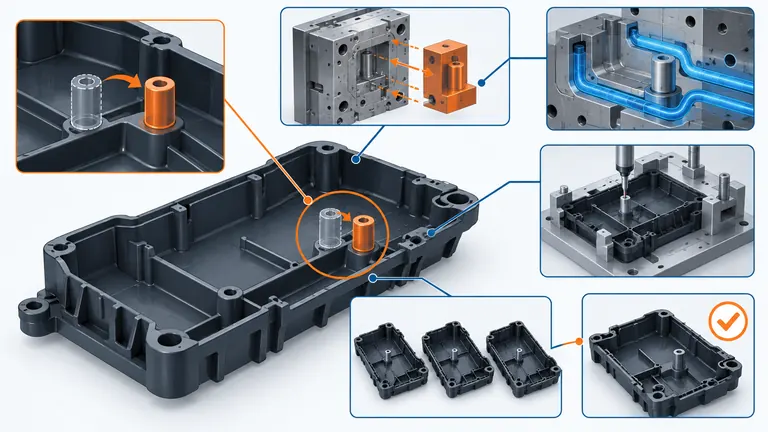
An apparently small CAD change can require one insert adjustment, or it can affect shutoffs, cooling, texture, gauges, process settings, and approved assembly performance. Quoting change cost from the volume of plastic added or removed is therefore unreliable. The team first needs a controlled technical impact review.
Price and timing should be built from the authorized design delta, affected mold and production systems, reversible versus irreversible steel work, trial and inspection evidence, and customer requalification requirements. Separate correction of a supplier nonconformance, customer-requested design change, normal wear restoration, and optional process improvement. Each has a different cause and commercial treatment.
Freeze the change definition before estimating work
The supplier cannot quote a stable scope if the input is a screenshot, a verbal request, or a CAD file without a controlled baseline. Begin with a change package that identifies exactly what is different and why.
Record the old and proposed CAD/drawing revisions, change notice number, affected part numbers, reason, requested timing, approving authority, and disposition of old inventory and work in process. Provide a visual delta and a feature list tied to dimensions or surfaces. Mark interfaces with mating parts, appearance zones, sealing paths, clips, datums, and test-sensitive features. If multiple tools, cavities, gauges, or assembly stations are affected, list each asset.
Classify the event before assigning cost. A customer design change intentionally changes approved product definition. A supplier correction restores the tool or process to the existing requirement. Wear restoration returns deteriorated tooling toward its approved condition. An improvement changes the method to reduce risk, cycle, scrap, or maintenance. These categories can overlap, but the quotation should show them rather than using a single “mold modification” line.
Use one assumptions and exclusions register. Examples include the CAD revision used for machining, whether texture matching is included, whether mating components will be supplied, which resin and color will be trialed, whether a gauge can be modified, and what customer submission level applies. An assumption should have an owner and closure date. If it materially affects steel work, keep the quotation conditional until closed.
AIAG’s current APQP resources explicitly identify change management and gated management as areas of the third-edition approach (AIAG APQP and Control Plan). The customer’s own requirements and change-approval process remain controlling. Do not interpret a generic change form as authorization to cut steel.
Trace the product delta into the mold architecture
Cost follows the affected systems, access, and recovery direction. Review the change in the context of the parting line, cavity/core split, actions, inserts, cooling, runner and gate, venting, ejection, texture, sensors, and mold strength.
Determine whether the plastic feature becomes larger or smaller and which steel surface creates it. Adding plastic often requires removing steel; removing plastic often requires adding steel by replacing an insert, welding, plating, or another approved method. The practical route depends on access, steel grade, heat treatment, coating, texture, required finish, local stress, and dimensional risk. “Steel-safe” should be verified feature by feature rather than assumed from the original DFM.
Check whether machining can occur in an accessible insert or requires disassembly and work in the main cavity/core. Replacing a removable insert may have higher material cost but lower risk and future service benefit. Welding can introduce hardness, distortion, polishing, texture, and requalification concerns; the toolmaker should identify the approved welding procedure and resulting inspection. If a cosmetic surface is affected, matching an existing grain or gloss can govern both timing and acceptance.
Follow the change outward. A boss move may affect cooling and ejector placement. A wall increase can change filling, packing, sink, cycle, and dimensional stability. A gate relocation can change weld-line position, orientation, vestige, and process window. A clip change may affect slides, lifters, ejection, assembly force, and durability. An added datum can require a fixture and measurement-program update.
Request an annotated mold-impact drawing and a before/after component list. The supplier should identify parts to machine, replace, purchase, weld, coat, texture, or inspect; estimated shop hours; outsourced operations; assembly and spotting; and risks that could expand scope. This evidence supports the quotation far better than a lump-sum response.
Price all work needed to return to an approved state
Machining is only one cost layer. A complete change quotation should include engineering, tool work, purchased components, trials, material, inspection, validation, documentation, logistics, and production interruption where applicable.
| Cost driver | Questions to close | Evidence |
|---|---|---|
| Engineering | Which revisions, analyses and drawings change? | Controlled delta and impact review |
| Tool work | Which components are machined, replaced, welded or textured? | Annotated tool design and work scope |
| Purchased systems | Are hot-runner, sensor, connector or standard parts affected? | Supplier part numbers and quotations |
| Trial | How many setups, resins, colors, cavities and iterations? | Trial plan and acceptance criteria |
| Inspection | Which dimensions, surfaces, assemblies and gauges change? | Measurement and gauge-change plan |
| Requalification | What customer submission or testing is required? | Authorized requirement matrix |
| Production impact | Is inventory or downtime needed during modification? | Schedule and buffer calculation |
| Documentation | Which FMEA, control plan, work instructions and records change? | Document-change list |
Illustrative example—hypothetical, not an AutoMoldingPro project. A mounting boss moves 3 mm on an approved housing. The affected boss is formed by a removable core insert, but its new position intersects a cooling passage and changes the inspection fixture. The quotation therefore includes design review, a new insert, cooling modification and leak test, mold disassembly/reassembly, trial material and machine time, dimensional layout, fixture modification, assembly confirmation, and controlled-document updates. The “3 mm” alone does not predict cost.
If the old and new parts must overlap during phase-in, include tool downtime, safety stock, segregated inventory, labeling, and effective-point control. If an old revision must remain available for service, decide whether reversible inserts, a duplicate tool, or a final buy is needed. These are program decisions, not hidden tool-shop charges.
Separate fixed change cost from any recurring price effect. A heavier part changes resin use. A longer cycle, added secondary operation, tighter inspection, or different packaging can change unit price. Conversely, a tool change intended to reduce cycle or scrap should not promise savings until the production result is demonstrated under agreed conditions.
Define requalification from affected risks
Not every change requires the same submission, and a successful mold trial is not sufficient evidence for every affected requirement. Build the verification plan from the product and process delta plus customer-specific rules.
Start with dimensional impact: changed features, related datums, tolerance stack, cavity-to-cavity effect, and gauge suitability. Then review material and process, appearance, assembly, functional performance, packaging, and traceability. Ask which previous evidence remains valid and why. A local insert change may still alter filling or cooling beyond the edited surface.
Update risk and control documents where the change affects failure modes, prevention, detection, reaction plan, or process settings. The AIAG quality core tools describe the linked roles of APQP, Control Plan, PPAP, FMEA, SPC, and MSA. The project should apply its customer-mandated versions and submission rules; this article cannot assign a universal PPAP level.
Create a release matrix with columns for requirement, affected/not affected rationale, evidence, sample source, cavity, responsible person, acceptance authority, and status. Include the mold-change completion inspection itself: component material and hardness where relevant, dimensions, cooling or hydraulic leak checks, electrical tests, action sequence, and safety review.
Plan iteration honestly. If the result depends on trial behavior, quote a defined first iteration and a method for approving additional work. Avoid both extremes: unlimited “all corrections included” language that hides assumptions, and a low initial quote that excludes any usable sample. State what constitutes completion of the quoted stage.
Control implementation, rollback, and phase-in
The approved change needs a schedule that protects current supply and prevents revision mixing. Work backward from the required effective point.
Confirm inventory by revision, open orders, work in process, material availability, customer line requirements, transport time, modification duration, trial capacity, inspection, and approval lead time. Calculate a buffer for the named interruption and uncertainty rather than selecting an arbitrary number of weeks. Identify the last old-revision shipment and first new-revision shipment using labels and traceability fields the customer recognizes.
Before machining, save the approved baseline: CAD, drawings, tool design, photographs, measurements, process record, samples, FMEA/control plan, gauge status, and commercial authorization. If rollback is technically possible, identify the components and data required. Do not assume welding or steel removal can be reversed.
After the change, record actual components and operations, deviations from the plan, inspection results, trial conditions, sample disposition, approvals, document revisions, and remaining open items. Update the asset history and spare list. If the change creates obsolete inserts or fixtures, label and retain or dispose of them under the authorized process.
For a change quotation, provide the controlled old/new data, change notice, mating interfaces, affected requirements, tool records, production schedule, inventory position, customer requalification rules, and acceptance authority. Ask the supplier to return technical impact, cost layers, schedule, assumptions, risks, trial plan, and completion evidence. That turns an uncertain “small change” into a controlled engineering and supply decision.
Conclusion
Estimate automotive mold changes from the controlled design delta and all systems needed to regain approval. Separate cause, tool work, recurring price effects, verification, and production interruption. Release work only after assumptions, customer approval path, phase-in, and completion evidence are explicit.