
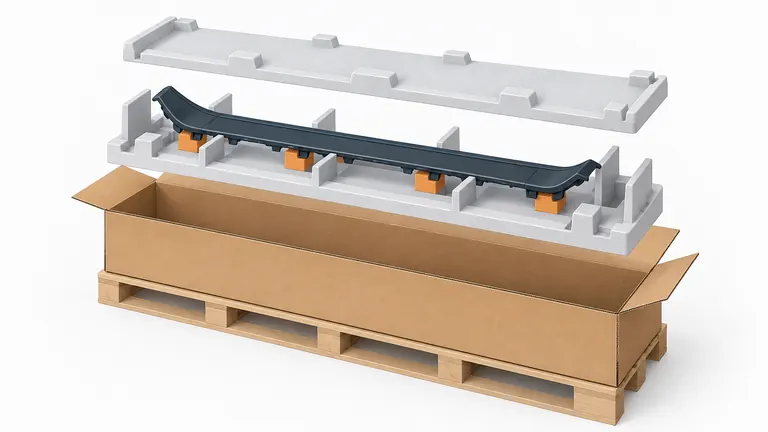
Conceptual illustration; not to scale.
A molded part can leave inspection within tolerance and arrive scratched, bowed, contaminated, mixed by lot, or loaded in the wrong orientation. Export packaging has to protect the specific product through stacking, vibration, handling, temperature and humidity—not merely fill a carton at the lowest cost.
Design the pack from part risks and the actual distribution route. Define contact and support zones, orientation, quantity, dunnage, cleanliness, labels, palletization, environmental protection, handling and acceptance. Validate the packaged product against representative hazards and customer requirements, then control packaging revisions like other production specifications.
Convert part risks into packaging functions
Start with the drawing, appearance standard, approved sample, material behavior, and receiving process. Mark Class A or visible surfaces, sealing lands, clips, pins, long unsupported spans, soft overmolded areas, texture, painted or decorated surfaces, electrical interfaces, and cleanliness-sensitive zones. Identify how the part can be damaged: abrasion, point loading, nesting lock, clip deflection, creep, contamination, moisture, UV, impact, compression, or mixed orientation.
Create one packaging requirement for each risk. A visible surface may need no part-to-part contact. A long trim piece may need support at defined locations to limit distortion. A clip may require clearance rather than foam pressure. A connector housing may need caps, cleanliness, or ESD controls defined by the customer. A left/right set may need poka-yoke pockets and clear labels. Do not select a tray, bag, foam, or carton before those functions are known.
Material condition matters. A hot part packed too early can deform. A conditioned hygroscopic part may change in storage. Painted or printed surfaces may need cure time and compatible interleaves. A returnable tray can accumulate dirt or wear. Define cooling or stabilization before packing, bag or barrier needs, allowable contact materials, maximum stack time, storage conditions, and cleaning/inspection of reusable packaging.
The packaging unit also needs to fit production and receiving. State pieces per pocket, tray, container, carton, pallet, and shipment; gross weights; manual-lift limits; forklift or pallet-jack access; stacking; and line-side presentation. AIAG’s packaging and labeling resources emphasize container, pallet, identification, tracking, and delivered-quality needs in automotive supply chains. Customer standards still govern the actual pack.
Design support, separation, and containment together
Support parts on robust, non-critical geometry. Three well-chosen support regions can be better than broad pressure on a flexible cosmetic surface, but the correct scheme depends on stiffness and orientation. Check the part at its hot-to-ambient transition, after storage, and under the maximum stack load. Do not assume a dimensionally stable-looking part is immune to long-term deformation.
Separate surfaces that can rub during vibration. Options include individual thermoformed pockets, partitions, sleeves, interleaves, caps, or controlled nesting. Each has trade-offs. Custom trays improve orientation and contact control but add tooling, storage, return logistics, and cleaning. Corrugated partitions are flexible and lower in capital but can shed fibers, absorb moisture, or collapse if poorly designed. Bags can control contamination yet may not prevent parts from striking each other. Foam may protect impact-sensitive areas but can mark textures, trap debris, or conflict with recycling requirements.
Containment prevents parts from escaping pockets or shifting as a layer. Use lids, top pads, straps, stretch wrap, or closed cartons based on the handling route. Restraint should not preload clips or distort long parts. Check the lowest layer under stack compression and the top layer under vibration. If an export pallet is double-stacked, include that condition only when the logistics plan permits it.
Avoid false cube optimization. Increasing parts per carton can reduce freight per piece but raise surface contact, compression, operator reach, and receiving damage. Compare total delivered cost, including packaging, transport cube, handling, damage, sorting, return freight, cleaning, and obsolescence. A reusable system can be attractive on a stable closed loop; expendable export packaging may be practical where returns are uncertain. Neither is universally best.
Define identification and traceability at every level
Packaging must preserve the production trace the customer needs. Define labels for part number, revision, quantity, supplier, lot or batch, production date, cavity or shift where required, purchase order or release, destination, and handling marks. State barcode or data format, label size and placement, and whether the receiving system requires an advance shipping notice. Do not add serial or cavity detail that the process cannot reliably maintain.
Prevent mixed parts and mixed revisions. Use line clearance, pack verification, controlled label printing, scan checks, and physical separation. If left/right or color variants share a line, build a verification step before the carton closes. If partial containers are permitted, define labeling and fill material so the receiving count remains clear. A correct outer label cannot compensate for mixed internal parts.
Trace returnable packaging as well. Identify container ownership, unique IDs where used, cleaning and inspection status, repair criteria, maximum wear, return quantity, and responsibility for loss. Worn pockets can allow movement that was not present during initial validation. Treat dunnage changes as controlled changes and determine whether revalidation is needed.
Volvo’s public delivery manual provides an example of customer-controlled packaging instructions with specified outer and inner packaging, quantities, stacking actions, straps, and labels. It should not be copied into another program. It demonstrates why the approved packaging instruction needs exact part, container, quantity, layer, and handling information.
Validate against the actual distribution route
Map the route from pack station to receiving line: internal conveyor or forklift, warehouse stacking, truck, port handling, ocean or air freight, customs inspection, distribution center, local transport, storage, and line-side handling. Record durations, orientations, pallet stacking, temperature and humidity range, vibration, shock, compression, and opportunities for repacking. The test plan should represent credible hazards rather than apply a standard name without a route.
ISTA explains that its procedures range from screening tests to general and enhanced simulations, and that selecting the correct procedure requires knowledge of the distribution environment. ASTM D4169 provides a uniform laboratory basis for evaluating shipping units through sequences of anticipated hazards, while noting that it does not replace material specifications or existing preshipment procedures. These frameworks help design a test; the buyer still selects levels, sequence, samples, conditioning, and acceptance criteria appropriate to the product and customer.
Define pre-test and post-test inspection. Record part dimensions and appearance at the specified conditioning state, pack configuration, pallet build, closure, and label. After testing, inspect packaging damage, part movement, abrasion, clip or feature damage, contamination, dimensional change, label readability, and receiving usability. Use the same functional datums and appearance criteria applied to production acceptance.
Include route-specific checks that a generic test may miss: prolonged stacking, high humidity, container condensation, customs opening and resealing, forklift tine exposure, or returnable-container contamination. Field feedback remains important. ISTA advises understanding actual distribution and considering retesting when the product, package, materials, closure method, or route changes.
Packaging approval checklist
| Decision | Evidence to approve |
|---|---|
| Part risks are defined | Marked appearance, contact, support, cleanliness and fragile-feature map |
| Pack configuration is controlled | Drawings/photos, material, pocket, quantity, layers, closure and pallet pattern |
| Production use is feasible | Cooling/stabilization, packing work instruction, ergonomics and line clearance |
| Identification works | Approved labels, scan test, lot/revision controls and partial-pack rule |
| Route hazards are addressed | Distribution map and selected conditioning/test sequence |
| Acceptance is measurable | Pre/post dimensions, appearance, function, package and label criteria |
| Changes are controlled | Revision, supplier, dunnage wear, cleaning, repair and revalidation triggers |
Run a short pack-line trial before approving the drawing. Operators should pack and unpack the planned quantity using production gloves, labels, scanners, closures, and handling equipment. Record pack time, reach and lift concerns, incorrect-orientation opportunities, part removal force, damage to clips or surfaces, and whether the receiving sequence can present parts without extra sorting. Verify the gross weight and actual pallet height rather than relying only on calculated values. Photograph the approved layer pattern and closure details as controlled visual aids, while keeping dimensions, materials, and acceptance requirements in the written specification. This trial often finds usability failures that a transport test alone cannot reveal.
Illustrative example: a long textured interior trim part passes final inspection but is bulk-nested for export. Vibration rubs the visible surface and the bottom layer bows under stack load. A revised pack uses supports on hidden structural ribs, separators at non-cosmetic zones, limited stack height, and controlled orientation. The validation checks appearance and the mounting datum after the planned route sequence. This is a hypothetical method; support positions and test levels must come from the actual part and logistics route.
This article concerns production plastic parts, not shipment of an injection mold. Tool preservation, spares, crate loading, and destination acceptance are covered in the export mold acceptance checklist. For a molded-part quotation, provide the part model, appearance/contact map, pack quantity, destination, route, pallet constraints, labels, and customer packaging specification through the RFQ page.