Why the Same Injection Molding Settings Produce Different Parts on Another Press
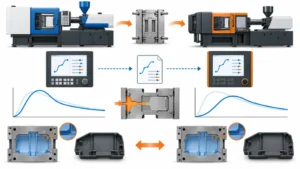
Transfer an automotive molding process by matching machine capability and actual melt, fill, pressure, thermal and cooling response—not copied settings.

Transfer an automotive molding process by matching machine capability and actual melt, fill, pressure, thermal and cooling response—not copied settings.
Investigate brittle molded parts through baseline comparison, material identity, moisture, thermal/shear history, geometry, welds and conditioned tests.

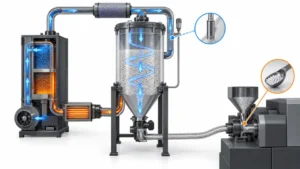
Control resin drying with grade-specific temperature, time, dew point, airflow, hopper loading, moisture measurement and traceability.

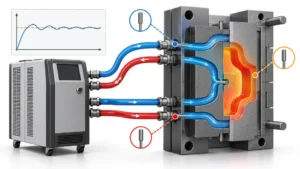
Compare temperature-unit setpoints with actual coolant and cavity-surface conditions using mapped measurements, stabilized cycles and reaction limits.

Review thick-to-thin transitions, local masses, flow, sink, voids, warpage, cooling and inspection before releasing an automotive housing mold.

Read HDT, glass transition and continuous-use temperature by test condition, time, load and exact resin grade before selecting an automotive plastic.

Compare automotive clip materials using actual strain, sustained load, cycles, temperature, moisture, orientation and finished-part validation.

Define exterior exposure, exact material and color, weathering method, appearance metrics and change controls instead of relying on a generic UV claim.

Choose slides, lifters, pass-through cores or clip redesign by release direction, stroke, wear, cooling, appearance and validation risk.

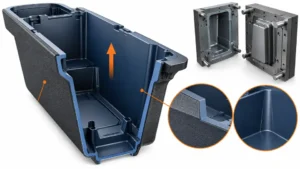
Review draw direction, wall depth, grain, draft, ejection and appearance zones before releasing a deep automotive console housing mold.
Join our mailing list and receive a 10% discount on your next mold or CNC project.
Send your drawings and detailed requirements via:
Email: jerry@ckmold.com
Or fill out the contact form below:
We will contact you within one working day. Please pay attention to the email with the suffix “@ckmold.com”