
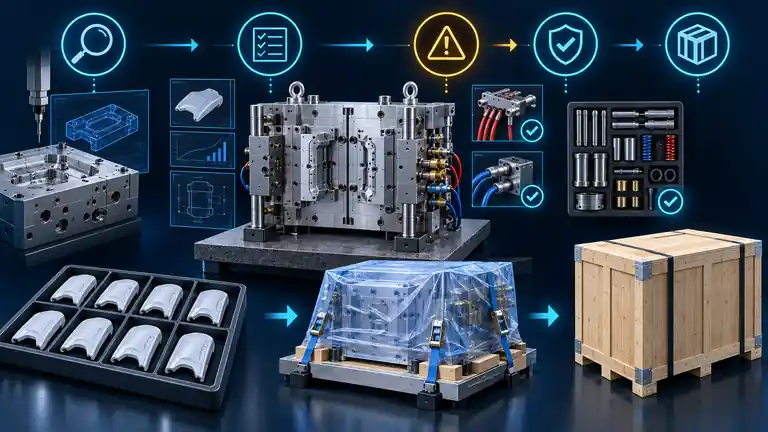
Conceptual illustration; not to scale.
Good samples do not prove that an export mold is ready to ship. The tool may still have an undocumented correction, leaking circuit, wiring mismatch, incomplete spares, unsuitable preservation, or an unresolved destination-machine interface. Once the crate leaves, every omission becomes slower and harder to investigate.
Release shipment only after the agreed product evidence, process trial, as-built tool condition, machine and utility interfaces, documentation, spare parts, preservation, packing, and commercial handover have passed defined gates. Record open items and formal concessions; do not use shipment as the deadline that converts incomplete work into acceptance. Final production approval may still require receiving-plant trials and customer submission.
Define acceptance levels and authority before the final trial
Export projects often confuse sample approval, mold acceptance, shipping release, receiving acceptance, and production release. Define them as separate decisions with named approvers and evidence.
Sample approval answers whether submitted parts meet the specified review scope under recorded conditions. Tool acceptance answers whether the built asset conforms to the approved design, function, condition, documentation, and agreed workmanship. Shipping release confirms the tool is complete, preserved, packed, insured, and authorized to leave. Receiving acceptance verifies delivery condition, installation interfaces, utilities, controls, and local trial. Production release follows the customer and quality requirements applicable to the production source.
Create an acceptance plan at purchase order or design approval, not after T1. List required trial stages, material and machine, sample quantities, cavity identity, process record, dimensional and functional requirements, appearance, cycle or rate evidence, correction loops, as-built documentation, spares, training, and witness or remote-review arrangements. Reference the controlling product and tool revisions.
Name who can approve, conditionally approve, reject, and accept a deviation for each gate. State whether signatures, electronic approval, customer submission, or third-party checks are required. If travel or remote access changes, define equivalent evidence rather than silently reducing scope.
Set the evidence retention location and file-naming rule at the same time. Acceptance is weakened when trial data, videos, reports, and approvals cannot later be connected to the exact mold and revision.
Verify part and process evidence from a production-intent trial
The source trial should use the intended resin, color/additives, cavity configuration, hot runner, auxiliaries, and a machine that can represent the agreed process. Any departure needs to be recorded with its effect on what the trial proves.
Stabilize the mold and process under a documented rule before collecting formal samples, while retaining startup evidence when it matters. Record machine identity and screw, material producer/grade/lot, drying and handling, regrind rule, mold and controller identity, active cavities, cycle, fill time, transfer, cushion, peak pressure, hold, recovery, melt and mold temperatures, cooling flow/temperature, part and runner weight, alarms, rejects, and actual trial duration.
Keep samples traceable by cavity and time block. Complete the agreed dimensional layout, material or performance tests, appearance review, assembly or fit evaluation, and packaging trial. Use released requirements and approved methods. A visually good part cannot close an unmeasured critical interface; a dimensional report cannot substitute for a specified functional test.
Review process robustness, not only one optimized point. Confirm cavity balance, venting, ejection, part sticking, gate behavior, cooling balance, hot-runner zones, repeatability, and sensitivity to expected operating conditions. If a run-at-rate or capacity demonstration is required, define it separately and record interruptions and quality disposition.
List every characteristic or test not completed at the source and identify where, when, and by whom it will be closed. Its absence must remain visible in the shipping decision.
Inspect the as-built mold and every moving system
Acceptance should compare the physical mold with the approved tool design and correction history. Cleanliness and polished appearance are not substitutes for dimensional, material, assembly, and functional checks.
Verify mold identification, overall dimensions, mass, closed height, locating ring, clamp slots, lifting points, center-of-gravity information where required, and fixed/moving-half orientation. Review mold base and plate alignment, support pillars, guide components, parting line, shutoffs, forming inserts, vents, gates, slides, lifters, ejectors, return system, wear plates, springs, limiters, and mechanical locks. Confirm fasteners, retaining methods, lubrication points, service access, and required safety markings.
Check critical steel and components against agreed materials, hardness or treatment records, and supplier certificates where required. Record every weld, insert change, engraving change, blocked cavity, correction, or approved deviation in the as-built file. Use appropriate inspection or nondestructive examination for identified risks; do not claim hidden condition from appearance alone.
Dry-cycle all movement through the intended sequence. Verify full travel, clearances, positive return, sensor response, hydraulic core lock, ejection, unscrewing or collapsible mechanisms, and manual service operations. Confirm that failure states do not create obvious collision paths. Apply machine and plant safety requirements at the receiving cell; a source dry cycle does not replace destination risk assessment.
Test cooling, hot runner, electrical, hydraulic, and pneumatic interfaces
Utilities must be accepted as systems with maps, ratings, connections, and test results. A hose connected during one trial does not document how the receiving plant should reproduce it.
Flow and leak-test every cooling circuit using a safe, documented method. Record circuit identifier, inlet/outlet, medium, test pressure, flow or restriction result, leak status, fitting standard, and the component served. Check baffles, bubblers, seals, manifolds, moving hoses, corrosion, drain-down, and inaccessible connections. Label the mold consistently with the drawing.
For hot runners, confirm supplier/model, zone map, heater resistance or current where appropriate, thermocouple type and polarity, insulation and ground checks, connectors and pinout, controller voltage/capacity, valve-gate actuation, alarms, and spare components. Follow the installed system’s supplier manual. Record the stable trial settings as a starting reference rather than a universal process guarantee.
For hydraulics and pneumatics, record cylinders, valves, pressure/flow needs, hose and fitting standard, sequence, sensors, locking, leakage and safe depressurization. For mold sensors and I/O, verify voltage, signal type, normal state, connector, cable identification, interlocks and robot permissives.
Compare every interface with the signed destination-machine matrix. The export mold machine compatibility guide covers tie bars, platen, nozzle, ejector, utilities, controls, automation and loading in detail.
Retain measured values and test conditions, not only pass marks. They provide the receiver with a baseline if a zone, circuit, sensor, or actuator behaves differently after transport.
Close the documentation and spare-parts package
A transferable mold needs records that match the as-built condition. A drawing set from design release is incomplete if corrections were made during trials.
Require an indexed package with native and neutral 3D data as agreed, 2D assembly and component drawings, bill of materials, material and heat-treatment records, standard-component sources, hot-runner manuals, cooling and utility diagrams, electrical pinout, hydraulic/pneumatic circuit, sensor and I/O list, maintenance and lubrication plan, disassembly instructions where needed, trial and process records, dimensional reports, correction history, approved deviations, and acceptance signatures.
Open representative files before shipment. Confirm they are readable, complete, correctly revised, and free of links to unavailable local folders. Verify units, language, file naming, cavity numbering, and agreement between drawings and physical labels. Protect customer-confidential information during transfer and provide only authorized data.
Inspect and inventory spare parts. Tie each item to a part number, drawing, quantity, material or treatment, and intended location. Typical project-specific spares may include heaters, thermocouples, seals, springs, ejector pins, wear components, sensors, connectors, nozzle tips, valve pins, or pre-fitted inserts according to risk. Do not use a generic spare list; prioritize failure consequence, procurement lead time, replacement skill, and planned service location.
Preserve and pack the tool for its actual transport route
Packing protects the accepted condition. Select preservation and crate design based on transport mode, duration, climate, handling, storage, mass, center of gravity, customs inspection, and destination unloading capability.
After the final accepted trial, remove resin safely from the system as required by the hot-runner and material procedures. Clean forming surfaces without damaging texture or edges. Drain cooling circuits and dry them sufficiently for the route and storage plan. Apply compatible corrosion protection to appropriate steel surfaces; protect connectors, fittings, nozzle inlet, sensors, hydraulic ports, and exposed precision interfaces. Record the product used and removal method for the receiver.
Install shipping bars or locks, cavity protection, ejector or slide restraints, lifting hardware, and covers according to the tool design. Do not let a restraint load a fragile component. Photograph the mold before wrapping, after preservation, inside the crate, and after final closure.
Design the skid and crate for the verified mass, center of gravity, lifting and tie-down points. Prevent movement, moisture entry, impact, and unauthorized access while allowing required inspection. Mark orientation, gross/net mass, center of gravity where needed, lifting points, handling limits, crate identification, destination, and shock/tilt indicators if specified. Packaging materials and markings must meet the destination’s applicable import rules; confirm requirements with the logistics and customs professionals involved.
Give the receiver the planned unloading method, required crane or forklift capacity, sling points, temporary-storage limits, and inspection contacts before dispatch. A safe crate can still be mishandled when the destination has not planned its arrival.
Use a shipment-release checklist with hard gates
The release record should make incomplete work visible and prevent a freight date from becoming the only approval criterion.
| Gate | Minimum evidence | Status and exception rule |
|---|---|---|
| Product | Traceable trial parts and agreed dimensional/functional/appearance results | Pass or documented approved deviation |
| Process | Complete actual trial record, cavity status and open-risk review | Pass for stated scope |
| Tool | As-built inspection, movements, components, corrections and identification | Punch list closed or formally accepted |
| Utilities | Cooling, hot runner, electrical, hydraulic, pneumatic and sensor test records | Every circuit/zone accounted for |
| Destination fit | Signed mold-to-machine interface matrix and adapters | All blocking conflicts closed |
| Documents | Indexed, opened, revision-checked as-built package | Missing files listed with approved due date only if non-blocking |
| Spares | Counted, identified and packed against the agreed list | Variance approved |
| Preservation | Cleaning, draining, corrosion protection and restraints recorded | Method verified |
| Packing/logistics | Crate, mass, lifting, marks, insurance, customs and receiving plan | Shipping authorization signed |
Classify punch-list items as shipment-blocking or non-blocking using pre-agreed criteria. A non-blocking item still needs an owner and closure date. Attach photographs, reports and approvals to the final record rather than relying on meeting minutes.
Illustrative example: accepting a hot-runner housing mold for export
This illustrative example is not a customer project. A four-cavity housing mold produces dimensionally acceptable samples at the toolmaker. The planned ship date is near, and the initial status report shows the mold as complete.
The shipment checklist finds that two cooling circuits were swapped on the drawing, one spare thermocouple is not the installed type, and the destination press uses a different ejector coupling. The trial parts remain valid evidence for the sampled conditions, but the asset is not yet ready for transfer.
The supplier corrects the as-built cooling map and repeats the circuit flow check, replaces the spare with the exact identified component, and fits an approved ejector interface verified through dry cycling. The final source trial record, correction history, pinout, spares, and machine matrix are placed in the indexed package. After cleaning, draining, corrosion protection, restraints, and crate photographs, authorized representatives sign shipping release.
The receiving plant still performs arrival inspection, utility checks, installation, a controlled trial, and the customer-required approval. Source acceptance reduced unknowns; it did not pretend to be destination production release.
Documents to send with the mold
- signed acceptance and shipping-release checklist with all approved exceptions;
- traceable trial, process, dimensional, material, functional, appearance and capacity records in scope;
- final as-built mold data, BOM, component and material records, circuit maps and change history;
- hot-runner, controller, sensor, electrical, hydraulic, pneumatic and cooling documentation;
- machine compatibility matrix, approved adapters, cell and automation requirements;
- maintenance, lubrication, preservation removal, startup and shutdown instructions;
- spare-parts and loose-component inventory with package locations;
- packing list, photographs, mass, center of gravity/handling data as needed, insurance and transport records;
- customer submission status, open actions, contacts, receiving trial and escalation plan.
Keep a controlled copy with both sender and receiver. Verify checksums or controlled-document transfer where the parties’ system supports it.
Conclusion
Ship only after product, process, tool, interface, records, spares, preservation, and logistics gates are evidenced. Send AutoMoldingPro the released part data, destination-machine sheet, tool specification, trial and testing requirements, documentation list, transport route, and customer approval plan to define an export-mold acceptance package.