
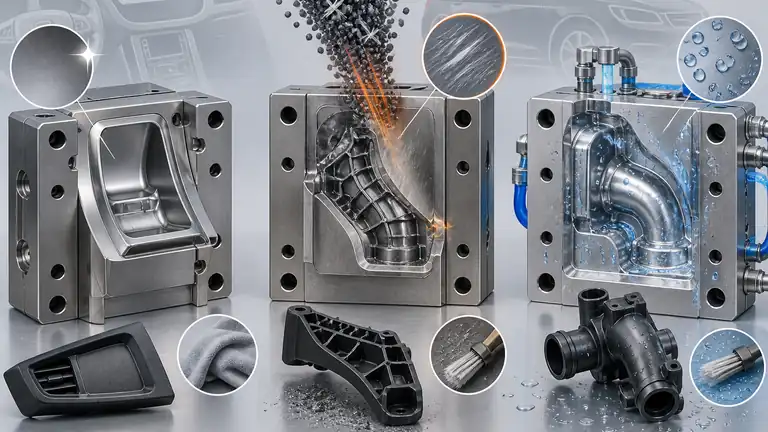
Conceptual illustration; not to scale.
The mold-steel line in an automotive quotation can look like a material choice, but it is also a decision about wear, polish, corrosion, rework and maintenance. A general-purpose grade may machine well and suit a moderate run, while a reinforced resin, abrasive texture or humid cooling environment can expose the wrong choice after production starts. Upgrading the entire mold without examining the actual risk can be just as wasteful.
Choose P20, H13 or stainless mold steel by the local duty of each mold component: resin abrasion, injection pressure, thermal exposure, corrosion risk, required polish or texture, expected production demand and the practicality of repair. Confirm the exact commercial grade, standard equivalence, delivery hardness, heat-treatment route, cleanliness, certificates and finish process. No steel is universally best and no generic life guarantee can be inferred from a grade name.
The comparison below concerns production tooling for automotive plastic parts. It is not a comparison of prototype aluminum and production steel molds.
Match the steel decision to the local mold duty
Why this matters: Steel selection goes wrong when the part is described only as “automotive” or “high volume.” Automotive parts range from unfilled cosmetic covers to glass-reinforced brackets, and one mold can contain large cavity blocks, polished inserts, slides, cores, wear plates and hot-runner components with different duties.
Start by separating the mold into functional zones. The cavity and core surfaces create the part and carry finish. Slides and lifters see movement and localized wear. Shutoffs need edge stability. Ejector and guide components have their own wear and alignment requirements. Holder blocks support inserts and may prioritize machinability and toughness. Cooling passages introduce corrosion and maintenance risk. A single grade across every zone may be convenient but is not automatically technically or commercially optimal.
Then define the resin. Unfilled PP and ABS may impose different abrasion and finish demands from glass- or mineral-filled PA, PBT or other reinforced compounds. Obtain the exact grade, reinforcement, color package, flame-retardant or additive package, processing temperature and any corrosive or abrasive behavior stated by the resin supplier. A family label is not enough. The same nominal polymer can have different tool duty when reinforcement and additives change.
Define the mold environment and duty: production volume as a planning input, cycle and cooling conditions, humidity, storage, cleaning method, abrasive contamination, pressure, temperature cycling, texture, polish or transparent-surface requirement, and the expected repair path. Production volume helps set the economic case, but it does not determine a steel grade by itself. A lower-volume tool can still require stainless steel if rust would damage a critical finish or cooling channel.
Finally, identify what evidence is needed. A supplier should state the steel manufacturer and exact grade, standard designation or equivalent, delivery condition, hardness range where applicable, heat-treatment record, material certificate and any recommended finish or surface treatment. “H13” or “P20” without supplier and condition is incomplete because commercial variants are not identical.
Create the steel map before asking for a final price. For each zone, state the resin contact, motion, finish, corrosion exposure, treatment and repair expectation. The map lets the supplier explain why a holder, cavity insert, slide and wear plate do not necessarily use the same material. It also helps the buyer compare proposals that use different grades but protect the same functions. Any proposed equivalent should be evaluated by its supplied condition and documented properties, not by a similar-sounding designation.
Understand what P20, H13 and stainless options trade
Why this matters: P20-type prehardened mold steels, H13-type through-hardening steels and stainless mold steels solve different combinations of machinability, toughness, wear, polishability and corrosion exposure. The names are useful starting points, not final specifications.
P20-type prehardened steel suits many large blocks and moderate wear duties because it can be machined in supplied condition. Uddeholm describes Impax Supreme as prehardened with good machinability, polishing and photo-etching properties, and later nitriding or local hardening for selected wear needs. That is supplier-specific, not a universal P20 claim. It may be a sensible baseline when resin, demand and repair strategy fit.
H13-type steel is a through-hardening hot-work tool-steel family used when higher temperature strength, wear resistance or thermal-fatigue performance is needed in an appropriate component. ASSAB describes its H13 designation as a chromium-molybdenum-vanadium steel with high-temperature strength, hot-wear resistance, toughness and hardenability. The final result depends on section size, heat-treatment route, hardness, machining allowance, distortion control and the actual supplier grade. H13 does not turn an unsuitable mold design into a stable process, and it may add heat-treatment, distortion and finishing work.
Stainless mold steel is a response to corrosion and finish requirements rather than a universal premium upgrade. Uddeholm describes Stavax ESR as stainless mold steel combining corrosion and wear resistance, polishability, machinability and hardening stability, with rust-free cooling channels as a maintenance benefit in relevant environments. Stainless inserts can be valuable for humid production, corrosive materials, polished or transparent surfaces and areas where rust would be difficult to repair. They can also require different machining, welding and heat-treatment controls and may not be needed for every holder or plate.
Use the manufacturer’s technical data for the exact grade and condition. Do not copy a hardness, wear ranking or expected life from one brand to another. The relevant question is whether the selected steel and treatment protect the specific feature for the intended use and maintenance plan.
Do not interpret a supplier’s comparative chart as a project guarantee. Such charts are useful for screening, but the toolmaker still must confirm section size, heat-treatment route, finish, local load and repair method. An exact commercial grade may be suitable for a cavity while a nominally similar grade is not suitable for a thin slide or polished insert. Ask for the data sheet and certificate that apply to the material actually ordered.
Compare use conditions before specifying a whole mold
Why this matters: An effective comparison records the risk, the local component and the evidence that will confirm the choice. It prevents “premium steel everywhere” from becoming a substitute for an engineering review.
Select the steel combination that meets the local wear, finish, corrosion and repair requirement with the least unsupported cost; a mixed steel package can be appropriate when the zones have different duties.
| Use condition | P20-type prehardened option | H13-type through-hardened option | Stainless mold-steel option | Evidence to request |
|---|---|---|---|---|
| Large mold block with moderate wear | Often attractive for machinability and modification | May add treatment and finishing work without needed benefit | May be unnecessary unless corrosion affects the block | Supplier grade, delivery hardness and tool duty statement |
| Glass- or mineral-filled resin | Review local inserts and wear surfaces; may need treatment | Candidate where wear and thermal duty justify hardening | Candidate where wear and corrosion both matter | Resin TDS, wear-risk map, treatment and hardness record |
| High polish or transparent surface | Suitable only if exact cleanliness and finish are adequate | Can work with controlled heat treatment and polish route | Often considered where polishability and corrosion resistance are important | Polish standard, surface process, steel certificate and sample finish |
| Humid plant or water-channel corrosion risk | Requires corrosion-control maintenance | Depends on grade and environment | Candidate where rust-free channels and surfaces have value | Cooling-water condition, maintenance plan and corrosion rationale |
| Many future design changes | Machinability and modification can be advantageous | Welding/heat-treatment plan becomes important | Repair process and weld compatibility must be confirmed | Steel-safe plan, weld recommendation and insert strategy |
| High-pressure or thermal-fatigue duty | Review whether a prehardened block is adequate | Candidate if heat treatment and toughness fit the duty | Candidate only if corrosion/finish also justify it | Mold-flow/process conditions and material data |
Use the table by local zone, not by marketing category. A mold may use a P20-type holder with H13 or stainless inserts. The correct combination depends on the supplier’s design and the customer’s maintenance and repair requirements. Ask the moldmaker to explain which areas are upgraded and why.
The evidence should be attached to the row that motivated the choice. If abrasive resin drives the selection, identify the wear surface and the resin supplier’s information. If polishability drives it, identify the finish and the inspection or master-sample method. If corrosion drives it, identify the water or plant condition and the maintenance benefit expected. If future correction drives it, identify the insert and repair route. This prevents a broad steel upgrade from hiding the actual risk.
Illustrative example: a large holder is proposed in a prehardened P20-type grade, a moving wear insert in a treated H13-type grade and a polished cavity insert in stainless mold steel. The buyer does not approve the combination merely because it includes three names. The supplier must show hardness and treatment records, polish and texture requirements, cooling and maintenance assumptions, and the inspection evidence for each zone. If the resin, volume or finish changes, the map is reviewed again.
The steel map should be reviewed when the material grade, surface finish, cycle, production site or maintenance method changes. A corrosion argument based on the plant environment may not apply after the tool moves to a dry site, while a reinforced resin change may create a new local wear risk. Keep those variables beside the recommendation. This is more useful than a generic ranking because it shows the condition under which the chosen package remains appropriate and the condition that would require a new review.
Treat heat treatment, finish and repair as one decision
Why this matters: Steel grade alone cannot predict the finished mold. Heat treatment changes hardness, distortion risk and the work required to restore dimensions. Surface finish controls the molded appearance and release behavior. Repairability controls how the tool will behave after a correction, weld or insert replacement.
For through-hardened steel, ask for the rough-machining, stress-relief, heat-treatment, semi-finish, hardening, final-machining and polishing sequence. Uddeholm’s mold-steel guidance distinguishes prehardened steels from through-hardening steels and notes that through-hardened cavity or core inserts are commonly supported in prehardened holder blocks. The sequence matters because late distortion can move a critical dimension or degrade a polish.
For P20-type prehardened steel, confirm the delivered hardness and whether the supplier plans nitriding, local hardening, coating or no treatment. A treatment may improve a selected wear surface, but it can affect machining, dimensional correction and repair. For stainless grades, confirm heat-treatment condition, corrosion protection, welding recommendation, polish route and whether the cooling circuit and maintenance chemicals are compatible.
Finish is a product requirement, not only a tool-shop preference. A polished cavity, a textured interior, a cosmetic shutoff and an etched surface require different preparation and inspection. Ask for the applicable texture standard or master, polishing level, parting-line treatment, weld repair visibility limit and how the finish will be checked after T1. A steel that can be polished in theory may still fail if the toolmaker cannot control cleanliness, orientation or repair marks.
Repair planning should identify replaceable inserts, wear plates, access, spare components and the limits for welding or re-machining. If a correction could change a datum or cosmetic surface, the approval route should be defined before the mold is cut. This connects steel selection to the moldmaker’s correction plan and the eventual production handoff.
A correction plan should state whether the component can be reground, welded, re-heat-treated or replaced. Record the finish after correction and the inspection needed to verify it. On a textured surface, the texture supplier or customer may need to approve a local repair. On a hardened insert, the permitted material-removal route may be different from a prehardened block. Treating these limits as part of the steel selection avoids a later choice between a risky repair and a full insert replacement.
Evaluate total use cost instead of material price alone
Why this matters: The cheapest steel block is not always the lowest-cost tool, and the most expensive grade is not automatically the best investment. Total use cost includes material, machining, heat treatment, polishing, texturing, corrosion protection, maintenance, downtime, replacement inserts and the commercial effect of a delayed correction.
Build a simple life-cycle comparison. List the local duty, initial cost, machining and treatment duration, finish risk, expected maintenance tasks, spare strategy and consequence of failure. Use actual supplier quotations and documented assumptions. Do not insert an unsupported mold-life number. A supplier may provide a life estimate for a specified grade and process; record it as a supplier estimate and define the conditions behind it.
Consider how maintenance will be performed. A stainless cooling circuit may preserve cooling consistency in a humid environment, but it does not remove the need for water-quality control and inspection. A hard insert may resist abrasion, but it can complicate welding or require a replacement instead of a simple local correction. A prehardened block may support quick modification, but a wear surface may need a separate insert or treatment.
Illustrative example: a two-cavity PA housing has a glass-filled resin, a polished connector face and a mold installed in a humid production area. The supplier proposes P20-type steel for the holder, H13-type steel for a high-wear slide and stainless inserts for the polished connector surfaces and selected cooling-sensitive areas. The buyer asks for the exact grades, hardness and treatment records, plus the reason each zone is different. The proposal is not accepted because “more expensive is safer”; it is evaluated against wear, finish, corrosion and repair evidence.
If the production material changes later, revisit the local steel map. A new reinforcement, additive, color or processing window can change wear or corrosion. Treat the change through the customer’s approved change-control process, not as an informal resin substitution.
Use scenario-based comparison rather than a single “tool life” number. One scenario can value low initial cost and easy modification; another can value corrosion control, spare inserts and reduced maintenance in a humid plant. State which assumptions are verified and which are supplier estimates. The result should explain the tradeoff and the condition that would reverse the decision. It should not turn a catalog property into a promise about future production quantity.
Ask the moldmaker for a grade-specific steel package
Why this matters: The RFQ should request a steel schedule with component, supplier, commercial grade, standard designation, delivery condition, heat treatment, hardness, finish requirement, certificate and repair route. It should distinguish cavity/core inserts from holder plates and standard mold components.
Require a component-level steel schedule with exact supplier grade, designation, supplied condition, hardness, treatment, finish, certificate and repair assumptions before approving the mold steel.
Ask these questions:
- Which resin and additives drove the wear and corrosion assessment?
- Which surfaces require polish, texture, optical finish or edge stability?
- Which components are P20-type, H13-type, stainless or another grade, and why?
- What are the supplied hardness and heat-treatment conditions for each critical component?
- What distortion allowance and final inspection follow heat treatment?
- How are weld repairs, local corrections and future inserts handled?
- What maintenance, water-quality and corrosion-control assumptions support the recommendation?
- Which certificates, inspection records and finish samples will be delivered?
- What spare or replacement components are recommended for wear areas?
The answer should be linked to the mold design, material specification and production plan. It should not be a generic steel brochure. If the project needs a new production tool, use the automotive mold manufacturing service to review the component-level steel schedule; for an existing tool, the mold transfer and repair route may require an incoming steel and condition inspection first.
Add the steel schedule to the mold design review and preserve it with the final tool records. Check that the ordered material matches the approved schedule and that critical inserts retain their identity through heat treatment and finishing. If an equivalent is proposed, record who approved the substitution and which properties were compared. This is especially important when the mold is later transferred, repaired or used as the baseline for a second source. The automotive mold manufacturing service can review the schedule together with cavity layout, cooling and maintenance access.
Conclusion
Choose mold steel by local duty, resin abrasion, corrosion, finish, heat treatment and repair strategy. Compare P20-type, H13-type and stainless options by exact supplier grade and condition, not names alone. Request certificates, hardness, finish, treatment and maintenance assumptions before steel approval.
References
- Uddeholm, Impax Supreme — P20-type prehardened mold-steel properties and supplied condition.
- ASSAB, 8407 2M — H13 designation, high-temperature strength, wear, toughness and injection-molding application.
- Uddeholm, Stavax ESR — stainless mold steel, polishability and corrosion-related maintenance considerations.
- Uddeholm, Steel for Plastic Moulding — prehardened and through-hardening mold-steel application guidance.