
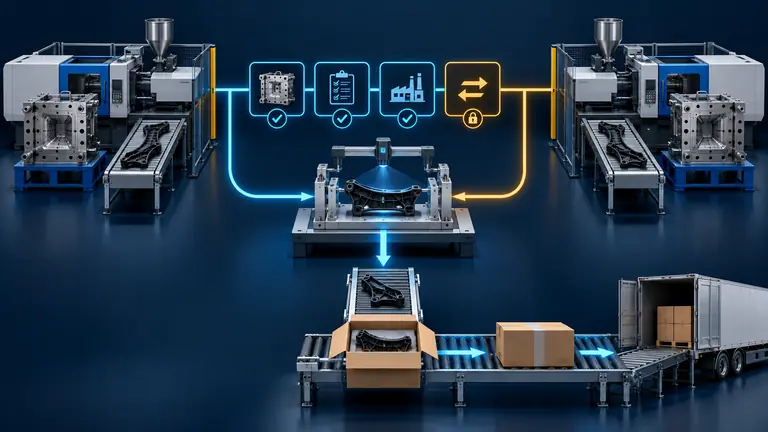
Conceptual illustration; not to scale.
A second molding source can reduce exposure to capacity loss, logistics disruption, or commercial dependency, but the quoted part price is only a fraction of the decision. Duplicate tooling, transfer rights, engineering work, validation, inventory, packaging, systems integration, and the rules for switching production can determine whether the backup is genuinely usable.
Build the business case around a defined operating model. Decide whether the second source will hold an idle tool, run a small recurring share, duplicate the complete process, or become an alternate regional supplier. Then estimate one-time qualification costs, recurring cost differences, switch-event costs, and the financial effect of risk reduction. Approve the source only after ownership, technical equivalence, capacity, quality evidence, logistics, and customer-change requirements are clear.
This article focuses on the commercial and operational decision. For the technical comparison after a duplicate tool exists, use the two-tool part comparison plan.
Choose the second-source operating model before requesting quotes
Suppliers cannot price the same scope when the buyer has not decided how the backup will operate. A tool stored without regular trials has different cost and readiness from a supplier producing 20 percent of annual demand. Define the model first, then ask bidders to price the same assumptions.
Common models include an emergency-only duplicate tool, scheduled low-volume production, a fixed dual-source split, regional production for separate markets, and a transferable tool held at an alternate site. Each changes the expected tooling design, material approval, packaging, safety stock, maintenance, workforce familiarity, capacity reservation, and customer submission plan.
An emergency-only tool appears inexpensive because it carries little recurring volume. It can also lose readiness as resin, operators, software, auxiliary equipment, machine availability, and product revisions change. A warm source that runs periodically costs more to maintain but generates current evidence and practiced logistics. A fixed production split improves continuity and comparison data, yet may reduce economies of scale and complicate lot traceability.
Write an operating statement with annual demand range, awarded share, surge requirement, activation notice, expected run frequency, approved plants and machines, tool ownership and location, material source, packaging lane, service-parts horizon, and customer approval constraints. Ask each supplier to identify which assumptions drive price and lead time. Without this statement, a low quotation may simply exclude the readiness the program expects.
State the review cadence and sunset condition as well. A backup strategy should be reconsidered when demand, product revision, plant footprint, material availability, or program life changes.
Separate one-time, recurring, and switch-event costs
A useful cost model avoids hiding qualification expenses in tooling or comparing recurring prices with different inclusions. Keep the categories separate so management can test alternate sourcing scenarios.
| Cost category | Typical items | Questions to verify |
|---|---|---|
| One-time establishment | DFM, duplicate mold, gages, fixtures, automation changes, trials, measurement, testing, submission, travel and launch support | Who owns each asset and which evidence is included? |
| Recurring production | Part conversion, resin, color/additives, packaging, freight, duties, inspection, scrap assumptions, maintenance and overhead | Are material, volume, Incoterms, currency and quality scope aligned? |
| Readiness retention | Periodic trials, storage, preservation, reserved capacity, spare parts, training, system maintenance and revalidation | What keeps an infrequently used source ready? |
| Switching event | Expedited material, line changeover, validation lot, premium freight, extra inspection, inventory repositioning and customer notification | Which costs occur every activation? |
| Exit or transfer | Tool inspection, records, preservation, packing, transport, import/export work and receiving trial | Are transfer rights and responsibilities explicit? |
Request a separately priced breakdown rather than a single amortized number. State amortization volume and what happens if demand ends early, moves between sources, or exceeds the assumption. Distinguish customer-owned tooling from supplier investment and identify taxes, customs, insurance, and finance terms for professional review.
Normalize quotations to the same annual volume, order quantities, material grade, cycle and cavity assumptions, inspection level, packaging, delivery point, currency basis, and submission scope. The automotive injection molding quote comparison explains that normalization step in more detail.
Estimate the technical qualification work honestly
Second sourcing is a product and process change even when the drawing does not change. The new combination of tool, machine, plant, material handling, operators, measurement systems, packaging, and logistics needs a risk-based approval plan.
Confirm the customer’s required notification and submission level before authorizing production. Review applicable customer-specific requirements, contracts, quality agreements, APQP plan, control plan, and PPAP expectations. Do not assume an existing approval automatically covers a second plant or duplicate mold. Likewise, do not assume every program requires the same submission package.
Typical work includes DFM reconciliation, tool design review, machine-interface confirmation, mold trials, process development, cavity balance, measurement-system review, dimensional layouts, material and performance testing specified by the product, appearance approval, packaging validation, capacity evidence, and production release. Gages and fixtures may need duplication, transfer, correlation, or software updates. If Tool A samples are used as references, verify their identity, revision, cavity, age, and conditioning.
Price learning cycles and correction loops explicitly. A first trial is rarely the same as customer release. Tool adjustments, repeated samples, test lead times, engineering review, and transport can dominate the calendar. The automotive tooling lead-time plan helps separate build completion from production approval.
If the second source will receive an existing tool instead of building a duplicate, include inspection, documentation recovery, preservation, transport, destination-machine fit, and receiving qualification. These costs should not disappear behind the term “free transfer.”
Value resilience without inventing a universal disruption number
There is no defensible generic percentage that proves a second source is worthwhile. Value depends on the program’s contribution margin, customer consequences, recovery time, current failure modes, inventory, alternative capacity, and probability assumptions. Make those assumptions visible.
Build scenarios rather than one expected-value claim. Start with credible disruption events: press or facility outage, mold damage, supplier insolvency, labor or utility interruption, material shortage, logistics lane failure, quality containment, cyber incident, or regional restriction. For each, estimate time to detect, decide, authorize, secure material, prepare the backup, produce, validate, transport, and replenish inventory.
Compare the current single-source exposure with each proposed operating model. Account for existing safety stock, repair options, transferable capacity, customer-approved substitutes, and inventory obsolescence. Avoid counting the same benefit twice—for example, both safety stock and immediate second-source production during the same first days.
Use a range for uncertain values and show which assumption drives the decision. The result may justify a complete duplicate tool for one safety-critical, long-lead component while supporting only better transfer records and strategic spares for another. Risk reduction should be proportional to consequence and recovery difficulty, not applied as a slogan to every part.
Define how a switch will actually be approved and executed
A second source that cannot be activated under real customer, material, quality, and logistics rules is only theoretical capacity. Create a switching playbook while the program is stable.
Name who can declare an event, authorize production, notify the customer, release material, change schedules, approve deviations, and return to the primary source. Identify objective triggers such as predicted inventory depletion, confirmed capacity loss, missed recovery milestones, or a quality containment threshold. Commercial tension alone should not bypass product approval.
The playbook should include current contacts, source and tool status, approved process and control plan, available raw material, packaging, labels, EDI or order setup, carrier and customs requirements, first-lot inspection, traceability, enhanced containment when required, and customer submission status. Define whether primary and secondary parts may be mixed and how lots are identified.
Exercise the process periodically at a level justified by risk. A tabletop review can reveal expired contacts and unclear authority; a scheduled production lot can demonstrate machine, people, materials, records, and logistics. Record findings and update the plan. Do not describe an untested emergency promise as guaranteed capacity.
Use a four-part sourcing decision worksheet
The following tool keeps price, readiness, risk, and approval visible on one page.
| Decision area | Required input | Evidence requested | Decision |
|---|---|---|---|
| Operating model | Demand, split, activation time, region, program life | Written capacity and readiness assumptions | Model selected / revise |
| Total cost | One-time, recurring, retention, switch and exit costs | Itemized quotes with common basis | Commercially viable / not viable |
| Technical readiness | Tool, machine, material, gage, process and validation plan | DFM, trial, measurement, testing and capacity evidence | Technically qualified / open actions |
| Governance | Ownership, change approval, trigger, traceability, logistics | Contracts, customer direction and switch playbook | Activatable / not activatable |
Add an owner, due date, confidence level, and source for every unresolved input. Use ranges for uncertain demand and switch frequency. Recalculate if product revision, volume, location, material source, or customer requirements change.
Illustrative example: warm backup versus emergency-only capacity
This illustrative example uses assumptions only. A buyer compares two proposals for an automotive bracket. Both include a duplicate four-cavity mold. Supplier B offers a lower part price if the tool remains idle and is activated only after an emergency. Supplier C proposes a small scheduled share with periodic runs and current inventory.
The normalized model shows that Supplier C has higher recurring logistics and changeover cost. It also includes current process records, trained operators, active material procurement, maintained gages, routine cavity data, and an exercised shipping lane. Supplier B’s quotation excludes periodic trials, capacity reservation, validation after long storage, and premium material procurement during activation.
The buyer does not automatically select the more expensive option. It estimates the required activation time and compares it with available inventory and customer approval timing. If the program can tolerate a long restart and the tool is easy to transfer, emergency-only capacity may be sufficient. If interruption consequences are high and the validation path is lengthy, a warm source may justify its recurring premium.
The decision record states the chosen model, excluded costs, demand assumptions, readiness tests, and switch authority. That makes future reviews possible instead of treating the original quote as permanent truth.
Questions to include in the second-source RFQ
- Which plant, machines, shifts, cavities, auxiliaries, and annual hours support the quoted capacity?
- Which tooling, hot-runner, gages, fixtures, automation, spares, and software are included, and who owns them?
- Which material producer, grade, color/additive, regrind, packaging, and traceability assumptions control the quote?
- What DFM, trials, dimensional work, testing, submission, capacity study, and correction cycles are included?
- How will Tool A and Tool B output be compared and approved by cavity?
- What recurring activity keeps an idle or low-volume source ready?
- What notice, material, validation, premium freight, and customer actions apply to a switch?
- What happens to amortization, assets, records, and inventory if demand or sourcing share changes?
Require exclusions and assumptions in writing. A quotation that does not define readiness should not be scored as if it does.
Conclusion
Select a second source by operating model, total cost, technical proof, and executable switching rules—not part price alone. Send AutoMoldingPro the BOM or drawing, annual demand range, current tool status, sourcing objective, destination market, validation requirements, and desired activation time for a scoped assessment.