
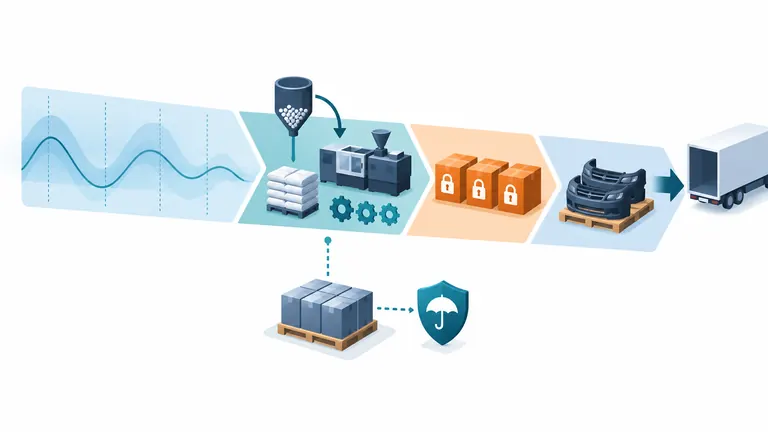
Conceptual illustration; not to scale.
An annual forecast can justify a mold and reserve capacity, but it does not tell the molder exactly what to ship next Tuesday. When forecasts, firm releases, resin lead times, mold capacity, and inventory ownership are not separated, one party expects flexibility while the other builds stock that may become obsolete.
Use a layered supply agreement: long-range forecasts for capacity and material planning, defined firm and flexible horizons for production commitment, release orders for authorized quantities and dates, and an agreed buffer policy for specific risks. State which signal is binding, how changes are handled, who owns each inventory layer, and how engineering changes or end-of-program exposure are resolved.
Give each demand signal one clear job
The annual forecast supports tooling cavitation, press capacity, labor planning, resin agreements, packaging assets, and supplier readiness. It should show expected program life, annual volume, seasonality, ramp, peak weeks, regional or part variants, and known launch or shutdown periods. A single annual total hides the release pattern that determines whether the cell can respond.
A rolling forecast updates that planning view. It should identify time buckets, update frequency, version, and the difference between information and commitment. Volvo Group’s EDI guidance describes a DELFOR message that can carry firm and forecast delivery requirements with quantities, dates, and locations. That is one customer system; other buyers use portals, blanket orders, schedules, or emailed releases. The parties must define the controlling document for their relationship.
A firm release or purchase order authorizes specific quantities, ship or delivery dates, destinations, packaging, and commercial terms. Ford’s published production purchasing terms overview separates quantity and volume projections in distinct sections, illustrating why a projection should not be casually treated as an order. The actual contract, purchase order, releases, and customer terms govern; this article does not create a universal legal interpretation.
Create a signal hierarchy: contract/blanket order, latest valid release, forecast, supplier acknowledgement, shipment authorization, and exception message. State which version wins when systems disagree. Record cumulative quantities where the customer uses them, and reconcile receipts, in-transit stock, and rejected quantities. A technically capable molder can still miss deliveries if both parties plan from different demand versions.
Align horizons with physical lead times and capacity
Map the replenishment chain from order signal to customer receipt: resin and insert procurement, color or compounding, production scheduling, mold setup, drying, startup approval, molding, secondary operations, inspection, packaging, export documentation, pickup, transit, customs, and receiving. Identify which lead times are fixed, variable, or affected by minimum purchase quantities. The firm horizon should be compatible with actions that cannot be reversed without cost.
Capacity planning must use good-part output. State production-intent cycle, effective cavities, shifts, uptime, scrap, planned maintenance, changeovers, inspection and secondary-operation constraints, and available machine windows. Compare average demand and peak releases. If the supplier shares a press with other tools, specify the protected capacity and decision process for conflicts.
Use a time fence table:
| Horizon | Typical planning use | Changes to define contractually |
|---|---|---|
| Long range | Tooling, press, labor, resin source, packaging assets | Forecast update and capacity escalation |
| Flexible | Material reservation and provisional schedule | Permitted quantity/date movement and cost exposure |
| Firm | Production and committed purchased inputs | Authorization, cancellation and expedite rules |
| Shipping | Pack, labels, documents, carrier and destination | Shipment release and change cutoff |
The lengths cannot be universal. A locally stocked commodity resin, customer-supplied insert, imported engineered grade, returnable packaging loop, or overseas lane each creates a different constraint. Set horizons from evidence and review them when cycle, yield, packaging, or transport changes.
AIAG and Odette’s MMOG/LE is an automotive supply-chain self-assessment framework covering areas such as capacity planning and crisis management. It can help structure a capability review, but customer-specific logistics agreements and releases still control the program.
Design safety stock for a named risk
Safety stock is not a substitute for insufficient capacity or an undefined forecast. Name the uncertainty it covers: demand variation inside the replenishment lead time, transit variation, resin lead-time variability, yield variation, a planned mold-maintenance event, or a launch ramp. Do not add separate buffers for several labels if they cover the same risk and time window.
Choose where the buffer sits. Raw resin can support several part variants but still requires machine time. Work in process shortens some operations but can become obsolete. Finished goods respond fastest but carry the highest design-change and storage exposure. Capacity reserve avoids physical inventory but requires an available press, people, material, and packaging. A second approved tool or source addresses a different continuity risk and has its own validation burden.
Calculate the buffer from an agreed service objective and variability model where sufficient data exist, or start with a clearly labeled temporary policy during launch. Record average and peak demand, replenishment lead time, forecast error, yield and downtime history, transport variability, and review period. Never present one “weeks of stock” value as a universal automotive rule.
Define ownership and disposition. Who buys resin held for the customer? When does finished stock transfer economically? What happens after an engineering change, forecast reduction, canceled release, quality hold, or end of program? Are customer-specific inserts or orange resin usable elsewhere? The answer belongs in the commercial agreement. Physical stock without ownership rules can turn a delivery buffer into a dispute.
Set minimum and maximum levels, replenishment trigger, age limit, FIFO or other rotation, condition checks, storage requirements, and cycle-count frequency. If nylon conditioning, contamination, color, or shelf-life-sensitive inserts matter, protect those states. Review actual consumption and reset the buffer when demand or lead time changes.
Run a shared exception process
A good plan expects signals to move. Compare the newest forecast and release with the previous version by part, date, and quantity. Highlight changes inside each horizon. The supplier should acknowledge what can be met, identify the constraining operation, and quantify inventory and material exposure. The buyer should confirm priority, approved substitutions or dates, and commercial responsibility.
Create triggers for escalation: peak demand above demonstrated capacity, release inside the agreed lead time, forecast drop leaving committed material, cavity loss, yield decline, resin shortage, delayed returnable packaging, export disruption, or an engineering change. Assign contacts in purchasing, planning, production, quality, and logistics. An exception should contain facts and options, not only “urgent.”
Illustrative example: a forecast shows stable monthly demand, but releases arrive in large end-of-month peaks. The mold has adequate annual hours yet the secondary assembly and packaging cell cannot complete the peak. Adding finished-goods stock might help, but the first decision is whether releases can be leveled, assembly capacity can be reserved, or packaging assets can turn faster. The chosen buffer should cover the residual risk after those constraints are understood.
Measure forecast accuracy by horizon, release volatility, schedule adherence, fill rate, premium freight, obsolete stock, and inventory age. Metrics should drive decisions rather than blame. A consistently biased forecast may require capacity or commercial correction; a stable forecast with repeated misses may reveal a production constraint. Preserve the latest valid release and acknowledgements so the parties can distinguish demand change from execution failure.
Information to agree before serial supply
- Annual and peak demand, program life, ramp, variants, shutdowns, and end-of-program assumptions.
- Forecast horizon, bucket, frequency, version control, and non-binding/binding status.
- Firm and flexible horizons tied to actual material, production, and transit lead times.
- Release format, cumulative-quantity logic, acknowledgement, change cutoff, and exception contacts.
- Demonstrated good-part capacity, maintenance, changeover, inspection, packaging, and transport constraints.
- Buffer purpose, location, quantity method, ownership, replenishment, age, and disposition.
- Engineering-change, quality-hold, forecast-reduction, expedite, and obsolete-inventory rules.
Turn these items into a signed operating matrix with one owner and one source system for each signal. Include the time zone and cutoff for releases, calendar rules for holidays and plant shutdowns, part-number and revision handling, response time for acknowledgements, and the contact path when an EDI or portal message fails. Test the process with a sample release before launch: receive it, translate quantities and dates, check the cumulative position, create the production requirement, reserve packaging and transport, and send the acknowledgement. A forecast policy is only useful when both parties can execute the same transaction without silently interpreting dates, quantities, or authorization differently.
Review the matrix at launch, after a material or lane change, and whenever forecast error or expedite frequency crosses the agreed trigger. Keep temporary launch buffers time-limited; otherwise they can become permanent inventory without a current risk justification.
This topic differs from MOQ. The annual volume versus order quantity article explains production and purchasing lot economics; the present decision is how forecasts, releases, and buffers coordinate serial supply. When requesting a molding proposal, send the demand profile, release pattern, lead-time expectations, packaging loop, and inventory terms through the RFQ page.