
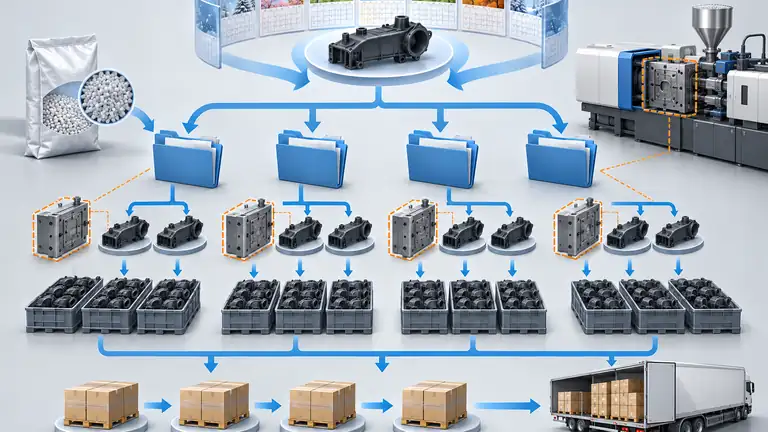
Conceptual illustration; not to scale.
Home › Blog › Automotive Injection Molding MOQ: Annual Volume vs. Order Quantity
Automotive sourcing and manufacturing decision guide
An annual forecast does not tell a molder how often to install the tool, prepare resin, approve first-off parts, or ship. When annual volume, purchase-order release, production batch, pack multiple, and MOQ are treated as one number, unit-price comparisons hide inventory, changeover, obsolescence, and delivery assumptions.
State four quantities separately: annual demand over a named period, each contractual release, the manufacturing batch proposed for one setup, and the supplier’s minimum commercial acceptance condition. Add demand timing, pack multiple, lead time, material constraints, inventory ownership, and change rules. Compare price tiers only when suppliers use the same demand and delivery scenario; no universal automotive molding MOQ exists.
The goal is a replenishment rule that balances setup economics with responsiveness and revision risk, rather than forcing one arbitrary minimum onto every part.
In This Guide
- Define Annual Demand, Order Quantity, Production Batch and MOQ
- Understand Which Costs Change With the Batch
- Illustrative Demand Scenarios for RFQ Preparation
- Choose Who Owns Inventory and Revision Risk
- Prepare a Demand Brief the Supplier Can Actually Quote
- Agree a Replenishment Rule, Not Just One MOQ Number
Define Annual Demand, Order Quantity, Production Batch and MOQ
Why this matters: The four quantities serve different decisions and may be expressed in parts, assemblies, shots, packs, or currency. Mixing them causes incorrect capacity, material, price, and delivery calculations.
Define each quantity with its unit, time basis, part or assembly level, and contractual meaning. Extend BOM quantities where needed and ask the supplier to state how releases are grouped into production batches and how MOQ is applied.
There is no universal AutoMoldingPro or industry MOQ stated in this article. The workable minimum depends on the part, tool, exact resin/color purchase, setup/changeover, inspection, packaging, inventory and delivery cadence.
Annual demand is forecast consumption over a named program year. Show ramp, peak, decline and service demand separately when they differ.
Order quantity is the amount requested on a purchase order or release. It may be delivered once or in scheduled drops.
Production batch is the quantity made in one setup/campaign before the tool, material or color changes. A supplier may combine several delivery releases into one production batch and hold finished inventory.
MOQ is the minimum commercial quantity the supplier will accept for a production/order condition. It can reflect setup, material procurement, packaging or administration, but it should not be mistaken for annual capacity.
For assemblies, component demand must reflect quantity per assembly. SAP’s BOM quantity documentation illustrates the basic relationship between required assembly quantity and component quantity.
Build a demand-definition table by part number and program year. Record pieces per vehicle or assembly, annual base and range, launch and peak periods, service demand, typical and maximum release, delivery frequency, pack multiple, requested lead time, and forecast status. Then add supplier-return fields for proposed batch, MOQ unit, price tier, material purchasing constraint, and inventory assumption. This lets purchasing identify whether “10,000 MOQ” means one purchase order, one manufacturing campaign, one color, one pack multiple, or an annual commitment.
Illustrative scenario: an assembly forecast is 100,000 units per year and uses three identical clips. The clip’s annual component demand is 300,000, while a monthly assembly release of 8,000 creates a 24,000-clip delivery need. The molder might run 48,000 clips every second month and hold one release, subject to pack size and inventory terms. None of those numbers alone is the MOQ. Write the relationship explicitly before comparing another supplier that proposes monthly production with a different piece price.
Annual
Used for mold/cavity, capacity and lifecycle planning. Time basis: program year.
Order/release
Used for contractual delivery quantity and dates. Time basis: PO or call-off.
Production batch
Used for setup, campaign, material and inspection planning. Time basis: one manufacturing run.
MOQ
Used for commercial acceptance/pricing. Time basis: supplier-defined order or batch condition.
Understand Which Costs Change With the Batch
Why this matters: Molding cost does not scale linearly with quantity. Each campaign carries setup, material transition, stabilization, first-off, records, and teardown, while larger batches create inventory and revision exposure.
Separate fixed-per-batch, per-piece, material-procurement, packaging, logistics, and inventory costs. Ask suppliers to explain which constraint sets each price tier or minimum and compare scenarios rather than assuming the largest batch is best.
A short batch still needs mold setup, material preparation, process startup, first-off release, in-process records, teardown and administration. Exact color or specialty resin may have a purchase/compounding/package constraint different from the molding batch.
Material and color changeovers also consume time and material. Asaclean’s injection molding changeover instructions describe emptying/cleaning the feed path and displacing one resin with the next; the actual purge method and amount depend on the machine, resin and supplier procedure.
Larger batches can reduce setup frequency but increase finished-goods inventory, storage, aging, obsolescence and engineering-change exposure. The lowest unit conversion cost is not automatically the lowest supply-chain cost.
Map the manufacturing route into cost drivers. Setup-driven work includes scheduling, tool handling, connections, material and color preparation, purge, startup scrap, process stabilization, first-off inspection, document opening and closure, teardown, and cleaning. Quantity-driven work includes resin, machine and labor time, secondary operations, inspection, packaging, and handling. Some purchased resin, color, inserts, labels, or cartons have supplier package or purchase constraints that do not equal the economical molding batch. Ask whether unused material can be safely stored, transferred, or charged separately.
Then add supply-chain effects. A larger campaign can reduce setup frequency and apparent conversion cost, but it increases cash tied in stock, space, damage or contamination risk, age-related review, forecast error, and obsolescence after engineering change. A smaller batch improves responsiveness but may require more first-off work and changeovers. Use total scenario cost and risk, not a universal percentage. The preferred policy may differ between high-running current production, a volatile launch, color variants sharing one tool, and low-volume service supply.
Setup-driven
- Tool installation and connections
- Dryer/material/color preparation
- Startup stabilization and first-off
- Teardown and cleaning
Quantity-driven
- Resin and purchased components
- Machine/operator time
- Inspection/assembly/packaging
- Freight and handling units
Inventory-driven
- Storage and financing
- Damage/contamination/aging
- Forecast error
- Revision and end-of-program obsolescence
Illustrative Demand Scenarios for RFQ Preparation
Why this matters: A price request with only one annual number encourages every supplier to invent its own cadence. Their quotations can therefore reflect different setup frequencies, inventory banks, and delivery commitments.
Issue several labelled demand scenarios or one controlled base case with a credible range. For each, request production batch, release cadence, lead time, inventory owner, price, constraints, and response to demand or revision change.
Illustrative examples — assumptions only: the quantities below are planning patterns, not AutoMoldingPro limits, market norms or price promises. Each scenario still requires part/tool/material review.
Use the illustrative table as a conversation template, not a market benchmark. For steady demand, ask whether monthly production or combined releases provide the better balance and what capacity or material assumptions support the answer. For a launch peak, compare validated surge capacity with a prebuild, including frozen forecast, ownership, storage, inspection, and revision risk. For service demand, examine annual or semiannual campaigns, tool preservation, small material and color purchases, and staged delivery. For assemblies, synchronize child-part batches and purchased-component constraints.
Illustrative decision: two suppliers quote the same 180,000-piece annual demand. Supplier A assumes twelve equal production batches and five-day release lead time; Supplier B assumes four campaigns, customer-owned stock, and a three-month frozen forecast. Supplier B’s unit price is lower, but the commercial offer transfers more inventory and revision exposure. Add both operating models to the scenario table, normalize freight and packaging, and decide whether the extra commitment is acceptable. Do not “correct” one price without obtaining a supplier-owned revised scenario.
| Demand scenario | RFQ implications |
|---|---|
| Steady production | Annual demand: 240,000 parts Release: 20,000 monthly Batch question: make monthly or combine releases? RFQ evidence: peak rate, pack quantity, inventory owner, response time |
| Seasonal/launch peak | Annual demand: 180,000 parts Release: 10,000–35,000 by month Batch question: prebuild versus surge capacity? RFQ evidence: frozen window, bank ownership, shelf/condition limits, change exposure |
| Low-volume service | Annual demand: 6,000 parts Release: 500 quarterly or irregular Batch question: annual campaign with staged delivery? RFQ evidence: tool storage, resin/color availability, packaging life, forecast commitment |
| Multi-part assembly | Assembly demand: 100,000/year BOM: three clips per assembly Component demand: 300,000 clips/year RFQ evidence: synchronized batches, purchased-part MOQ and assembly inventory |
Choose Who Owns Inventory and Revision Risk
Why this matters: When production batches exceed releases, someone finances, stores, preserves, traces, and ultimately owns the stock. If these terms are implicit, forecast changes and engineering revisions become disputes.
Define ownership and risk for raw material, work in process, finished goods, safety stock, and obsolete inventory. Use frozen and planning windows, release triggers, storage and reinspection rules, and explicit treatment of customer-driven changes.
If production batch exceeds delivery release, identify who owns raw material, work in process and finished goods; where it is stored; how it is preserved and traced; when title transfers; and what happens after forecast reduction or engineering change.
Use a frozen/releasable forecast window. Outside that window, volume is planning information rather than authorization to produce. For safety stock or launch bank, define target, replenishment trigger, expiry/reinspection rule and financial ownership.
Do not hide inventory inside a unit-price comparison. Ask suppliers to show the batch assumption behind each price tier and separately price extraordinary storage, split delivery or obsolete stock treatment where relevant.
Create an inventory-responsibility matrix. For each stock type, record physical location, legal title, financial owner, authorization to purchase or produce, target and maximum, lot and shelf or review requirements, insurance or damage responsibility, replenishment trigger, permitted substitutions, and disposition after demand reduction, design change, quality hold, or end of program. If material must be bought in a larger package than one batch, distinguish unused raw material from finished parts because their reuse and obsolescence risks differ.
A frozen window should identify what the buyer is committing to, not merely what appears in a forecast portal. Outside it, information may support capacity planning but not authorize production. For a launch bank, state when the stock is built, which approved revision it represents, how it is rotated, and whether a later change makes it reworkable or obsolete. Illustrative scenario: a supplier proposes two months of finished stock to achieve a lower unit price. Before accepting, quantify who pays, what happens after a drawing change, and whether traceability and preservation remain suitable through the holding period.
Prepare a Demand Brief the Supplier Can Actually Quote
Why this matters: A supplier cannot propose a defensible batch or MOQ from annual volume alone. Resin, color, tool sharing, first-off, pack quantity, destination, lead time, and demand variability can dominate the decision.
Send a part-level demand brief with annual and periodic profile, releases, pack and delivery conditions, manufacturing constraints, and forecast rules. Require suppliers to return a defined MOQ, batch, price tier, lead time, and inventory model.
Attach a simple demand table by part number and program year. Include the following fields and ask the supplier to return proposed MOQ, economic batch and constraints.
Complete the demand-brief fields before asking for price. Give annual volume by year, launch ramp and end-of-program outlook, monthly or weekly peaks, service demand, typical and extreme releases, delivery frequency, destination, lead time, pack quantity, and frozen-versus-planning horizon. Add exact resin and color, approved-source limits, cavities and expected cycle where known, shared tool or variant sequence, changeover controls, first-off and inspection requirements, downstream assembly, and any customer-owned material or packaging.
Review the supplier response for definitions. “MOQ: 5,000” is incomplete without unit, application, color/material grouping, release or batch basis, pack multiple, price, and lead time. Ask whether several releases can be produced together, where resulting stock is held, and which party carries it. Request price tiers against the same delivered scope and forecast case. The brief should also ask for constraints outside the molder’s control, such as a resin producer’s minimum color compound, a purchased insert pack, or returnable-dunnage availability, so they are not misrepresented as molding capacity.
| Demand input | What purchasing should specify |
|---|---|
| Demand profile | • Annual volume by year • Monthly/weekly peak pattern • Ramp and end-of-program dates • Service demand and uncertainty |
| Release profile | • Typical/minimum/maximum release • Delivery frequency and lead time • Pack quantity and destination • Forecast/frozen-window rules |
| Manufacturing profile | • Exact resin/color/source • Cavities and cycle assumption • Changeover/first-off requirements • Secondary assembly and inspection |
| Supplier response | • MOQ definition and unit • Proposed production batch • Price tiers on same scope • Material/packaging purchase constraints • Inventory ownership and replenishment rule |
Agree a Replenishment Rule, Not Just One MOQ Number
Why this matters: Negotiating one MOQ number does not explain when production starts, how releases consume a batch, what changes price, or who responds when demand moves. Operational teams still need a repeatable rule.
Document a replenishment policy covering order minimum, batch trigger, forecast commitment, lead time, pack multiple, price tier, inventory and material authority, split deliveries, demand changes, and engineering-change treatment. Review it when major inputs change.
Protolabs’ quote guidance shows quantity as a price-changing input, but automotive production adds forecast, capacity, packaging and approval constraints. Compare supplier proposals at the same release and annual-volume assumptions.
Document the final rule: order minimum, production-batch trigger, lead time, forecast commitment, price tier, safety stock, material purchase authority, split-delivery terms and engineering-change treatment. Reopen it when demand, resin, color, cavity count or downstream scope changes.
Use the full automotive molding RFQ checklist once that article is live, or start at the short project RFQ. For the serial route, review automotive plastic injection molding.
Scope boundary: This article is a planning aid, not an OEM approval rule. The released drawing, contract, customer-specific requirements and agreed validation plan control the actual project.
Write the rule in executable terms. For example: the buyer issues releases in full-pack multiples within an agreed frozen window; the supplier may combine named releases into a production batch once a threshold or time trigger is reached; production beyond firm demand requires separate authority; price follows the stated annual and batch tier; safety stock has a target, owner, and replenishment trigger; material purchases above firm needs require approval; and engineering changes initiate inventory review before the new revision becomes effective. Use your contract and customer system rather than copying this illustration verbatim.
Test the rule against exceptions: launch demand above forecast, release below pack quantity, urgent premium freight, cavity loss, resin shortage, color change, quality containment, drawing revision, service demand, and program cancellation. Identify communication time, decision owner, price mechanism, and stock disposition for each. Reopen the policy if annual demand, release pattern, resin or color, tool cavities, process route, packaging, destination, or validation burden changes. A useful MOQ agreement supports delivery decisions repeatedly; it is not merely a number printed on the original quotation.
Conclusion
Separate annual demand, each release, the production batch, and MOQ, then compare supplier scenarios with inventory and change risk visible. Submit demand by period, release range, resin and color, pack and destination, lead time, frozen window, and service outlook; require the supplier to return its batch logic, price tiers, constraints, and ownership terms.
Related Decision Guides
- Quoting a Multi-Part Automotive Plastic Assembly: BOM, Molds and Assembly Scope
- Automotive Injection Molding RFQ Checklist: Files, Volumes and Validation Requirements
- Keeping Repeat Automotive Molding Orders Consistent with Approved Samples
Share Demand Cadence, Not Only Annual Volume
Provide annual demand by year, typical and peak releases, exact resin/color, packaging quantity, delivery frequency and forecast commitment. MOQ and batch options can then be discussed on a visible basis.
Request a Batch and MOQ Review
If the inquiry popup does not open in your browser, use the full automotive project RFQ.