
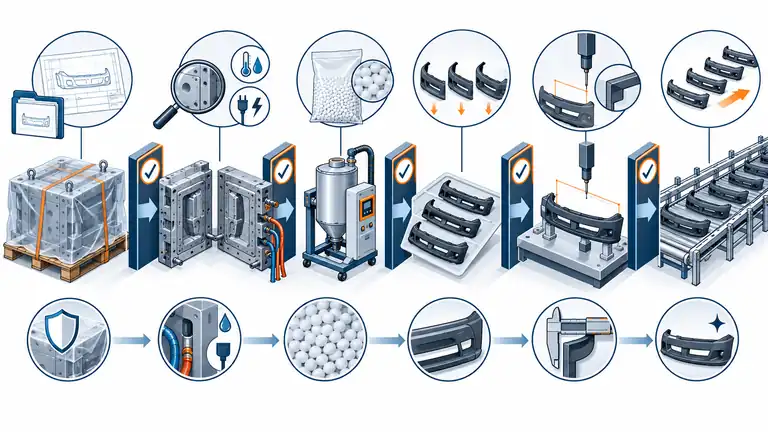
A repeat order after a long gap is not simply the previous setup loaded again. The drawing may have changed, approved material may be unavailable, gauges may be out of calibration, the mold may have deteriorated in storage, and the customer’s validation expectations may differ. Discovering these issues at the scheduled production start threatens delivery.
Treat the restart as a risk-based release event. Reconfirm product configuration, demand and approval requirements; audit the stored tool and production cell; verify resin, purchased components, gauges, packaging, and controlled documents; then run a planned trial with defined acceptance. The length of the gap is only one trigger—the number and significance of changes determine the evidence required.
Rebuild the approved baseline before scheduling production
The first task is to determine what “same part” means today. Use controlled records, not an old purchase order title or a physical sample alone.
Confirm customer and supplier part numbers, current CAD and drawing revisions, engineering changes issued since the last run, approved material grade and color, appearance standard, special characteristics, mating interfaces, test requirements, packaging, labeling, and destination. Identify the last approved production revision and compare it with the current order. If a service part intentionally remains at an older revision, document that exception and its authorization.
Review the last production package: mold and process revision, cavity status, setup record, material lot or approved source, inspection results, capability evidence where applicable, deviations, nonconformances, maintenance actions, and last accepted samples or boundary samples. A “golden sample” may help appearance or assembly comparison, but it does not override current engineering data or prove that its material condition remains representative.
Check customer-specific approval requirements. Determine whether the restart, time since last production, tool movement, material-source change, process-site change, equipment change, repair, or engineering revision requires notification or resubmission. Obtain the decision from the authorized customer channel. Do not infer a universal PPAP rule from the duration alone.
Use a restart baseline table:
| Baseline item | Last approved state | Current required state | Evidence/action |
|---|---|---|---|
| Product data | Revision and date | Current order revision | Controlled delta review |
| Material/color | Exact grade/source/state | Current approved availability | Supplier evidence and customer disposition |
| Mold | Revision, cavities, last condition | Inspected restart condition | Storage and maintenance records |
| Process/cell | Machine and setup | Proposed restart cell | Compatibility and setup review |
| Quality controls | Gauge, program, plan | Current calibrated/controlled state | Calibration and document review |
| Packaging/label | Last approved format | Current destination requirement | Packaging and label confirmation |
| Customer approval | Last submission/status | Restart requirement | Written customer decision |
The repeat-order consistency guide focuses on ongoing repeat production. A long-gap restart adds asset storage, obsolete inputs, and reactivation evidence.
Inspect the tool and cell as a system
A visual check of the mold exterior is insufficient. The reactivation review should follow the stored condition, mold design, purchased-system manuals, and production risks.
Compare the tool to its shutdown and periodic storage records. Verify identity, location, revision markings, preservation, corrosion, impact damage, missing loose items, open repairs, and spare inventory. Remove protection using approved methods. Inspect parting and shutoff surfaces, cavities and cores, gates, vents, ejection, slides/lifters, fasteners, cooling circuits, seals, connectors, sensors, and lifting provisions. Test hot-runner electrical and functional conditions under the manufacturer’s instructions.
Storage procedures matter. Husky’s hot-runner guidance includes cleaning dirt, debris, and condensation, completing preventive work, inspecting moving components, protecting accessible surfaces, and draining cooling water for specified storage conditions (Husky service and storage guidance). Those instructions are specific to the documented system; apply the actual mold and component manuals.
Verify the proposed cell. Confirm clamp, platen, tie-bar space, injection unit, screw and barrel suitability, nozzle interface, ejector, water supply and flow, hydraulic/pneumatic services, hot-runner controller, dryer and material handling, robot, secondary operations, and inspection equipment. If the original machine is unavailable, record differences and decide what process or validation evidence must be re-established.
Check calibration and software. Gauges, sensors, torque tools, scales, color instruments, leak testers, and test fixtures may have expired status. Inspection programs and machine recipes may have been revised or lost. Restore from a controlled source and verify against current drawings. A saved setup is a starting point, not evidence that the present machine and material will reproduce old results.
Classify findings before committing the run: ready for planned setup, service required, engineering review required, or customer disposition required. This prevents production pressure from converting an unresolved condition into an informal acceptance.
Verify material, components, and packaging availability
The mold can be ready while the supply chain is not. Long gaps increase the chance of resin discontinuation, grade/source change, expired color standard, degraded customer-supplied stock, missing inserts, or obsolete packaging.
Confirm the exact resin manufacturer, commercial grade, reinforcement or filler, color system, approved source, and relevant condition. Obtain the current technical data and processing guidance. Check whether the formulation, designation, or regulatory status has changed. A same-family substitute requires technical and customer approval according to the program; do not accept “equivalent nylon” or “same UL rating” as sufficient evidence.
Inspect stored resin and components against their packaging, lot, age, storage, contamination, and supplier instructions. Hygroscopic materials may require controlled drying, but drying cannot reverse every form of contamination or degradation. Use the grade-specific guidance and verify the material state needed for molding and later measurement.
For customer-supplied resin or inserts, reconcile quantities including setup, sampling, expected scrap, retained samples, and unused stock. Define who supplies replacements if incoming items are out of tolerance or insufficient. Check metal inserts for dimensions, finish, cleanliness, orientation, and feeding compatibility where applicable.
Packaging should be reapproved against current route and receiving use. Inspect returnable containers for condition and quantity. Verify dividers, protective films, contact zones, labels, barcodes, lot identification, and pallet configuration. A packaging specification from the last run may not match the current destination or transport lane.
Create a shortage and obsolescence action list with needed-by date and substitute/approval path. Long-lead items should be released before the molding slot is fixed. If a material or packaging change is likely, include its sample and approval timing in the restart schedule rather than assuming purchasing will solve it in parallel.
Run a restart trial with decision-ready evidence
The trial should answer whether the current tool, cell, material, controls, and packaging can produce the required part. Define acceptance before starting.
Prepare a trial plan with purpose, quantity, machine and auxiliaries, mold/cavity status, resin grade/lot/color, drying and handling, startup sequence, process-record fields, sampling by cavity and time, inspections, functional or assembly checks, packaging trial, owners, and stop criteria. Identify destructive tests and retained samples. Confirm safe setup and manufacturer procedures.
Start from the last controlled setup but establish a stable current process. Record actual conditions and adjustments. Separate startup scrap from stable output and label samples by cavity and time. Watch for effects consistent with storage or maintenance: leaks, blocked cooling, sticking actions, unstable hot-runner zones, corrosion marks, flash, short shots, ejection damage, appearance shifts, or dimensional drift.
The evidence should follow changed risk. At minimum, verify changed or critical dimensions, cavity comparison, appearance against current criteria, material and color identity, assembly interfaces, and packaging. Add capability, functional, environmental, or customer submission work where the applicable requirements demand it. A few acceptable parts do not demonstrate delivery capacity; if capacity matters, use a separately defined run-at-rate plan.
Illustrative example—hypothetical. A glass-filled nylon bracket returns after 24 months. The original resin grade remains available, but the mold was moved to another rack, one water fitting was replaced, and the original press has been retired. The restart plan includes tool inspection and water-flow/leak checks, destination-machine compatibility review, grade-specific drying, cavity/time-labeled samples, dimensional and assembly checks in the defined moisture condition, and customer disposition of the machine change. The example does not assume failure; it identifies evidence triggered by actual changes.
Issue a restart result with passed, conditionally accepted, and open items. Do not schedule serial shipment until the responsible authority closes the required release conditions.
Build the restart schedule backward from approved delivery
The requested ship date is not the molding start. Work backward through approval, production, inspection, packaging, and transport, then add the reactivation activities and decision points.
List document review, customer requirement confirmation, material procurement, tool inspection, spare or repair lead time, gauge calibration, machine reservation, trial, laboratory or assembly testing, customer review, production, final inspection, packaging, and logistics. Assign duration, predecessor, owner, and latest safe decision date. Show uncertainty as a range or contingency task.
AIAG and Odette describe MMOG/LE as a supply-chain capability and continuous-improvement tool used across the product lifecycle, including aftermarket/service phases, with attention to capacity, risk, and crisis management (AIAG MMOG/LE). Apply the customer’s specific logistics agreement and release rules.
If demand is urgent, evaluate controlled options: partial quantity after first approval, alternate approved machine, parallel gauge calibration, premium material logistics, or a customer-authorized deviation. Do not compress the schedule by silently deleting validation. If the tool or material cannot meet the need, communicate the evidence and decision deadline early.
After serial production, update the new baseline: current mold condition, process record, inspection, samples, maintenance, packaging, material, approvals, and next storage plan. A successful restart should improve the evidence available for the next gap.
For an RFQ or restart request, send current STEP and drawing, old and new revision history, forecast and required releases, exact material/color, last process and inspection records, mold location and maintenance history, destination machine, customer submission requirements, packaging, and mating components. Ask the supplier to return a gap audit, schedule, trial plan, evidence list, and exclusions.
Conclusion
Restart long-idle automotive molding by rebuilding the approved baseline, inspecting the complete tool/cell system, confirming material and controls, and running a risk-based trial. Schedule from approved delivery backward and obtain customer decisions for relevant changes. The previous setup is useful evidence, not automatic release.