
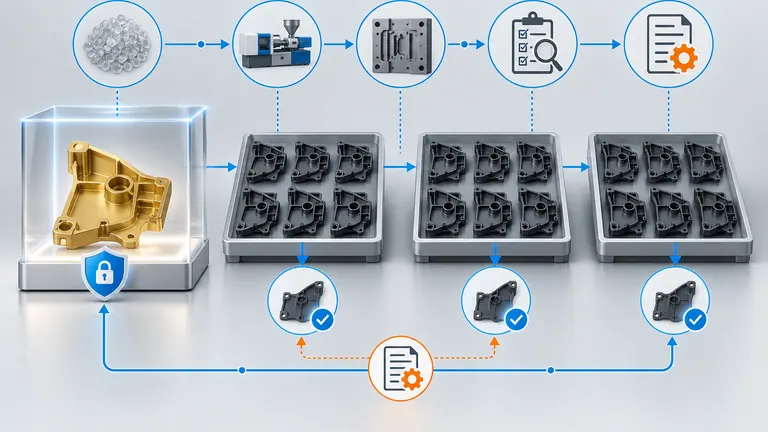
Conceptual illustration; not to scale.
Home › Blog › Keeping Repeat Automotive Molding Orders Consistent with Approved Samples
Automotive sourcing and manufacturing decision guide
Repeat orders often arrive with the phrase “same as last time.” That shortcut can silently preserve an expired deviation, an old drawing, an adjusted process, a substitute resin, a damaged cavity, or a changed pack. The parts may still look familiar while the evidence connecting them to the approved condition has broken.
Release every repeat order against a revision-controlled hierarchy: current design and customer requirements, valid changes and deviations, approved material and source rules, tool and process state, inspection and Control Plan, packaging, and defined boundary samples. Verify first-off output by active cavity, retain lot-to-shipment traceability, and route every proposed change through impact review and authorization before use.
Consistency comes from controlling identity and change at each order—not from trying to reproduce one old sample by appearance alone.
In This Guide
- Build a Baseline Hierarchy That Resolves Conflicts
- Use Approved and Boundary Samples as References, Not Substitutes
- Repeat-Order Consistency Checklist
- Release the Setup With Identified First-Off Parts
- Trace Exact Material and Production History Without Requiring the Same Lot Forever
- Stop Uncontrolled Changes and Reapprove the Affected Evidence
Build a Baseline Hierarchy That Resolves Conflicts
Why this matters: Drawings, deviations, material rules, process documents, packaging instructions, and samples can conflict or become effective on different dates. “Use the latest” is unsafe when no one has defined precedence or applicability.
Create a controlled hierarchy with owners, revisions, effective dates, and conflict rules. Reference the applicable set on the production order or traveler, and stop for disposition whenever two controlling records disagree.
List the controlling records in precedence order. A typical hierarchy starts with the customer contract and released drawing/specification, then approved engineering changes/deviations, exact material requirements, process/Control Plan and inspection documents, packaging instruction, and physical boundary samples for characteristics that need a visual or tactile reference.
Give each record a revision and effective date. The production traveler or order release should reference those revisions rather than saying “same as last order.” Last order may contain a temporary deviation, old drawing or undocumented adjustment.
Volvo Group’s public PPAP evidence table includes design records, engineering changes, material/performance results, sample product, master sample and checking aids as distinct records. That separation supports a useful rule: no single sample carries the full product definition.
Build a baseline register by part number. Include customer contract or sourcing requirement where it governs, released CAD and drawing, engineering changes, customer-specific requirements, deviations and expiry, material and color specification, approved source restrictions, mold and insert revision, process program, process flow, PFMEA, Control Plan, inspection instructions, gauges, packaging and label instruction, and any authorized physical master. Give each record an owner and effective serial, date, or lot. Archive superseded versions so historical shipments remain reconstructable.
Use the register during order review. Illustrative scenario: the prior shipment used deviation D-17 for temporary 100% inspection, but D-17 expired after 20,000 pieces; meanwhile drawing revision C is now effective and the packaging instruction remains revision B. The new order must reference drawing C and pack B, while D-17 cannot be copied forward without renewed authority. If the mold program or insert has not been updated for revision C, scheduling stops. This process prevents a successful previous shipment from becoming an undocumented substitute for current release data.
Design authority
- Released CAD/drawing/specification
- Approved engineering changes
- Customer-specific requirements
- Authorized deviations and expiry
Manufacturing authority
- Tool/cavity and process version
- Exact resin grade/color/source rule
- PFMEA/Control Plan/work instruction
- Inspection and reaction plan
Reference evidence
- Appearance/boundary samples
- First-off and retained samples
- Photographs under controlled conditions
- Previous lot and issue records
Use Approved and Boundary Samples as References, Not Substitutes
Why this matters: An approved or boundary sample is tangible and convenient, so teams may treat it as the complete specification. It cannot reliably define hidden geometry, material identity, numerical limits, or its own aging and storage effects.
Define exactly which visual, tactile, or assembly boundary the sample represents and which requirements remain controlled by documents and tests. Identify, protect, review, and replace the sample only through an authorized process.
An approved sample is evidence of an accepted condition at a point in time. It does not replace the released drawing or specification, and it cannot authorize a hidden dimensional, material or process deviation.
Define what the sample controls: overall color direction, maximum acceptable sink, texture, gate vestige, flash boundary, assembly feel or another named condition. Mark characteristics that cannot be judged from the sample and remain controlled only by drawing/test data.
Identify part number/revision, tool/cavity, resin grade/color/lot, molding date, approval reference, sample owner, storage condition and review/replacement date. Protect against sunlight, heat, contamination, deformation and handling damage.
Samples age. Polymers can relax, creep, absorb moisture, change appearance or become scratched/contaminated; the sample’s condition may no longer represent its approval date. Periodically compare its integrity with records and replace it only through a controlled approval. Never “refresh” a sample by selecting a convenient current part without authorization.
If drawing data and sample appearance conflict, stop and obtain disposition from the design/customer authority. Do not choose whichever reference is easier to meet.
Create a sample-control record that states part and design revision, sample ID, mold and cavity, material grade/color/lot, production date, process or trial reference, approval record, controlled characteristics, characteristics explicitly not controlled, storage method, owner, permitted handling, review date, and replacement rule. Mark the physical item without damaging the evaluated surface. Use photographs only as locator or condition records; they do not preserve gloss, texture, color, feel, or dimensional truth by themselves.
At use, first inspect the reference for contamination, scratches, warpage, fading, creep, moisture effects, or handling damage. Then compare production parts only under the defined method. A maximum-sink boundary does not authorize an out-of-tolerance rib, and a color master does not prove the resin grade. If the drawing and sample disagree, quarantine the decision and ask the design or customer authority to resolve it. When replacement is needed, retain the approval link between old and new samples; selecting a convenient current part would erase the control history.
Repeat-Order Consistency Checklist
Why this matters: Repeat-order checks are often distributed across planning, material control, molding, quality, and warehouse systems. A gap at any handoff can release the wrong revision or obscure suspect stock.
Use one staged checklist from order review through shipment. Each check should reference evidence, name the responsible role, and include a stop or reaction rule when the baseline, first-off, traceability, inspection, or packaging status is uncertain.
Use the checklist at order review, setup, in-process control and shipment release. A checked box should point to a record, not a verbal assumption.
Adapt the checklist to risk instead of checking every historical document on every order. Before scheduling, verify the purchase order identity, effective baseline, deviation validity, material and pack availability, tool status, maintenance, and required delivery. Before setup, confirm the physical mold and inserts, program, resin and color, drying and regrind instructions, gauges, reference samples, and current inspection plan at the cell. At first-off and in process, record cavity, conditions, checks, reaction, and any intervention. Before shipment, reconcile accepted quantity, holds, labels, packaging, and lot release.
Make each box auditable. “Material checked” should link to receiving or issue identity; “first-off passed” should link to identified samples and results; “pack correct” should name the instruction revision. Illustrative use scenario: planning releases the right part revision, but setup finds one interchangeable insert with no readable ID. The checklist reaction is to stop and verify the insert against maintenance and tool records—not to compare a molded part visually and continue. The completed record follows the order so later customer feedback can be bounded to the actual production state.
| Repeat-order checkpoint | Consistency evidence |
|---|---|
| Before scheduling | • PO part/revision and quantity match release • Open deviations are valid for this order • Tool/cavity status and maintenance are current • Material and packaging supply are available |
| Before setup | • Correct mold/inserts and program loaded • Approved resin grade/color/source rule verified • Drying/regrind/changeover instructions available • Current inspection plan and reference samples at cell |
| At first-off | • First-off IDs by active cavity • Critical dimensions/features checked • Appearance compared under defined conditions • Process parameters and deviations recorded |
| During the run | • Material lot and cavity trace maintained • Sampling frequency and reaction plan followed • Suspect output segregated • Stops, adjustments and tool interventions logged |
| Before release | • Quantity and inspection status reconciled • Deviations/holds have disposition • Labels and pack revision verified • Lot evidence retained per agreement |
| After shipment | • Order record closes material-to-shipment chain • Retained samples stored as required • Customer feedback linked to lot/cavity • Lessons/change requests enter formal review |
Release the Setup With Identified First-Off Parts
Why this matters: A single unmarked first-off part can miss cavity-specific damage, the wrong insert, startup contamination, color transition, or an undocumented process adjustment. Passing it does not establish a controlled setup.
Define stabilization, identify first-off parts by every active cavity, and inspect risk-selected characteristics that can detect wrong identity or setup drift. Record actual material and process conditions and require disposition before operating outside the approved baseline.
Define when first-off begins: after approved startup, material purge, stabilization and any cavity activation. Keep setup scrap traceable but separate from the accepted first-off set.
Check each active cavity where cavity-specific variation can occur. The inspection depth depends on risk and the current Control Plan; it is not automatically a full layout on every order. At minimum, cover the characteristics selected to detect wrong revision, material, insert, setup, cavity damage or appearance drift.
Record the process version and actual conditions with the first-off decision. A part that passes after an undocumented process adjustment does not establish a repeatable baseline. If the setup requires a change outside the approved window, stop and route the change for technical disposition.
The Control Plan and recent history should determine first-off depth. Typical triggers include initial setup, material or color change, mold or insert maintenance, cavity activation, prolonged stop, parameter or program change, and movement to another approved press. Checks may include identity, key dimensions, assembly or gauge fit, appearance boundaries, weight, marking, or a short functional screen. A full layout on every order is not automatically useful, while one superficial visual check may be inadequate for a cavity-sensitive clip or housing.
Use a first-off release form with order, part/revision, tool and insert IDs, press, date/time, operator and inspector, active cavities, sample IDs, resin/color/lot, drying and regrind, process-program revision, stabilization point, checks, results, deviations, and authorization. If an adjustment is required, compare it with the approved process window and reaction plan. Preserve the pre-adjustment condition and suspect production boundary. Only resume when the change is permitted or has received technical authorization; otherwise an apparently good first-off may rest on an uncontrolled process.
Identity
Order, part/revision, date/time, tool/cavity, press, operator/inspector and sample IDs.
Condition
Resin grade/color/lot, drying, regrind, process version and any startup intervention.
Decision
Checks performed, results, boundary comparison, accepted deviation and named release authority.
Trace Exact Material and Production History Without Requiring the Same Lot Forever
Why this matters: Demanding the same material lot forever is impractical, yet recording only a broad part number makes containment too wide. The necessary traceability resolution depends on actual product and process risk.
Control the released material identity and link each consumed lot, production interval, cavity state, inspection status, package, and shipment at the resolution required by the customer and risk analysis. Define transition and mixed-material boundaries in advance.
“Exact material” normally means the released manufacturer/grade/color and any approved source or property requirements—not reuse of one resin lot for the program’s life. Each actual lot should be recorded so performance or appearance concerns can be bounded.
Link purchase/receiving identity, certificate or supplier record where required, drying and blend/regrind data, hopper/press time window, molded lot, cavity identity, inspection status, pack labels and shipment. Define how mixed-material transitions are controlled and how the affected time/quantity window is calculated.
Traceability resolution should match risk. Lot-only identity may be enough for one part; cavity, shift, material batch and assembly component identity may be required for another. The customer’s contract and safety/critical-characteristic rules govern.
Map the traceability chain before production: supplier and purchase identity, receiving lot, certificate or verification where required, storage and conditioning, dryer and hopper issue, colorant or regrind blend, press time interval, mold and cavity, downstream components, inspection release, container label, finished lot, and shipment. When one raw lot spans several production lots or a hopper transition mixes material, document the logic used to calculate the affected window. Barcode systems help only if the physical and data transitions are controlled.
Choose resolution proportionately. Cavity identification may be essential where dimensions or wear differ; shift or time-window identity may be enough for another part. An assembled product may need links to purchased-component lots. Test the system with a mock trace: start from one shipment and identify material and production history, then start from one suspect raw lot or cavity event and identify affected inventory and customers. Record elapsed time and unresolved gaps. This is more meaningful than assuming that a printed lot code automatically creates effective containment.
Stop Uncontrolled Changes and Reapprove the Affected Evidence
Why this matters: Material, process, tooling, software, inspection, sub-tier, packaging, or location changes can enter through maintenance or shortage response without being recognized as changes to an approved production state.
Screen proposed and emergency changes before implementation, assess affected product and process evidence, obtain the required internal and customer authorization, and control timing, inventory, validation, and traceability through the transition.
Volvo’s supplier manual identifies drawing/specification, process, material and sub-tier changes as customer-notification triggers in its system. IATF’s official FAQ page is the correct public starting point for current clarifications, but paid-standard and customer-specific text must be checked by the responsible team.
Use a change request that states reason, old/new condition, affected parts/tools/cavities, risk analysis, proposed validation, inventory/transition plan, approval authority and effective serial/date. Include maintenance-driven changes when they alter an approved condition.
Align repeat orders with the automotive plastic injection molding route and define evidence on the quality and automotive validation page. For a new or transferred baseline, start a project review before releasing the first repeat order.
Scope boundary: This article is a planning aid, not an OEM approval rule. The released drawing, contract, customer-specific requirements and agreed validation plan control the actual project.
Use a change-request form with reason, old and proposed conditions, affected part numbers and customers, tools and cavities, sites and sub-tiers, risk analysis, evidence to repeat, customer-notification requirement, trial plan, inventory segregation, effective date or serial, rollback, owner, and approvals. Include tooling refurbishment, replacement sensors or hot-runner components, new colorant source, changed regrind, software updates, alternate gauges, subcontracted operations, and pack changes when they can affect the released condition. “Maintenance” is not an exemption when the result changes form, fit, function, appearance, process, or detection.
Illustrative scenario: the approved resin grade is temporarily unavailable and a distributor proposes a nominally similar material. Do not release it from a generic datasheet comparison. Confirm design authority, source and grade, processing and shrinkage, color, regulatory or customer constraints, affected testing, tool/process settings, labeling, and inventory transition. If temporary approval is granted, define quantity, time, containment, traceability, and expiry. After implementation, update the baseline register and repeat-order documents so the next setup cannot accidentally return to an obsolete condition.
Conclusion
Release repeat orders against named revisions, verify first-off output by active cavity, and preserve a tested material-to-shipment traceability chain. Before scheduling, provide the current drawing, material and source rule, mold and insert status, process and inspection versions, boundary-sample record, packaging revision, and every active or proposed change.
Related Decision Guides
- T1 Sample Approval vs. Production Release: What Still Needs to Be Closed?
- Automotive Injection Molding MOQ: Annual Volume vs. Order Quantity
- Automotive Molding Capacity: What a Run-at-Rate Trial Should Demonstrate
Release the Next Order Against a Named Baseline
Provide the current drawing, material rule, tool/cavity status, reference-sample record, Control Plan, packaging revision and open change list. The review can focus on what changed since the approved order.
If the inquiry popup does not open in your browser, use the full automotive project RFQ.