
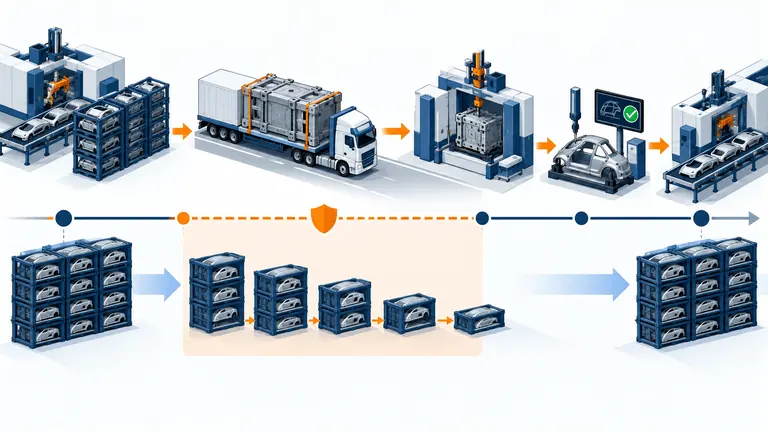
Moving an automotive mold stops approved production at one site before the receiving site has proved equivalent output. A buffer can protect customer releases during transport, installation, trial, correction, and approval—but only if its quantity, revision, shelf or storage limits, ownership, and drawdown rules match the actual transfer plan.
Calculate the buffer from demand during the protected window plus defined uncertainty, then subtract usable inventory and any approved alternate supply. Build the window from last production through receiving-site release, not transport time alone. Confirm product revision, packaging, traceability, material condition, cash and obsolescence responsibility, and the decision points that release or consume the stock.
Define the protected window and demand signal
The buffer’s purpose is to cover a named interval when the original tool cannot make approved parts and the new site is not yet released. If the interval is vague, inventory becomes an arbitrary number of weeks.
Build the transfer timeline from the last accepted source-site run. Include final production and inspection, mold cool-down and preparation, condition audit, preservation and packing, export and import formalities if applicable, transport, receiving inspection, installation, machine and auxiliary setup, tool service or adaptation, material readiness, dry cycle, molding trial, dimensional and functional review, customer submission or approval, serial run, packaging, and first delivery from the receiving site.
For each task, identify nominal duration, credible delay range, predecessor, owner, and evidence of completion. Transport may be only a small part. Customer review, machine scheduling, hot-runner interface correction, cooling repair, gauge availability, or material approval can govern the protected window.
Use the right demand signal. Separate long-range forecast, firm releases, service demand, and planned shutdowns. Map demand by day or week across the window, including plant-specific destinations and left/right or color mix. Do not average a peak launch week into an annual rate. Confirm whether the customer may change releases inside the transfer horizon.
Automotive logistics guidance treats materials management as a controlled capability. AIAG’s MMOG/LE resources address capacity planning, risk, crisis management, and supply-chain processes across the product lifecycle (AIAG MMOG/LE). Customer schedules and agreements remain controlling. Volvo’s published delivery manual, for example, states that serial delivery instructions define exact dates and quantities and that suppliers should compare schedules with available capacity (Volvo delivery manual).
Set the buffer start and end gates. Start may be the last approved lot before tool shutdown. End should be first approved, deliverable production at the receiving site—not the first mold trial.
Calculate quantity with visible assumptions
A practical model separates base demand, uncertainty, usable inventory, expected scrap or hold, and alternate supply. Avoid a single “safety factor” that no one can explain.
Use this structure:
Required transfer buffer = demand during protected window + named uncertainty allowance + non-saleable trial/service needs − verified usable inventory − approved alternate supply
Demand during the protected window should use the customer’s dated release/forecast hierarchy. The uncertainty allowance can cover specific risks such as customs variability, one expected correction loop, customer approval timing, or forecast change. Do not add all worst cases simultaneously unless that is the approved scenario; instead show base, credible delay, and severe contingency cases.
Verified usable inventory means the correct part revision, material and appearance status, remaining shelf/storage suitability where relevant, acceptable packaging, labels, and destination. Quarantined stock, unapproved samples, parts reserved for another plant, or inventory without traceability should not reduce the requirement until dispositioned.
Illustrative example—hypothetical, not a supply commitment. Firm releases during the planned five-week protected window total 25,000 parts. The team models a two-week approval-delay case at 4,500 parts per week, adding 9,000. It also needs 600 parts for receiving-site assembly and destructive validation. Verified usable inventory at the source is 3,500, and no alternate source is approved.
25,000 + 9,000 + 600 − 3,500 = 31,100 parts
The team could set 31,100 as the target build under this scenario, then round only for an explicit production or packaging reason. It should also calculate a base case without the delay and a severe case if management needs a contingency decision. If demand changes before the build, update the model rather than preserving the original number.
Translate parts into shots, run hours, material, packaging, pallets, storage space, inspection capacity, and cash. Use demonstrated acceptable output—not nominal cycle and perfect yield—to schedule the source run. Include changeovers, maintenance, downstream operations, and final inspection. Confirm that building the buffer does not endanger other current releases.
Check product life, revision, and inventory risks
More stock is not always safer. The buffer can become obsolete, degrade, consume storage capacity, or hide an unresolved transfer problem.
Confirm the product revision throughout the protected window. If an engineering change is scheduled, decide whether the buffer should be old revision, new revision, or split by customer effective point. Map old and new inventory, in-transit stock, rework possibility, and authorization. A buffer built to the wrong revision creates both shortage and obsolescence.
Review material and part storage limits. Plastics may change dimension or appearance with moisture, temperature, UV exposure, stress relaxation, or packaging pressure depending on resin and geometry. Adhesives, labels, lubricants, seals, or assembled components can introduce separate life limits. Use grade- and component-specific manufacturer guidance and customer rules; do not assign a generic shelf life to all molded parts.
Validate packaging for the buffer duration and handling frequency. Long storage can increase stacking load and surface-contact time. Confirm supports, contact exclusions, orientation, bag or film compatibility, container condition, maximum stack, lot identification, FIFO, and repacking restrictions. If parts will be stored at a third-party warehouse, define environment, inventory transactions, and damage reporting.
Create a buffer risk table:
| Risk | Control | Evidence before build |
|---|---|---|
| Revision obsolescence | Effective-point and disposition plan | Approved change schedule |
| Material/part aging | Condition-specific storage and review | Supplier/customer requirement |
| Appearance or deformation | Validated pack and stacking | Packaging trial/inspection |
| Mixed lots/cavities | Traceable labels and locations | Inventory and scan plan |
| Forecast reduction | Ownership and drawdown rule | Commercial approval |
| Quality hold | Segregation and replacement scenario | Inspection/reaction plan |
| Delayed transfer | Recalculation and escalation trigger | Weekly status and decision date |
Finance and purchasing should approve ownership and obsolescence treatment. The supplier should not assume the customer will purchase excess forecast stock, and the customer should not assume the supplier will finance an undefined transfer delay. Use the governing agreement and written authorization.
Tie buffer release to mold-transfer gates
Inventory should be built and consumed against the same transfer control plan. Define who can authorize each gate and what evidence is needed.
Before the buffer run, close current drawing and material, source tool condition, maintenance, cavity status, process, inspection, packaging, labels, quantities, and customer authorization. Produce cavity- and lot-traceable parts under the approved source process. Retain samples and records that can support later comparison with the receiving-site output.
Before tool shipment, complete the joint condition review, documentation and spare inventory, preservation, interfaces, packing, and logistics. The automotive mold transfer checklist owns that technical handover. The buffer calculation should use its actual open actions and timing.
At the receiving site, compare new samples with current product requirements and the agreed source baseline. Evaluate dimensional, appearance, assembly, functional, material, and process evidence according to affected risks and customer requirements. A mold that cycles does not close the transfer. If correction is needed, update the protected-window forecast and buffer balance immediately.
Set inventory release rules. Which lots can ship while transfer approval is pending? What inspection or certificate accompanies them? How is FIFO managed? When can receiving-site parts mix with source-site parts? If two origins require different labels or approvals, keep them separate. Define the final buffer disposition once the new site is stable.
Track daily or weekly: opening buffer, customer demand, shipped quantity, holds, rejects, usable balance, revised days of coverage, transfer-gate status, and next decision. Coverage should use current demand, not the original average. Establish escalation points before coverage falls below expected remaining approval time.
Use decision dates instead of hoping the plan holds
A robust transfer plan includes predetermined decisions. If transport slips, if the first trial fails, or if customer approval extends, the team should know when to add a source run, expedite an action, activate an alternate route, or negotiate revised releases.
Some options disappear once the mold is removed. Set a final go/no-go review before source production ends and again before shipment. Confirm buffer quantity and quality, destination readiness, transport booking, documentation, receiving machine slot, resin, gauges, people, and customer approval availability. If a critical item is missing, compare the cost and schedule of delaying shipment with the risk of losing source production capability.
If the source can run again after packing, record the unpack, setup, production, and repacking lead time. If shipment or modification makes return impossible, identify that irreversible point. A second tool or approved alternate source can reduce exposure, but it requires its own capacity and equivalence evidence.
Provide management with scenarios, not false certainty: planned release, one correction loop, extended approval, and severe disruption. Show buffer quantity, cash, storage, obsolescence exposure, and remaining shortage risk for each. Approve the scenario used to authorize production.
For a transfer request, prepare demand by week and destination, current releases, inventory by status/revision, source capacity, tool and maintenance records, destination readiness, route and customs timing, validation requirements, packaging, material availability, and customer decision lead time. Ask both source and receiving suppliers to confirm tasks and durations. This allows the buffer to be recalculated from evidence.
Conclusion
Build a transfer buffer from demand over the full source-stop-to-new-site-approval window, plus named uncertainty and validation needs, less only verified usable supply. Protect revision, storage, packaging, traceability, and commercial ownership. Track coverage against transfer gates and act at predetermined decision dates before options disappear.