
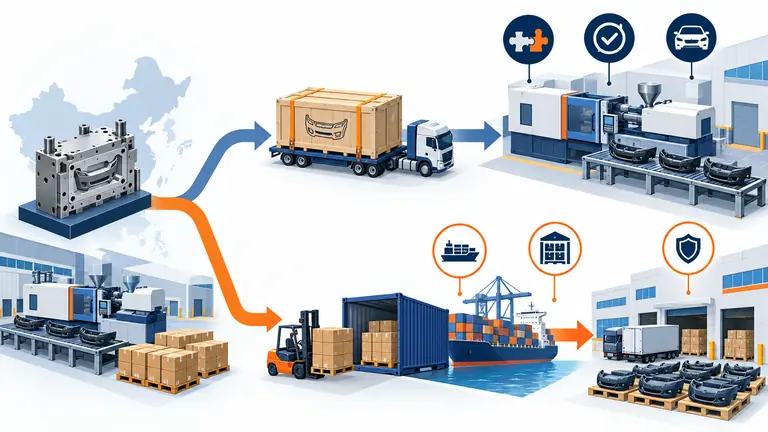
A buyer can order a mold in China and export it to a local molder, or keep the mold with the supplier and import finished parts. The lower tool price or piece price does not settle the decision. Machine compatibility, validation, logistics, demand stability, tool custody, and the buyer’s local molding capability can dominate the result.
Compare the two supply models against the same product revision, production volume, destination, quality requirements, and program horizon. Tool export shifts serial-process responsibility to the destination molder and demands destination-machine compatibility and revalidation. Parts production keeps mold and process integration with one supplier but adds finished-goods logistics, border, inventory, and remote-custody considerations. A hybrid or staged path may be justified.
Define the two operating models precisely
“Buy a mold” can mean an export-ready tool accepted in China and shipped to a customer-nominated molder. “Buy parts” can mean supplier-owned or customer-owned tooling remains at the Chinese production site, with approved parts exported on releases. The commercial and technical boundaries must be written.
For tool export, identify who designs and builds the mold, where it is trialed, which machine and auxiliary equipment are used for acceptance, who supplies resin and gauges, what documentation and spares ship, who arranges preservation and freight, and who performs destination installation, setup, trial, correction, and customer approval. The destination molder should review the tool specification before steel release, not after arrival.
For parts production, identify who owns and holds the mold, who maintains it, which cell and sub-suppliers are approved, how demand is released, what inventory is held, the delivery term and destination, how changes are controlled, and how a future transfer would work. Include packaging, traceability, receiving inspection, and customer submission boundaries.
A hybrid can use Chinese parts production during launch and transfer later, retain a bridge or backup tool, or split tooling and serial production suppliers. These options create additional interfaces and may require repeated validation. They should be selected to retire a named risk rather than presented as free flexibility.
Build a responsibility map for product design, DFM, mold design approval, material, trials, gauges, PPAP or customer submission, process validation, serial quality, logistics, maintenance, changes, and transfer. If two parties believe the other owns a task, the supply model is not ready for quotation.
The export mold acceptance checklist details pre-shipment evidence. The present decision is broader: whether exporting the asset or exporting production parts better fits the customer’s complete operating system.
Test machine, process, and validation transferability
An export tool must fit and run in the destination system. Platen and tie-bar space are only the beginning. Review mold dimensions and weight, daylight and stroke, clamp requirement, locating ring, nozzle interface, sprue or hot-runner connection, injection-unit capacity, ejector pattern and stroke, hydraulic/pneumatic/electrical interfaces, cooling connections and available flow, controller compatibility, robot clearance, lifting, and local safety requirements.
Compare the trial machine with the destination machine. Differences in screw diameter, injection rate, pressure capability, control behavior, platen deflection, cooling supply, hot-runner controller, dryer, robot, or downstream equipment can change the process window and part result. Acceptance in China should demonstrate the agreed tool condition, but destination approval still needs production-intent evidence.
Ask for a machine compatibility matrix signed off by the destination molder before mold design release. Include actual machine manuals and interface drawings where available. The destination-machine fit guide provides a focused checklist.
For parts production in China, machine transferability is less immediate because the builder and molder may share the launch cell. However, the buyer still needs evidence that the proposed serial cell, material handling, automation, inspection, and secondary operations are production intent. If the mold later moves, missing interface records become a transfer risk.
Validation must be assigned by evidence level. Mold acceptance, molded-part dimensional approval, material certification, process capability, assembly testing, and system approval are different decisions. The customer’s requirements determine submission and change approval. AIAG describes APQP, Control Plan, PPAP, FMEA, SPC, and MSA as linked core tools (AIAG Quality Core Tools); neither supply model removes the need to define applicable customer-specific requirements.
Compare recurring supply economics and working capital
Tool export typically adds asset packaging, freight, customs handling, destination setup, and possible correction or revalidation. It may reduce ongoing finished-part international freight and pipeline inventory if production is close to use. Parts production avoids an early tool move but places each shipment into an international logistics and inventory model.
Build two cost views. The launch cash view shows mold, validation, gauges, packaging development, export crate or initial logistics, destination setup, and duplicated trials. The recurring view shows accepted part price, packaging, transport, duties and taxes as applicable, receiving, inventory carrying, inspection, and quality or disruption scenarios. Do not bury tool-export cost in the first year’s piece price unless the amortization method is explicitly part of the comparison.
| Decision area | Export mold to destination | Produce parts in China | Evidence |
|---|---|---|---|
| Launch interface | Tool builder to destination molder | Tool builder integrated with production site | Responsibility and timing map |
| Machine risk | High importance before design release | Serial-cell evidence still required | Compatibility/process matrix |
| Validation | Destination re-establishment normally needed | Production-site validation | Customer requirement matrix |
| Recurring logistics | Shorter if destination is local | International finished-goods lane | Landed-cost model |
| Inventory | Potentially lower pipeline | Transit and risk-specific buffer | Demand and lead-time scenarios |
| Tool custody | At destination | Remote with supplier | Ownership/custody records |
| Changes/repair | Local capability and data required | Integrated supplier response, remote oversight | Change and maintenance plan |
| Continuity | Depends on local cell/tool backup | Depends on lane, supplier, inventory, backup | Contingency plan |
For the parts-production model, use a current landed-cost analysis. Incoterms® rules allocate specified delivery obligations, costs, and risks, but not every contract issue (ICC explanation). Product classification, origin, destination, customs value, and current trade measures must be confirmed by qualified parties. The total landed-cost checklist provides the calculation structure.
Illustrative example—hypothetical. A stable, high-volume part used near a qualified local molder may favor tool export if destination setup and revalidation are manageable and recurring freight/inventory dominate. A lower-volume part with uncertain design and no capable destination molder may favor parts production at the integrated supplier, at least initially. These are scenario conclusions, not universal rules; change maturity, total demand, or available local capability and the answer may reverse.
Compare control, maintenance, and change response
The asset location changes who can inspect, maintain, repair, and modify it. Buyers should compare the actual control process, not assume local is always transparent or remote is always inaccessible.
For an exported tool, confirm the destination molder has compatible equipment, maintenance skills, purchased-system support, spare access, controlled drawings, and authority boundaries. Decide who resolves tool-builder versus molder responsibility if the destination process does not reproduce the acceptance result. Preserve baseline evidence before shipment so damage, setup difference, or design issue can be distinguished.
For a tool retained in China, define ownership marking, location, permitted use, access and audit rights, maintenance records, cycle tracking, spare inventory, insurance where applicable, and transfer package. A remote tool should still have an auditable identity and condition. The mold storage and custody guide separates ownership, custody, authorization, and cost.
Engineering changes need a common controlled process. In the export model, product engineering, tool builder, and destination molder may all participate. In the parts model, the supplier may integrate work faster, but customer authorization and validation still govern. Compare response assumptions for CAD review, quotation, steel work, trial scheduling, samples, freight, customer approval, and inventory phase-in.
Maintenance budgeting should follow actual tool systems and exposure. If proprietary hot-runner or sensor support is stronger in one location, include spares, service travel, downtime, and local component availability. Do not compare only hourly toolroom rates.
Use a weighted decision with explicit gates
Weight criteria by the program’s real risks. A safety- or function-critical application with demanding customer approval may place more weight on process governance and local integration. A stable aftermarket part may prioritize total cost, flexible releases, and service supply. The weight should be approved before supplier scores are known.
Score evidence, not sales claims. A suggested matrix includes product/design maturity, destination molding capability, machine compatibility, validation plan, launch timing, recurring landed cost, demand variability, inventory exposure, maintenance support, change response, tool custody/transfer, logistics resilience, and IP/control requirements. Use a 1–5 scale only if each score has a written definition and source.
Set non-negotiable gates. Examples are confirmed destination machine fit before export-tool steel release, customer acceptance of the proposed production site, approved material source, controlled data package, and a feasible validation path. A weighted total should not allow excellent freight cost to compensate for a failed technical gate.
Before RFQ, prepare controlled STEP and 2D data, material and appearance requirements, annual demand and release pattern, customer validation requirements, destination and candidate machine data, desired ownership/custody model, packaging and logistics assumptions, and expected change/service needs. Ask each bidder to return both operating models where feasible, using the same assumptions and responsibility table.
The final award should state not only where the mold is built, but where parts are approved for serial production, where the asset will reside, how releases and changes flow, and what evidence enables future transfer. Those decisions create the supply path.
Conclusion
Choose tool export or China parts production by comparing complete operating systems. Test destination compatibility and revalidation for an exported mold; test landed cost, inventory, remote custody, and transferability for imported parts. Use technical gates and an evidence-weighted matrix, then document the responsibilities that continue after launch.