
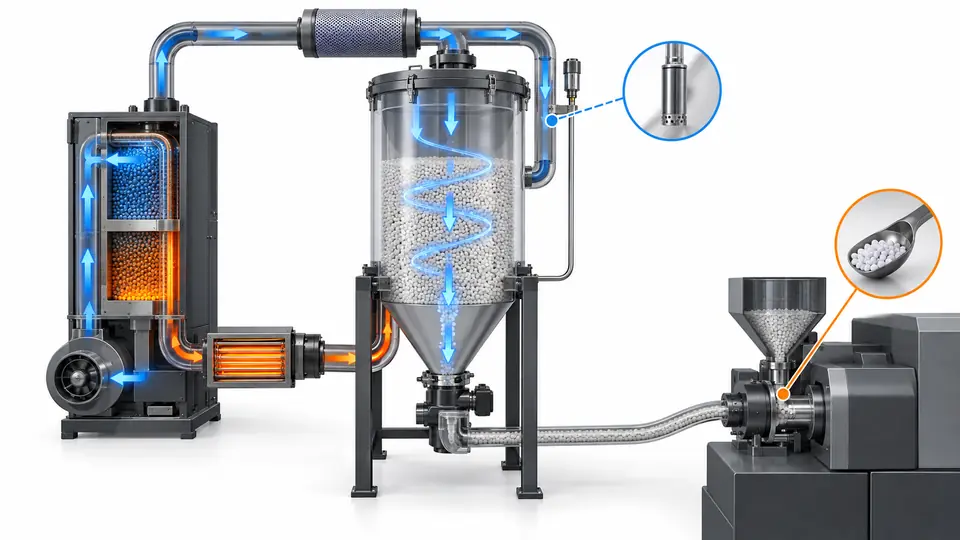
A dryer can display the specified temperature while wet pellets reach the machine because the air is not dry enough, flow is restricted, residence time is short or newly added material short-circuits the hopper. Conversely, excessive heat or time can damage some grades.
Use the current supplier instruction for the exact grade and control the complete path: package exposure, loading, pellet temperature, time, dew point, airflow, hopper residence and transfer to the throat. When a moisture limit governs release, verify it with a suitable method and sampling plan. One dryer-temperature value is not proof.
Start with the exact grade and incoming condition
Different polymers and grades absorb moisture differently, and opened or damaged packaging changes the starting condition.
Identify manufacturer, full grade, color/additives, lot, packaging condition and exposure history. Obtain current drying temperature, time and moisture guidance from the material supplier.
Do not apply a nylon, PBT or TPU family table as final instructions for every compound. Do not apply a nylon, PBT or TPU family table as final instructions for every compound. For nylon specifically, drying before molding and dimensional acceptance after molding are two different decisions: which state a nylon part’s dimensions are accepted in — dry-as-molded or conditioned — is decided in Dry-as-Molded vs. Conditioned Nylon Parts: Which Dimensions Should Be Accepted?; this guide owns getting the pellets dry, and that guide owns the acceptance state of the part once it is made. Flame retardants, reinforcement and additives can change temperature limits. Inspect moisture-barrier bags and record when they are opened. Cold material may develop surface condensation after entering a warm plant. Quarantine unidentified or visibly contaminated resin; drying cannot restore the wrong material. BASF grade information illustrates that handling recommendations can distinguish unopened from previously opened containers.
Build the review around exact grade document, lot/package status, open-time history and customer material requirement. The decision is whether the drying plan matches the actual material and starting condition. Conservative redrying protects unknown exposure but can add delay or thermal history; direct moisture evidence may support a better decision.
Control the four drying functions
Heat, dry-air dew point, time and airflow each perform a different function and none can substitute completely for another.
Verify pellet temperature, drying-air dryness, sufficient exposure time and airflow through the material bed. Record actual values and alarms, not only setpoints.
NOVATEC explains that heat mobilizes moisture, low-dew-point air creates a vapor-pressure driving force, time permits diffusion and airflow carries heat and moisture. A low dew point without heat may dry too slowly; high heat with wet air may not reach the target; time on a clock is irrelevant if pellets were below temperature. Inspect filters, regeneration, heater, blower and return-air path. Use supplier ranges and dryer capability rather than a universal dew-point number.
The working record should contain process and return temperatures, dew point, airflow or differential indicators, time at condition and dryer maintenance rather than a conclusion copied into email. Review the source, revision, units, sample selection and boundary conditions, then test whether all required drying functions operated together for the lot entering production. Higher temperature can shorten drying only within grade limits; excessive heat may degrade resin or additives.
Calculate residence and loading behavior
Average hopper volume can hide first-in/last-out mixing, channeling and fresh wet material entering the outlet too soon.
Size the usable hopper and feed rate for the required time, define loading level and refill method, and prevent undried additions from reaching the throat before qualification.
Use mass flow per hour and effective—not nameplate—hopper inventory. Consider bulk density, cone volume and production interruptions. A full batch drying approach gives a clear release time but may reduce flexibility; continuous operation needs stable plug-like movement or a supported residence distribution. Mark startup material and manage changeovers. If the machine stops, decide whether heat exposure becomes excessive or whether material can remain. Record loader events so a refill alarm can be related to affected shots.
Ask the supplier to connect hopper usable capacity, bulk density, consumption rate, refill events and residence-time calculation to the proposed part and production state. The evidence is sufficient only when every pellet population has received the required exposure before entering the machine. Large hoppers provide residence margin but increase inventory, energy and risk of excessive time for heat-sensitive grades.
Distinguish air dew point from pellet moisture
Dry air capability indicates the dryer environment; it does not directly state how much moisture remains in the pellets.
Use dew point to monitor dryer performance and a suitable material-moisture method when the specification requires pellet release. Define sampling location, handling, method and acceptance source.
A sample can absorb ambient moisture between hopper and analyzer. Collect it from the agreed location, use a clean sealed container and test promptly. Loss-on-drying, Karl Fischer and other methods may measure different volatile contributions and need grade-appropriate procedures. Calibrate or verify the instrument and use blanks/standards as applicable. Do not compare ppm or percent without converting units and basis correctly. A passing sample from the top of the hopper may not represent material at the machine throat.
Use dew-point trend, moisture method, sample point/time, sealed handling, instrument control and grade-specific limit to challenge the preferred option. The release test is whether dryer condition and pellet moisture are monitored as related but distinct evidence. Direct moisture testing adds time and equipment; it is most valuable when hydrolysis or customer requirements make actual pellet condition critical.
Protect the dry state through conveying and the machine
Resin can reabsorb moisture or mix with untreated material after leaving a well-controlled dryer.
Use a closed, clean transfer path, minimize open exposure, control machine-hopper residence and prevent shared-line contamination. Include regrind or masterbatch only under approved preparation rules.
Check hoses, receivers, seals and purge of previous resin. A small unheated machine hopper in humid air can undo drying during interruptions. If color concentrate has a different moisture condition, define how it is dried or protected and whether the supplier permits the route. Regrind has greater exposure and surface area history and should not enter by habit. At shutdown, identify material remaining in lines and hopper and decide its disposition. Trace dried lot and preparation window to the production batch.
Before closing this point, reconcile closed transfer layout, line-clearance record, machine-hopper exposure, additive/regrind controls and lot linkage with the controlled product definition. The reviewer should be able to show that the verified dry material state is maintained until melting. Fully closed systems improve control but need cleaning and maintenance; manual transfer can work only with strict exposure and identification limits.
Define alarms, holds and recovery
A dew-point, temperature or loader excursion needs a product decision, not only a dryer reset. If streaks are present, separate moisture from other splay causes before attributing the symptom to the dryer.
A dew-point, temperature or loader excursion needs a product decision, not only a dryer reset. If streaks are present, separate moisture from other splay causes before attributing the symptom to the dryer. That separation — moisture versus heat and residence, shear and decompression, venting and gas, condensation, and contamination, tested by controlled one-factor trials — is owned by Splay on Automotive Plastic Parts: Separating Moisture, Heat and Shear; this guide owns the drying path, and that guide owns deciding whether the streaks were a drying failure at all. Set evidence-based alarm limits and delays, identify the earliest potentially affected material, hold corresponding parts, correct the cause and re-establish drying evidence before release.
Use hopper residence and material movement to estimate which shots could contain under-dried resin. Do not release because surface splay is absent; hydrolytic degradation can affect properties without obvious appearance. Use material history and mechanical evidence to investigate brittle parts after a drying excursion before changing the resin or releasing affected output. Use material history and mechanical evidence to investigate brittle parts after a drying excursion before changing the resin or releasing affected output. That investigation — population, material, drying, process and geometry evidence, in sequence, before any resin change — is owned by Unexpected Brittleness in Automotive Molded Parts: What to Check Before Changing Resin; this guide owns the drying excursion and its containment, and that guide owns deciding whether the brittle parts are a wet-processing failure at all. Confirm the sensor and actual condition before changing limits. Recovery may require diverting material, extending time or rechecking moisture according to supplier guidance. Document interruption, action, affected lot and disposition. Trend repeated excursions for dryer maintenance or capacity review.
Release from this stage should cite alarm history, material-flow timeline, affected-part boundary, recovery record and moisture/part verification and explain why drying excursions lead to justified containment and verified restoration before production release. Immediate broad containment is safe but costly; a validated material-flow model can narrow the boundary without guessing.
Drying-system verification sheet
Complete the sheet for each exact resin grade and production lot.
| Review line | Input or evidence | Decision or action |
|---|---|---|
| Incoming | Grade, lot, package and exposure | Set starting state |
| Heat | Pellet/process/return temperature and limits | Mobilize moisture safely |
| Dry air | Dew point and regeneration status | Maintain drying force |
| Time/flow | Hopper capacity, feed, refill and airflow | Deliver exposure |
| Moisture | Method, sample point, units and limit | Verify pellets if required |
| Reaction | Alarm, affected material and recovery evidence | Control excursions |
Keep setpoints, actuals and material movement together. A compliant dryer display without lot and residence context does not release the pellets at the throat.
Drying-path worksheet — buyer fill-in
Complete one row per grade and production lot from the resin supplier’s current instruction for the exact grade and from the measured values at the press. Every field is blank until it is filled in from those sources; a blank field means the value has not been supplied, not that any default applies. No dryer temperature, dew point, time, airflow, residence, or moisture value is stated in this guide.
| Grade (manufacturer + full grade + lot) | Dryer temperature (setpoint + actual) | Dew point (actual) | Time at condition | Airflow | Residence (usable hopper capacity + feed rate + refill pattern) | Verified pellet moisture (value + units + method + sample point) |
|---|---|---|---|---|---|---|
The article’s illustrative scenario mentions a "nominal four-hour average" for a PA compound. That figure is a scenario value inside a labelled illustrative example, not a real setting and not a recommendation — do not copy it into this worksheet or into a production instruction. Fill in the time column from the supplier’s instruction for the exact grade and the calculated residence for the actual hopper and feed rate.
Applying the method to a defined situation
A PA compound requires controlled drying. The dryer shows the target temperature, yet moisture results near the machine vary after refills. Review finds that fresh pellets enter a partially empty hopper and reach the outlet before the nominal four-hour average. The team changes the loading rule, verifies airflow and dew point, calculates usable residence, and samples from the transfer point in sealed containers. Production after an excursion is held according to the material-flow timeline, not released from visual appearance alone.
This illustrative scenario is not a customer case.
Questions for the supplier review
- What exact grade instruction and moisture criterion apply?
- How long were packages open before loading?
- Are pellet temperature, dew point, airflow and time all verified?
- What usable hopper capacity and refill pattern determine residence?
- Where and how is pellet moisture sampled?
- Which parts are held after an alarm and what evidence releases recovery?
Information to submit for a project-specific review
Provide resin grade and supplier guidance, packaging/exposure history, dryer and hopper data, feed rate, loader/transfer layout, moisture method and limits, alarm history and affected part characteristics. Submit these inputs through the AutoMoldingPro request form. Mark unresolved points as assumptions so they can be priced and closed before tooling or production commitment.
Conclusion
Drying is a controlled material path, not a temperature setting. Grade identity, heat, dry air, time, flow, moisture evidence and reaction rules must remain connected to the production lot.