
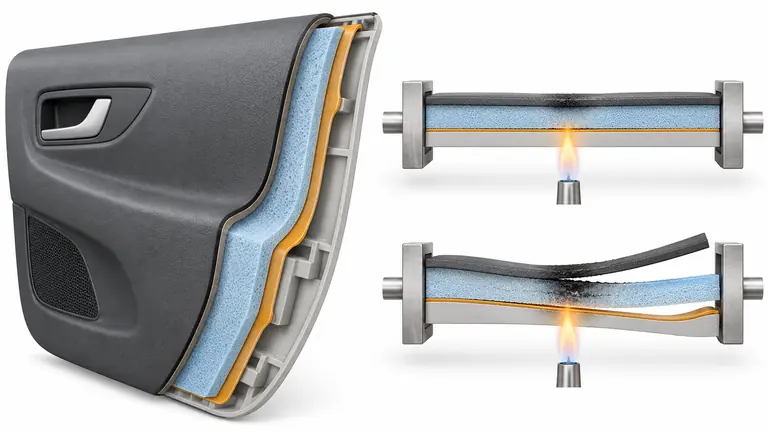
A supplier may present a passing resin or plaque result while the vehicle part uses a skin, foam, adhesive and substrate in a different thickness and orientation. The UL 94 guide explains how a resin rating is tied to the exact grade, thickness and color — and why it cannot be borrowed for a different construction. That evidence can be irrelevant if the regulated construction and specimen are not the same as the tested sample.
For U.S. scope, start with the current text of 49 CFR 571.302. Identify whether the component portions fall within its application, how single or composite materials are arranged, which surface faces the occupant space, and what specimen can be prepared. Then agree conditioning, sampling and reporting with the responsible customer or compliance function. Where flammability is one test inside a wider validation plan, the plan itself — which environmental tests apply, in what sequence, and whose laboratory responsibility each one is — is defined before quotation in Defining Environmental Tests for Automotive Plastic Parts Before Quotation; this guide owns the FMVSS 302 scope and specimen decision, and the test-plan guide owns the plan it sits inside.
The following review separates legal applicability, construction definition, laboratory execution and the limits of the resulting evidence.
Confirm whether the component portion is in scope
the listed occupant-compartment components and the location of material relative to occupant compartment air space can change cost, function and release evidence if it is decided after the quotation or tool concept is fixed.
Define mapping the production component and every relevant portion against the current regulation before requesting a test before commitment. Use project-specific inputs and an acceptance record; do not assume that a familiar process is automatically suitable for this part.
The review should begin with the physical function rather than a preferred manufacturing answer. The technical focus is the listed occupant-compartment components and the location of material relative to occupant compartment air space. Put that focus into the drawing, interface definition, quotation or validation plan that governs the work. Use the exact grade, geometry and condition under review, and identify connected characteristics that may move with the decision.
Use this sequence: mapping the production component and every relevant portion against the current regulation before requesting a test. Assign unresolved inputs to named owners, freeze the working revision and state the next commitment that would be costly to reverse. Trials should use representative material, tooling, equipment and handling; a prototype or illustrative comparison must remain clearly identified when it is not production evidence.
The minimum inputs are vehicle application, component name and location, occupant-facing surfaces, distance and adjacent materials, latest legal text and customer rules. Check units, conditioning, sample identity and requirement source. Request controlled customer documents instead of guessing proprietary rules. A conservative screening test may be useful beyond minimum legal scope, but it should be labelled as a customer or engineering requirement. Preserve the rejected alternative and its reason because volume, environment, appearance, assembly or equipment changes can reverse the choice.
The main failure path is assuming that every plastic in a vehicle has identical FMVSS 302 obligations or that an out-of-scope part needs no customer review. Isolate variables and watch coupled effects on dimensions, appearance, strength, cycle or inspection. Closure requires a documented applicability determination cites the current provision and identifies the responsible compliance decision. Connect original evidence to part and drawing revision, cavity or fixture, material lot and process state; then record both an acceptance condition and a reaction that tells production when to stop or reopen the review.
Define single, composite and non-adhering layers
whether contacting layers adhere at every point and therefore are tested together or separately under the regulation can change cost, function and release evidence if it is decided after the quotation or tool concept is fixed.
Define creating a controlled material-stack drawing and marking every adhesive, air gap, backing and discontinuity before commitment. Use project-specific inputs and an acceptance record; do not assume that a familiar process is automatically suitable for this part.
Treat this as a controlled interface between design intent and production evidence. The technical focus is whether contacting layers adhere at every point and therefore are tested together or separately under the regulation. Put that focus into the drawing, interface definition, quotation or validation plan that governs the work. Use the exact grade, geometry and condition under review, and identify connected characteristics that may move with the decision.
Use this sequence: creating a controlled material-stack drawing and marking every adhesive, air gap, backing and discontinuity. Assign unresolved inputs to named owners, freeze the working revision and state the next commitment that would be costly to reverse. Trials should use representative material, tooling, equipment and handling; a prototype or illustrative comparison must remain clearly identified when it is not production evidence.
The minimum inputs are production materials, thicknesses, adhesives, lamination coverage, seams, coatings, fasteners and supplier lot identities. Check units, conditioning, sample identity and requirement source. Request controlled customer documents instead of guessing proprietary rules. Composite testing can represent bonded construction, while separate testing may expose a weak layer; the applicable rule governs the choice. Preserve the rejected alternative and its reason because volume, environment, appearance, assembly or equipment changes can reverse the choice.
The main failure path is testing a fully bonded laboratory stack when production has intermittent contact or omitting a thin surface layer. Isolate variables and watch coupled effects on dimensions, appearance, strength, cycle or inspection. Closure requires sample construction records and photographs demonstrate correspondence with the actual component stack. Connect original evidence to part and drawing revision, cavity or fixture, material lot and process state; then record both an acceptance condition and a reaction that tells production when to stop or reopen the review.
Control specimen location, size and orientation
where the specimen is cut, which direction is most adverse and which occupant-facing surface is presented can change cost, function and release evidence if it is decided after the quotation or tool concept is fixed.
Define issuing a cutting plan tied to the released component and the regulation’s available-size provisions before commitment. Use project-specific inputs and an acceptance record; do not assume that a familiar process is automatically suitable for this part.
The useful question is not whether the option can work once, but whether its boundary conditions are visible. The technical focus is where the specimen is cut, which direction is most adverse and which occupant-facing surface is presented. Put that focus into the drawing, interface definition, quotation or validation plan that governs the work. Use the exact grade, geometry and condition under review, and identify connected characteristics that may move with the decision.
Use this sequence: issuing a cutting plan tied to the released component and the regulation’s available-size provisions. Assign unresolved inputs to named owners, freeze the working revision and state the next commitment that would be costly to reverse. Trials should use representative material, tooling, equipment and handling; a prototype or illustrative comparison must remain clearly identified when it is not production evidence.
The minimum inputs are part drawing, grain or flow direction, curvature, local thickness, seams, cut surfaces, occupant-facing side and specimen identifiers. Check units, conditioning, sample identity and requirement source. Request controlled customer documents instead of guessing proprietary rules. A flat surrogate can improve repeatability but may not represent a curved production part unless the governing plan authorizes it. Preserve the rejected alternative and its reason because volume, environment, appearance, assembly or equipment changes can reverse the choice.
The main failure path is letting the laboratory choose a convenient flat area that omits the production construction or reversing the test surface. Isolate variables and watch coupled effects on dimensions, appearance, strength, cycle or inspection. Closure requires traceable cutting maps, specimen dimensions and pre-test photographs show exactly what was tested. Connect original evidence to part and drawing revision, cavity or fixture, material lot and process state; then record both an acceptance condition and a reaction that tells production when to stop or reopen the review.
Agree conditioning and test execution
the prescribed environmental conditioning, apparatus, flame exposure, timing and burn-distance observation can change cost, function and release evidence if it is decided after the quotation or tool concept is fixed.
Define using the current regulatory procedure and laboratory work instruction with calibrated equipment and recorded deviations before commitment. Use project-specific inputs and an acceptance record; do not assume that a familiar process is automatically suitable for this part.
A supplier recommendation becomes actionable only when its assumptions can be checked against the released product. The technical focus is the prescribed environmental conditioning, apparatus, flame exposure, timing and burn-distance observation. Put that focus into the drawing, interface definition, quotation or validation plan that governs the work. Use the exact grade, geometry and condition under review, and identify connected characteristics that may move with the decision.
Use this sequence: using the current regulatory procedure and laboratory work instruction with calibrated equipment and recorded deviations. Assign unresolved inputs to named owners, freeze the working revision and state the next commitment that would be costly to reverse. Trials should use representative material, tooling, equipment and handling; a prototype or illustrative comparison must remain clearly identified when it is not production evidence.
The minimum inputs are conditioning time and environment, specimen supports, cabinet and burner setup, gas, timing marks, flame behavior and test date. Check units, conditioning, sample identity and requirement source. Request controlled customer documents instead of guessing proprietary rules. Third-party testing can add independence, but responsibility for defining the correct production specimen remains with the program. Preserve the rejected alternative and its reason because volume, environment, appearance, assembly or equipment changes can reverse the choice.
The main failure path is copying a result from a different method or treating a shortened specimen without documented handling as equivalent. Isolate variables and watch coupled effects on dimensions, appearance, strength, cycle or inspection. Closure requires raw time and distance observations, apparatus records and deviation notes support the reported calculation. Connect original evidence to part and drawing revision, cavity or fixture, material lot and process state; then record both an acceptance condition and a reaction that tells production when to stop or reopen the review.
Choose a representative sample population
variation from material lots, colors, thickness zones, layers, processes, tools and production changes can change cost, function and release evidence if it is decided after the quotation or tool concept is fixed.
Define selecting samples through the customer approval plan and preserving traceability from component to specimen before commitment. Use project-specific inputs and an acceptance record; do not assume that a familiar process is automatically suitable for this part.
Separate the mechanism being controlled from the document used to report it. The technical focus is variation from material lots, colors, thickness zones, layers, processes, tools and production changes. Put that focus into the drawing, interface definition, quotation or validation plan that governs the work. Use the exact grade, geometry and condition under review, and identify connected characteristics that may move with the decision.
Use this sequence: selecting samples through the customer approval plan and preserving traceability from component to specimen. Assign unresolved inputs to named owners, freeze the working revision and state the next commitment that would be costly to reverse. Trials should use representative material, tooling, equipment and handling; a prototype or illustrative comparison must remain clearly identified when it is not production evidence.
The minimum inputs are exact grades and colors, production route, cavity or tool, supplier lots, dates, regrind policy, coatings and change history. Check units, conditioning, sample identity and requirement source. Request controlled customer documents instead of guessing proprietary rules. More variants increase cost; grouping is acceptable only when a documented technical rationale and responsible approval support it. Preserve the rejected alternative and its reason because volume, environment, appearance, assembly or equipment changes can reverse the choice.
The main failure path is testing one convenient plaque then extending the conclusion to every color, grade or construction without authorization. Isolate variables and watch coupled effects on dimensions, appearance, strength, cycle or inspection. Closure requires the sampling rationale and traceability record show what population the result actually represents. Connect original evidence to part and drawing revision, cavity or fixture, material lot and process state; then record both an acceptance condition and a reaction that tells production when to stop or reopen the review.
Report the result without overstating approval
the difference between a laboratory result for defined specimens and legal certification of a vehicle or universal material approval can change cost, function and release evidence if it is decided after the quotation or tool concept is fixed.
Define reporting scope, method, observations, calculations, deviations and decision authority together before commitment. Use project-specific inputs and an acceptance record; do not assume that a familiar process is automatically suitable for this part.
Close this point at the level of the specific feature, material state, process step or inspection result. The technical focus is the difference between a laboratory result for defined specimens and legal certification of a vehicle or universal material approval. Put that focus into the drawing, interface definition, quotation or validation plan that governs the work. Use the exact grade, geometry and condition under review, and identify connected characteristics that may move with the decision.
Use this sequence: reporting scope, method, observations, calculations, deviations and decision authority together. Assign unresolved inputs to named owners, freeze the working revision and state the next commitment that would be costly to reverse. Trials should use representative material, tooling, equipment and handling; a prototype or illustrative comparison must remain clearly identified when it is not production evidence.
The minimum inputs are report number, specimen identity, construction, units, raw data, pass criteria, laboratory status and customer disposition.
The pass criterion itself is a maximum burn rate: under FMVSS 302, a material in scope shall not burn, nor transmit a flame front across its surface, at a rate of more than 102 mm per minute. A material also meets the requirement if it stops burning before it has burned for 60 seconds from the start of timing and has not burned more than 51 mm from the point where timing was started. The applicable customer requirement governs in every case — a customer may impose a stricter limit, a different specimen set, or additional reporting — and the specimen dimensions, conditioning, apparatus, and timing details come from the test method itself (49 CFR 571.302), not from this guide.
Check units, conditioning, sample identity and requirement source. Request controlled customer documents instead of guessing proprietary rules. Clear limitations make evidence reusable; broad claims may look stronger but create compliance and change-control risk. Preserve the rejected alternative and its reason because volume, environment, appearance, assembly or equipment changes can reverse the choice.
The main failure path is marketing a passing specimen as an FMVSS-certified part, hiding abnormal burning behavior or omitting a nonconforming replicate. Isolate variables and watch coupled effects on dimensions, appearance, strength, cycle or inspection. Closure requires a controlled report supports the exact construction and the customer or manufacturer records the release decision. Connect original evidence to part and drawing revision, cavity or fixture, material lot and process state; then record both an acceptance condition and a reaction that tells production when to stop or reopen the review.
FMVSS 302 pre-test scope record
Use this worksheet—the fmvss 302 pre-test scope record—during the supplier review. It is a decision aid for define what material construction and specimen population must be tested before relying on an fmvss 302 result., not a substitute for the drawing, customer specification or validation record.
| Review line | Required input or evidence | Release question |
|---|---|---|
| Confirm whether the component portion is in scope | vehicle application, component name and location, occupant-facing surfaces, distance and adjacent materials, latest legal text and customer rules | Is a documented applicability determination cites the current provision and identifies the responsible compliance decision available and traceable? |
| Define single, composite and non-adhering layers | production materials, thicknesses, adhesives, lamination coverage, seams, coatings, fasteners and supplier lot identities | Is sample construction records and photographs demonstrate correspondence with the actual component stack available and traceable? |
| Control specimen location, size and orientation | part drawing, grain or flow direction, curvature, local thickness, seams, cut surfaces, occupant-facing side and specimen identifiers | Is traceable cutting maps, specimen dimensions and pre-test photographs show exactly what was tested available and traceable? |
| Agree conditioning and test execution | conditioning time and environment, specimen supports, cabinet and burner setup, gas, timing marks, flame behavior and test date | Is raw time and distance observations, apparatus records and deviation notes support the reported calculation available and traceable? |
| Choose a representative sample population | exact grades and colors, production route, cavity or tool, supplier lots, dates, regrind policy, coatings and change history | Is the sampling rationale and traceability record show what population the result actually represents available and traceable? |
| Report the result without overstating approval | report number, specimen identity, construction, units, raw data, pass criteria, laboratory status and customer disposition | Is a controlled report supports the exact construction and the customer or manufacturer records the release decision available and traceable? |
For the decision to define what material construction and specimen population must be tested before relying on an fmvss 302 result., read the rows together. A technically acceptable feature can still be commercially incomplete, and a complete quotation can still rely on an unverified process assumption. Mark each row accepted, accepted with a bounded action, or open. A bounded action needs an owner, due date, quantity or activity limit and the evidence required for final closure.
Worked decision scenario
Consider this decision pattern. A door-trim assembly includes a decorative skin locally bonded to foam on a molded substrate, with unbonded contact elsewhere. A resin plaque report cannot answer the component question. The team maps the occupant-facing construction, marks bonded and non-adhering regions, defines cut locations and orientation, and agrees the sample population with the customer compliance owner. The laboratory report is then linked only to those defined specimens and does not claim whole-vehicle certification.
For FMVSS 302 sample requirements, the decision remains conditional on the stated geometry, material, load, environment, quantity and acceptance method. Changing one of those inputs reopens the affected review line.
Questions to ask the supplier
- How will you demonstrate that a documented applicability determination cites the current provision and identifies the responsible compliance decision?
- How will you demonstrate that sample construction records and photographs demonstrate correspondence with the actual component stack?
- How will you demonstrate that traceable cutting maps, specimen dimensions and pre-test photographs show exactly what was tested?
- How will you demonstrate that raw time and distance observations, apparatus records and deviation notes support the reported calculation?
- How will you demonstrate that the sampling rationale and traceability record show what population the result actually represents?
- How will you demonstrate that a controlled report supports the exact construction and the customer or manufacturer records the release decision?
For FMVSS 302 sample requirements, a useful answer names the controlled source, identifies assumptions and exceptions, and explains how the result will be transferred into production documentation. A yes/no response without revision, sample and condition context is not sufficient for release.
Information to submit for a project-specific review
Provide the component drawing and vehicle location, complete material stack, bonding pattern, thickness map, occupant-facing orientation, production process, variants, current customer specification and proposed laboratory method. Use the AutoMoldingPro request form to keep the current files and assumptions tied to one inquiry. Detailed validation documents can follow after the initial scope is understood.
Conclusion
Use the current regulation to define scope before cutting specimens. A useful FMVSS 302 record links the actual component construction, orientation, conditioning and raw observations to a clearly limited compliance decision.