
As-of date: 14 November 2026. Trade, customs and due-diligence rules change frequently; the regulatory summaries in this guide state the position as of that date and are general information, not legal advice. Confirm the current position with a qualified adviser or the responsible authority before relying on any of them.
A German Tier 1 can lose a launch even when its own design is fine, because one sub-supplier lets it down: a single-source housing, a late allocation, a tariff change, or a missing due-diligence declaration can stop a program that passed every engineering review. The hard part is knowing which evidence a German customer will ask for, in which order, and what a molded part must prove before tooling is approved.
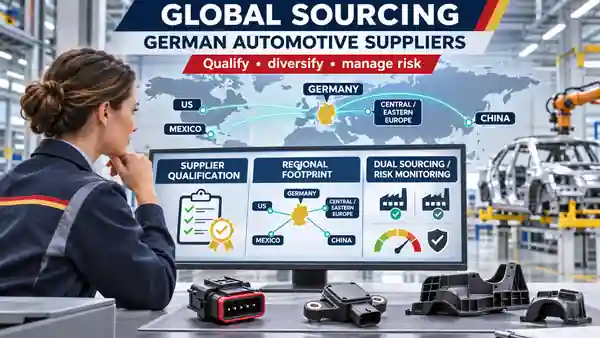
German automotive suppliers navigate global component sourcing by qualifying suppliers in layers — IATF 16949, customer-specific requirements, a VDA 6.3 process audit, and part approval through VDA Volume 2 PPA or AIAG PPAP — and by spreading production across regions so that no single country, mold, resin grade or sub-supplier can stop a program. For a molded part, the decision turns on four things: certificate scope covering the site and process, a tool-and-parts split that keeps approval evidence intact, mold ownership and data, and origin, due-diligence and carbon data producible on demand. Price is judged against total landed cost and supply risk, not mold price alone.
This guide is for two readers: a buyer sourcing molded parts into or through a German Tier 1 program, and a molding supplier trying to qualify for one. It keeps the trade and regulatory background short, because those topics have their own canonical homes on this site: USMCA rules in Understanding USMCA Impact on Automotive Component Sourcing, Mexico sourcing in Guide to Sourcing Automotive Components from Mexico for US Manufacturers, China sourcing for US programs in How Do US Automotive OEMs Source Injection Molded Components from China?, European EV startups in Guide to Sourcing Automotive Components for European EV Startups, and post-Brexit UK sourcing in How Do UK Automotive Manufacturers Source Post-Brexit Components?. This article covers what those guides do not: how a molded part is bought, qualified and protected inside a German program.
How is the German automotive supply chain structured — and where does a molded-part supplier fit?
Many overseas suppliers treat a German Tier 1 like any other buyer: quote a piece price, ship a few samples, and wait for a purchase order. What they get instead is a process audit, a long list of customer-specific requirements, and a nomination process that runs for months. Suppliers who do not understand this structure waste quotations, and buyers who skip it end up auditing the wrong suppliers.
The German automotive supply chain is a tiered, tightly integrated network: a supplier is nominated for a vehicle program only after capability audits, engineering review, prototype approval, and formal production process and product approval. A Tier 2 molding supplier sits in the middle of that chain and is expected to control its own process, its resin and insert sources, and its change discipline, because a failure at Tier 2 stops the Tier 1’s delivery to the OEM.
| Tier | Typical scope | What the customer expects | Typical sourcing risk |
|---|---|---|---|
| OEM | Vehicle design, final assembly, brand requirements | Customer-specific requirements flowed down to all tiers | Program delays, recalls, regulatory exposure |
| Tier 1 | Modules, systems, ECUs, interior assemblies, lighting | Full APQP ownership, PPA/PPAP, launch support, JIT or JIS delivery | Sub-supplier failure that stops OEM delivery |
| Tier 2 | Molded housings, connectors, clips, stampings, PCBAs | Process capability, traceability, change control, delivery discipline | Single tools, single resin grades, capacity limits |
| Tier 3 | Resins, metal stock, inserts, fasteners, chemicals | Material certificates, consistent grade, compliance data | Allocation, grade discontinuation, origin changes |
German networks are built for programs that run for years, with delivery often synchronized through Just-in-Time (JIT) or Just-in-Sequence (JIS) logistics — so a missed shipment matters immediately, and changing a qualified supplier means new samples, new approval, and sometimes OEM re-release. Switching costs are high, and buyers prefer certified, auditable partners over the lowest quote.
Engineering co-development is also common: Tier 1 suppliers often bring Tier 2 partners in during design, prototyping, and validation, so DFM input on wall thickness, gate location, draft, and datum strategy is expected before the tool is cut, not after T1. A supplier that can only quote a finished drawing competes on price alone; one that shows a DFM review, a moldflow read-out, and a datum proposal competes on launch risk. See DFM Before Automotive Tooling Release.
What does a "multilocal" footprint mean for one molded part?
For two decades, the default plan was simple: develop in Germany, source low-cost components globally, and ship parts to European plants. Tariffs, lockdowns, shipping disruptions, and geopolitical tension exposed how fragile that model was: a part that is cheap ex-works can become expensive once freight, duties, buffer stock, and expedite costs are added.
German suppliers are moving to multilocal sourcing networks: engineering and validation stay close to the OEM, series production moves to truck distance in Central and Eastern Europe, and major markets are served local-for-local. For a molded part, the practical form of this is usually a split between where the tool is built and where the parts are molded — and that split only works if the mold, the process data, and the approval evidence transfer cleanly.
BCG’s 2026 Global Automotive Supplier Study, published in March 2026 and based on more than 750 suppliers and almost 50 OEMs, makes "build multilocal, shock-resilient supply systems" one of its five strategic imperatives — dual sourcing for critical components, contracts that share volume risk more equitably with OEMs, and AI-enabled early-warning systems. The study also records increasing insolvencies among European suppliers, so financial screening of a small Tier 2 or Tier 3 supplier is now a sourcing step, not an afterthought.
| Region | Main advantage | Main trade-off | Typical fit for molded parts |
|---|---|---|---|
| Germany / Western Europe | Engineering depth, short distance to OEM plants | Highest labor and energy cost | Development, validation, complex or safety-critical parts |
| Central and Eastern Europe (Poland, Czech Republic, Hungary, Romania, Serbia) | Truck-distance logistics, EU customs area for most countries, lower cost base | Capacity and skilled-labor competition; Serbia is outside the EU, so customs and origin rules apply | Series production close to German assembly plants |
| China | Deep tooling ecosystem, fast mold builds, broad electronics supply base | Ocean transit time, tariff and geopolitical exposure, single-country dependence | Mold manufacturing, local-for-local supply to Chinese OEMs, selected exports |
| Other Asian "China+1" locations | Diversification from a single country | Supply base and tooling depth vary by location and process | Labor-intensive assemblies, electronics, standard parts |
| Mexico / United States | USMCA access, proximity to North American plants | Regional content rules, labor and capacity constraints in some areas | Local-for-local supply for North American vehicle programs |
For plastic components, the hybrid model is the key decision. Mold building may stay where tooling cost and lead time are competitive, while production moves close to the vehicle plant. Compare the two routes on landed cost, press fit, validation, and change control — see Sourcing Automotive Plastic Parts from China: Tool Export or Parts Production?, Will an Export Mold Fit the Destination Injection Molding Machine?, the Automotive Mold Transfer Checklist, and the Export Injection Mold Acceptance Checklist.
How do German customers qualify a new molding supplier?
A low quote from an unfamiliar supplier can look attractive until the first process audit. Missing control plans, weak traceability, or uncontrolled sub-suppliers can delay nomination, or force the buyer to resource after tooling is already paid for. Many sourcing teams also confuse a certificate with proof that a specific part and process are ready for series production.
German customers qualify new partners in layers: first the quality management system, usually against IATF 16949 and the applicable customer-specific requirements; next the actual manufacturing process, often with a VDA 6.3 potential analysis or process audit; finally each part, through VDA Volume 2 PPA or AIAG PPAP, depending on the customer. A certificate opens the door. Part approval proves the specific process works.
| Element | What it is | What to check for a molded part |
|---|---|---|
| IATF 16949 | Quality management system certification for automotive production organizations. It certifies the organization’s system, not a product. | Is the certificate valid, and does its scope cover the manufacturing site and the molding process that will make the part? IATF 16949:2016 is the current edition; the IATF has said a second edition is planned for publication around mid-2027, with dates it calls indicative — confirm the edition and transition rules with the certification body. |
| OEM customer-specific requirements (CSRs) | Additional requirements that each OEM adds to IATF 16949. | Which CSRs apply, which document and revision the supplier relied on, and whether the supplier has read them. CSRs change often: Ford, for example, updated its IATF and PPAP CSRs in November 2026. The IATF publishes member OEMs’ CSRs on its Global Oversight site. |
| VDA 6.3 | Process audit method published by the German Association of the Automotive Industry (VDA). A potential analysis (P1) evaluates a new supplier; elements P2–P7 assess project and series processes. | Ask for the last audit report with element scores, not a summary, and check whether the audited process resembles the part being quoted. |
| VDA Volume 2 (PPA) | German method for production process and product approval. | Confirm the expected approval scope, documents, and schedule before sampling. The published edition is the 6th edition (April 2020), which replaced fixed submission levels with a PPA agreement negotiated between supplier and customer. A 7th-edition draft (Gelbband) was issued for comment in January 2026 with risk-based scoping; harmonization with AIAG PPAP was discussed in its foreword but not agreed. Check which edition the customer’s contract invokes. |
| AIAG PPAP | North American production part approval method. | Used when the customer specifies it, often for North American programs. The PPAP manual (4th edition) lists 18 submission elements, with Level 3 the most common default. A supplier serving both German and North American customers may need to support both formats. |
A supplier should be able to show, for a comparable part, a PFMEA, a control plan, and measurement system analysis; lot-level traceability from resin lot and insert batch to production date, machine, and mold; a sub-supplier method covering resin distributors, insert makers, and toolmakers; an engineering change process that names who approves a change before it reaches the customer; and the ability to support the required PPA or PPAP format and language. See PPAP for Automotive Molded Parts and FAI vs. PPAP vs. a T1 Sample Report.
Expect the full cycle to take months, not weeks: independent market-entry guidance puts supplier qualification with a German OEM at roughly 12–24 months from first contact to series-production qualification — a planning input, not a promise. If the supplier cannot yet show that evidence, see Vetting a Chinese Automotive Injection Molder for a scored evidence screen that applies to any overseas molding candidate, not only to China.
Which regulations change what a molding supplier must be able to show?
Sourcing teams used to evaluate suppliers on cost, quality, and delivery. Now they also need human-rights risk analysis, carbon data for imported metals, and battery material documentation.
Three regulatory areas affect German automotive sourcing most directly, and for a molding supplier each one is a data-readiness task rather than a direct legal duty: the LkSG, CBAM, and the EU Battery Regulation’s digital battery passport. The molding supplier is usually not the directly obligated party — its customer is — but the data requests flow down through contracts and questionnaires.
LkSG — due diligence, still in force, but changing. The Act applies to companies with at least 3,000 employees in Germany from 1 January 2023 and at least 1,000 employees from 1 January 2024, according to BAFA, the enforcing authority. Its core duties — risk management, risk analysis, preventive measures, remedial action, a complaints procedure, and documentation — remain in force as of 14 November 2026. But BAFA stopped reviewing annual reports in autumn 2025, and the bill that would remove the reporting duty retroactively and limit fines to serious violations (Bundestag printed paper 21/2474) was referred to committee in January 2026 and had not passed. Germany also intends to replace the LkSG with legislation transposing the EU Corporate Sustainability Due Diligence Directive (CSDDD), amended by the Omnibus Directive (EU) 2026/470, which applies from 26 July 2029 to EU companies with more than 5,000 employees and more than €1.5 billion in worldwide net turnover. Until then, the LkSG applies.
CBAM — definitive regime since 1 January 2026. Under Regulation (EU) 2023/956, as amended by Regulation (EU) 2025/2083, importers of CBAM goods — cement, iron and steel, aluminium, fertilisers, electricity, and hydrogen — face authorization, reporting, and certificate obligations based on embedded emissions. Importers bringing in no more than 50 tonnes of CBAM goods per calendar year are exempt, except for electricity and hydrogen, and the first annual declaration and certificate surrender, covering 2026 imports, is due by 30 September 2027. Plastic molded parts are not CBAM goods, but imported metal inputs may be, depending on their CN classification — metal inserts, brackets, and terminals are the usual cases for a molder. On 17 December 2025 the Commission proposed extending CBAM to around 180 downstream steel- and aluminium-intensive products; as of 14 November 2026 that remains a proposal, not law.
EU Battery Regulation — digital battery passport from 18 February 2027. Under Regulation (EU) 2023/1542, Article 77, EV batteries, industrial batteries above 2 kWh, and light-means-of-transport batteries placed on the EU market or put into service from 18 February 2027 must have a digital battery passport, accessible by QR code. The obligation sits with the economic operator placing the battery on the market, not with suppliers of individual components — but that operator will need composition, origin, recycled-content, and carbon data from its supply chain — so a molder supplying battery-pack parts may be asked for that data well before the deadline.
None of this is legal advice. The point for a buyer is narrower: ask whether the supplier can produce the data, who owns each data item, and how often it is updated.
How do origin rules and tariffs change a molded-part decision?
A finished part can be built in a free-trade-agreement country and still lose its tariff advantage, usually because of an upstream input: a resin, insert, or electronic component from a non-qualifying origin that pushes the part outside the agreement’s rules.
Rules of origin decide whether a part qualifies for reduced or zero duty under an EU free trade agreement or USMCA: a part containing non-originating materials must usually undergo sufficient processing in the exporting country, as defined by product-specific rules. German suppliers therefore map sub-component origin, collect supplier declarations, and treat a resin or insert change as both an engineering change and a potential origin change.
The full USMCA rules treatment lives in Understanding USMCA Impact on Automotive Component Sourcing. The molded-part version: record the HS or CN classification and origin for each purchased input on the bill of materials; ask sub-suppliers for origin declarations and set a renewal date for each one; add an origin check to the engineering change process; and have a customs specialist confirm the product-specific rule before relying on a tariff preference.
| Change | Engineering impact | Possible origin impact |
|---|---|---|
| Switching resin supplier or production site | May require material approval and revalidation | Can change the origin of a significant input |
| Changing a metal insert or terminal source | Requires dimensional and functional checks | May change origin status and, for metals, CBAM exposure |
| Moving the mold to another country | Requires requalification and customer approval | Changes where the transformation takes place |
| Adding an assembly or overmolding step elsewhere | Changes the process flow and control plan | May change where sufficient processing occurs |
Any of these changes also triggers the change-control question — who approves it, what revalidation it needs, and how the customer is notified. See Engineering Changes to Automotive Molds and Engineering Change Control for Automotive Tooling and Production.
How should a buyer judge single-source and shortage risk in molded parts?
The 2021–2023 semiconductor shortage showed how a component worth a few dollars can stop a vehicle line; the same weakness exists in plastic parts — one mold, one press, one resin grade, or one small sub-supplier with weak finances. BCG’s 2026 study notes increasing insolvencies among European suppliers, which has turned hidden single-source dependencies into real launch and service-part risks.
German suppliers have moved from pure just-in-time to hybrid models: strategic buffer stock for critical parts, multi-year capacity agreements, and financial screening of sub-suppliers. The test for a molded part is not whether a buffer exists, but whether it is sized, owned, and releasable — and whether a second source is qualified before it is needed, not after.
| Risk signal | What to check | Practical mitigation |
|---|---|---|
| One mold makes 100% of the volume | Mold condition, maintenance records, spare inserts | Spare critical inserts, a duplicate tool, or a qualified second source |
| Sub-supplier shows financial stress | Late deliveries, staff turnover, deferred maintenance, payment-term requests | Financial screening, tool ownership confirmation, contingency plan |
| Single approved resin grade | Grade availability, allocation history, discontinuation notices | Pre-approved alternate grade where the customer allows it |
| Tool ownership is unclear | Purchase agreement, tool tags, asset register | Written ownership, documented release rights, current mold drawings |
| No process documentation | Setup sheets, process window, approved sample | Archived process records and approved master samples |
A second source makes sense when demand is growing, a supplier shows distress, a region carries elevated risk, or service-part supply must continue for years. Do not assume the same drawing will produce the same part: a second-sourcing plan starts from an authorized technical baseline and agrees in advance which dimensions, appearance attributes, and approvals must match — see Second-Source Automotive Injection Molding. If the tool itself has to move, plan for custody, incoming inspection, press compatibility, and requalification; see the Automotive Mold Transfer Checklist.
Settle tool ownership in the contract before tooling starts — title, maintenance and storage, and return of the tool and its data. See Automotive Mold Ownership Questions to Resolve Before Tooling Starts and Mold Payment Milestones.
What should a molding supplier prepare for digital data requests?
Most suppliers know their direct suppliers well and their sub-suppliers barely at all, so a Tier 3 disruption often surfaces as a late shipment. Meanwhile, customers keep asking for carbon footprints, traceability records, and compliance evidence.
German suppliers increasingly use shared data platforms such as Catena-X to see beyond their direct suppliers. Catena-X is the automotive industry’s open data ecosystem for sovereign, standardized, and secure data exchange across the value chain, with each participant keeping control of its own data. Participation is generally a business decision, not a legal requirement — but a customer may still ask suppliers to share data through a specific platform or format.
Catena-X reported in September 2026 that 1,069 OEMs and suppliers were exchanging data through the network, up from 182 in December 2025, with first use cases in quality management, product carbon footprint, and certificate management; in July 2026 it launched the first trusted cross-border automotive data ecosystem with China, aimed first at battery-passport data. Platform choice matters less than data quality. A molding supplier that wants to be ready should prepare lot-level traceability from resin lot and insert batch to production date, machine, and mold; consistent part numbers, revision levels, and material identifiers; energy and material data that can support a product carbon footprint calculation; and digital copies of approval documents, inspection results, and change records.
Agree with the customer which fields, format, footprint basis, validator, and update triggers apply. Do not buy software before cleaning master data, and do not treat a dashboard as a substitute for supplier visits and process audits.
Buyer Review: German Tier 1 Program — Molded Part
| # | Check | Pass looks like | Fail looks like |
|---|---|---|---|
| 1 | Certificate scope | IATF 16949 certificate names the site and the molding process that will make the part; scope, dates, and certification body verified through an independent channel | Logo on a slide; scope covers a head office or a different process |
| 2 | Customer-specific requirements | Supplier names the OEM CSRs, document, and revision it relied on for this quotation | "We are IATF certified" offered as the whole answer |
| 3 | Process evidence | PFMEA, control plan, and MSA shown for a comparable part, tied to a drawing revision | Generic quality manual only |
| 4 | DFM before steel | DFM review, moldflow read-out, and datum proposal shared before tooling release | Tool cut from the drawing with no review record |
| 5 | Tool ownership and data | Written title, maintenance and storage owner, release rights, current mold drawings and process records | Ownership "understood" but undocumented |
| 6 | Tool/parts split | Mold-build location, production location, press-fit check, and re-approval plan agreed before award | Mold exported with no destination-machine check or requalification plan |
| 7 | Sub-supplier control | Resin, insert, and toolmaker sources named, monitored, and traceable to lots | Single resin grade with no alternate and no allocation history |
| 8 | Origin and CBAM data | HS/CN classification and origin recorded per input; metal-input CBAM exposure checked | No origin declarations; insert source unknown |
| 9 | Due-diligence data | Code of conduct, questionnaire answers, and sub-supplier names producible on request | "Not applicable" with no evidence |
| 10 | Shortage and second source | Buffer sized and owned, duplicate-tool or second-source route agreed, financial screening done | One mold, one site, no buffer, no contingency |
Worked Decision Scenario (Illustrative)
All figures in this scenario are illustrative teaching numbers with stated assumptions. They are not a quotation, a lead-time promise, or AutoMoldingPro capability data.
A German Tier 1 is nominating a supplier for an interior sensor housing — glass-filled PA66, two metal inserts, a sealing interface, and a visible appearance zone — at an assumed 240,000 parts a year, released weekly, over a three-year program plus service parts. The buyer’s first decision is not the mold price. It is the qualification order.
Step one, the buyer checks the certificate: IATF 16949, scope naming injection molding at the site that will make the part, verified through the certification body, plus the OEM CSRs the Tier 1 flows down. Step two, the buyer asks for process evidence for a comparable part — a PFMEA and control plan extract, a cavity-identified dimensional summary, and lot traceability from resin lot to finished-part lot. One candidate can show all three; the other can show only a certificate and a sample part, and is not shortlisted even though its mold price is lower.
Step three is the footprint decision. The mold is built in China, where the tooling ecosystem is deep, and the parts are molded in Central Europe, close to the Tier 1’s assembly plant. Before award, the buyer confirms the destination press — tie-bar spacing, platen size, shot capacity, ejector pattern, and utilities — using the checks in Will an Export Mold Fit the Destination Injection Molding Machine?. The PPA submission is agreed as VDA Volume 2, 6th edition, the edition the customer’s contract invokes; the 7th-edition draft is noted but not assumed. Step four is the risk plan. Annual demand of 240,000 parts is about 4,615 parts per week, so a four-week strategic buffer is about 18,460 parts, held at the molding site under a written agreement. The single approved resin grade is the known weakness, so the buyer starts the alternate-grade approval route with the customer before series production, rather than during a shortage.
Tooling is released only when the DFM review is signed, the destination-press fit is confirmed, the PPA scope is agreed, tool ownership is written down, and the buffer and second-source plan are named.
Questions to Ask the Supplier
- Who owns the mold, and what release rights does the buyer have?
- Will the mold be exported, and has the destination press been checked for fit?
- Does the IATF 16949 certificate scope cover this site and process, and can it be verified through the certification body?
- Which OEM customer-specific requirements apply, and which document and revision did the supplier rely on?
- Which approval format applies — VDA Volume 2 PPA or AIAG PPAP — and which edition?
- How are resin and insert sources controlled, declared, and traced to lots, and what happens if a sub-supplier fails?
- Can the supplier produce origin, CBAM, and due-diligence data on request?
- What is the buffer policy, who owns the buffer, and what is the qualified second-source route?
Information to Submit for a Project-Specific Review
- STEP or Parasolid model and controlled 2D drawing with revision level
- Exact resin grade or OEM material specification, color, and texture
- Annual volume, ramp-up curve, program life, and service parts
- Critical dimensions, GD&T datums, appearance zones
- Required approval format, edition, and submission scope
- Tool ownership, mold standard, steel, cavity count, and target mold life
- Production location, destination-press data if the mold will move, delivery terms, packaging, labeling, and origin documentation needs
- Compliance data the end customer expects
Send the profile and the evidence request together, and ask candidates to identify assumptions instead of silently filling gaps. To ask AutoMoldingPro to assess fit, use the request-a-quote page and provide those inputs. AutoMoldingPro is operated by C.K. MOLD & ENGINEERING LIMITED, which is IATF 16949 certified and ISO 9001 Certified. No price, lead time, or certification outcome is promised in this article.
Conclusion
German automotive suppliers source globally with discipline, not on price alone. For a molded part, confirm the certificate scope, the approval format and edition, tool ownership, the tool-and-parts split, sub-supplier origin and finances, and change control — then compare quotations on total landed cost and supply risk.
Request a project-specific review — send the drawing revision, annual volume, approval expectations, and the evidence pack you need assessed. Contact: jerry@ckmold.com, +86 19854763925.
References
- IATF Global Oversight — https://www.iatfglobaloversight.org/
- AIAG, Production Part Approval Process (PPAP-4) — https://www.aiag.org/training-and-resources/manuals/details/PPAP-4
- BCG, The 2026 Global Automotive Supplier Study — https://www.bcg.com/publications/2026/the-2026-global-automotive-supplier-study
- BAFA, The Supply Chain Due Diligence Act at a glance — https://www.bafa.de/EN/Supply_Chain_Act/Overview/overview_node.html
- European Commission, Carbon Border Adjustment Mechanism — https://taxation-customs.ec.europa.eu/carbon-border-adjustment-mechanism_en
- OrigoPass, EU Battery Passport 2027: what it is, who must comply, and what data it needs (plain-English guide to Regulation (EU) 2023/1542) — https://www.origopass.eu/guides/eu-battery-passport-2027
- Catena-X, Network grows by more than a factor of five to over 1000 companies — https://catena-x.net/news/catena-x-network-grows-by-more-than-a-factor-of-five-to-over-1000-companies/