
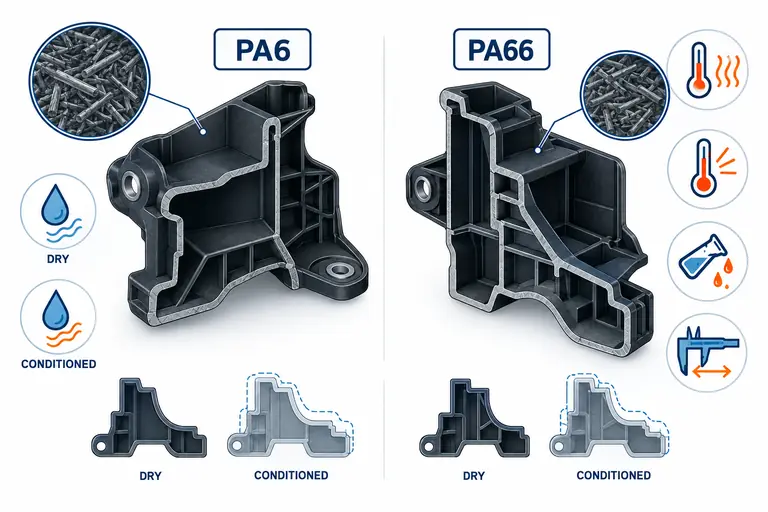
“Nylon with glass fiber” is not a complete under-hood material specification. PA6 and PA66 grades can differ in reinforcement, heat stabilization, hydrolysis resistance, impact modification, electrical behavior, moisture response, and processing needs. Comparing only polymer names can miss the condition that controls the part.
Choose an exact grade by mapping the component’s temperature-time profile, fluids, load, moisture state, geometry, and customer tests. Compare data under relevant conditions, design around anisotropic shrinkage and conditioning, and verify the production-molded assembly. PA66 is not automatically required for every hot location, and PA6 is not automatically interchangeable where both appear plausible.
Describe the under-hood duty as a time-dependent envelope
Record where the component sits, nearby heat sources, shielding, airflow, contact surfaces, and what occurs after engine or vehicle shutdown. Separate continuous operating temperature, normal cycles, short peaks, and abnormal events. A single “maximum temperature” can lead to an expensive over-specification or an unsafe interpretation of a brief data-sheet test.
Add the mechanical duty at each temperature: static clamp load, vibration, pressure, connector insertion, fastener preload, impact, and creep-sensitive deflection. A cosmetic cover, cable bracket, coolant connector, air-intake part, and terminal housing have different consequences of distortion. Identify welded joints, seals, metal inserts, and adjacent components that constrain thermal expansion.
List every plausible medium: water and humidity, coolant composition, oil, fuel vapor, grease, washer fluid, road salt, cleaners, and any process chemical. State concentration, temperature, duration, splash versus immersion, replenishment, and whether load is applied during exposure. Heat, water, glycol, and stress can interact; independent room-temperature screening does not necessarily represent the assembly.
Finally, identify the required condition at dimensional and functional acceptance. Nylon absorbs moisture after molding, and that moisture can change dimensions and mechanical response. The buyer should define whether parts are measured dry-as-molded, after controlled conditioning, at equilibrium with a specified environment, or at more than one state. The related dry-versus-conditioned nylon guide explains why the drawing and report must name the state.
Compare grade systems, not neat-resin stereotypes
PA6 and PA66 are semicrystalline polyamides, but the final compound controls performance. Glass percentage and fiber orientation affect stiffness, strength, shrinkage, warpage, weld-line behavior, surface, and tool wear. Heat stabilizers target thermal aging; hydrolysis-resistant packages target hot water or glycol exposure; impact modifiers trade stiffness and flow for toughness; mineral combinations may improve dimensional behavior. Color and electrical packages can also matter.
PA66’s higher melting point and elevated-temperature property retention often make it a candidate for hotter duties. Autodesk’s PA66 material summary notes that moisture absorption still affects dimensions and properties, even though retention is lower than PA6 in its general comparison (Autodesk PA66 materials). That statement is a design warning, not permission to apply one moisture value to all grades.
PA6 can offer useful flow, toughness, and processing characteristics and may suit many under-hood housings and ducts when the exact stabilized grade meets the environmental requirement. Resin producers now offer specialized PA6 and PA66 compounds; a generic matrix comparison can become obsolete or misleading. An automotive positioning guide lists both families across different under-hood applications and calls out hydrolysis-resistant grades for fluid-handling uses (Entec guide).
Treat datasheet values as screening evidence. Ask for the current TDS, processing guide, long-term heat-aging or hydrolysis data relevant to the grade, conditioning method, specimen thickness and orientation, test temperature, and retention criterion. If the supplier cannot provide a condition matching the duty, record a validation gap.
Control moisture at molding, measurement, and service
Moisture creates three separate questions. First is resin moisture before molding. Excess moisture in the melt can cause hydrolytic degradation, splay, viscosity change, and reduced properties. The acceptable moisture level and drying cycle must come from the resin producer’s current guide for the exact grade and dryer arrangement. Time and temperature alone are not evidence that pellets reached the required state; handling after drying matters.
Second is moisture in the molded part before inspection or assembly. Parts leave the mold relatively dry and then absorb moisture according to grade, wall, temperature, humidity, packaging, and time. Dimensions can move while stiffness and toughness change. Define elapsed time, storage, conditioning, and measurement environment. Seal packaging only when the process and downstream assembly require a controlled state; do not use sealed bags to hide an undefined acceptance condition.
Third is the service equilibrium and cycling that the part may experience. A bracket near a warm airflow path may not reach the same state as a coolant-contact connector. A water- or glycol-exposed wall can experience local effects that a standard humidity-conditioned specimen does not reproduce. Dimensional stacks, seal compression, insert stress, and fastener load should be assessed in the relevant state.
Use a condition-control table in the drawing or validation plan:
| Stage | Condition to define | Record to retain | Decision affected |
|---|---|---|---|
| Resin receipt | lot, packaging, storage | certificate and lot identity | traceability and shelf handling |
| Before molding | dryer, setpoint, time, measured moisture method | dryer and moisture record | degradation and process stability |
| Part inspection | time after molding, temperature, humidity or conditioning recipe | sample history | dimensional acceptance |
| Assembly | storage and handling window | lot and assembly time | insertion, snap, seal and preload |
| Validation | preconditioning plus exposure sequence | complete test log | release to intended duty |
Account for flow, fiber orientation, shrinkage, and tooling
Glass-filled nylon is direction-dependent. Flow aligns fibers, so shrinkage and stiffness differ along and across the flow direction. Gate location, wall transitions, weld lines, ribs, bosses, and packing determine local structure. A material card can support simulation, but it cannot replace measurements from a representative mold and process.
Review the gate relative to the highest load and tightest datum. A weld line through a clip root or pressure boundary may control performance even when bulk tensile values look strong. Thick sections can create sinks, differential cooling, and longer cycles; thin flow paths may demand higher pressure and change fiber orientation. Inserts can constrain shrinkage and concentrate stress during conditioning and thermal cycling.
PA6 and PA66 grades also differ in melt and mold-temperature recommendations, residence-time sensitivity, freeze behavior, and ejection. Use the supplier’s range and document the actual melt condition rather than relying only on barrel setpoints. Check machine capacity, hot-runner suitability, venting, cooling, wear surfaces, and safe purge/changeover procedures.
For a transferred mold, do not assume a new grade can be corrected entirely with process settings. Compare the original material, cavity dimensions, process, and accepted part state. If the candidate shifts a mounting interface differently by flow direction, steel-safe correction may be possible only on selected features; other changes can require inserts or redesign. Quote those consequences before promising equivalence.
Validate the part through a risk-based sequence
Build a requirement-to-test matrix with one owner and acceptance rule for every critical function. Start with material identity and molding records. Evaluate a practical process window across representative lots and cavities. Measure functional features at the stated moisture condition. Then assemble with production-intent hardware and mating parts before environmental exposure.
The sequence matters. A housing may pass a leak test before thermal cycling yet lose seal compression afterward. A fastened bracket may meet dimensions unassembled but creep under preload at temperature. Chemical exposure without stress can miss cracking at an insert or sharp corner. Define whether samples remain assembled, powered, pressurized, or loaded during each stage.
| Risk | Evidence before trial | Molded-part check | Assembly or environmental check |
|---|---|---|---|
| thermal deformation | exact-grade temperature/aging data | dimensions across process window | loaded heat exposure and remeasurement |
| moisture movement | conditioning data | dry and defined-conditioned dimensions | fit after humidity or fluid sequence |
| fluid degradation | producer compatibility data | surface and mass/property screen if relevant | duty-specific exposure under representative stress |
| weld-line weakness | flow review | cavity and location inspection | functional load at required condition |
| insert or seal stress | expansion and geometry review | section and dimensional checks | thermal cycling, torque or leak function |
Do not use one favorable sample as the acceptance basis. State lots, cavities, sample count, conditioning, equipment, calibration, report content, and failure disposition. Customer-specific requirements decide whether additional PPAP, laboratory accreditation, or change approval is needed.
Prepare an RFQ that lets suppliers recommend responsibly
Provide CAD and a controlled drawing, current material if one exists, exact under-hood location, temperature-time profile, media list, loads, mating components, seal and fastener details, critical dimensions, acceptance condition, annual volume, validation matrix, and customer-specific material rules. Identify whether the supplier is expected to select a grade or quote a named grade.
Ask proposals to name manufacturer, complete grade, reinforcement and stabilization, color, production source, drying and process assumptions, test evidence, missing validations, tool implications, and declaration status. Require separate pricing for required external tests and clearly identify who supplies assemblies and mating parts.
A supplier who recommends “PA66-GF30” without these details has not completed material selection. Conversely, a buyer who asks for PA66 only because the location is under the hood may suppress a viable grade and obscure the actual requirement. Use the RFQ checklist to control common inputs, then add the duty and conditioning matrix above.
Conclusion
Choose PA6 or PA66 at exact-grade level, with temperature, fluids, load, moisture state, process, and validation defined together. Send AutoMoldingPro the CAD, drawing, current grade, duty profile, mating details, volume, and required tests through the contact page for a molding and tooling review.