
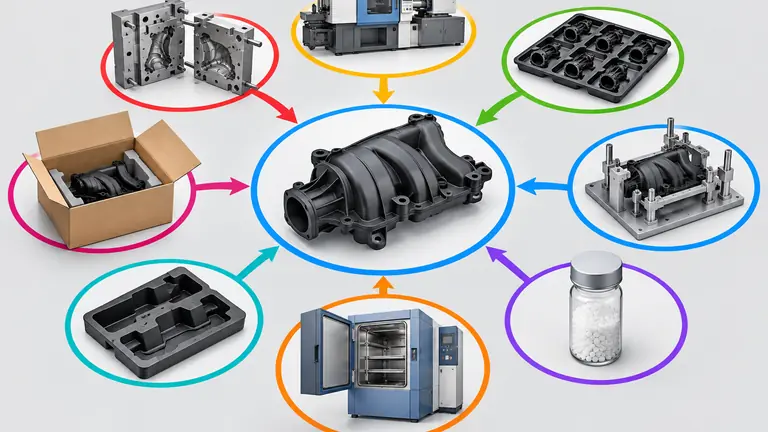
Conceptual illustration; not to scale.
The mold price may be clear while the sampling and PPAP quote is not. Later, the buyer discovers separate charges for extra cavities, dimensional reports, functional gages, laboratory testing, shipping, resampling after a tool correction or a customer-requested submission level. The disagreement is usually caused by an incomplete scope, not by a single unreasonable line item.
An automotive molded-parts RFQ should separate included work from conditional work: sample quantity and source, inspection characteristics, gages and fixtures, material and performance tests, PPAP or customer-form preparation, packaging and shipping, and rework or resampling triggers. No universal market price should be assumed. The supplier should price the defined evidence and show the assumptions that can change it.
This guide is about cost scope. It does not repeat a full PPAP explanation or a general RFQ file checklist.
Cost the decision, not just the plastic samples
Why this matters: Sampling cost is often treated as “part price multiplied by quantity.” That ignores the work required to create a representative sample, inspect it, prepare records and deliver it in the customer’s required format. A molded part can be inexpensive while the evidence needed to approve it is labor-intensive.
Start with the decision the samples must support. A T1 trial may need enough parts to debug fill, flash, ejection, assembly and dimensions. A pilot run may allocate parts to dimensional, functional, destructive or customer evaluation needs. A PPAP submission may require production-source samples, material and performance evidence, measurement-system work and a submission warrant. These are different scopes and should not share one vague “sample charge.”
AIAG identifies PPAP, APQP, Control Plan, FMEA, MSA and SPC as automotive Core Tools. The applicable customer manual determines which elements are required and at what submission level. A supplier can prepare a package, but the RFQ should state whether the buyer expects a supplier-prepared draft, a complete customer submission, or only the records that support the buyer’s own submission. If the customer requirement is not yet known, price a clearly labelled assumption rather than inventing a default level.
Separate non-recurring engineering from recurring production cost. Tool trial time, gage design, report creation and external tests are often launch or project costs. Packaging validation, routine incoming inspection and lot-release checks may become recurring costs. A quote that bundles them cannot be compared with one that lists them separately.
Ask for a line-item basis, quantity and trigger. “PPAP included” should identify the submission level or element list, number of parts, inspection scope, test assumptions and revision covered. “Samples included” should identify whether the parts are from T1, a pilot or a production run, and whether extra cavities or multiple material lots are included.
The RFQ should also state whether the supplier must attend a customer review, revise a report, upload evidence to a portal or retain samples. Those activities may be minor in one program and substantial in another. Separate a supplier’s own quality-system records from customer-facing submission work. When an item is customer-owned, such as an approved mating component or test method, identify the handoff date and the consequence of delay. That turns the commercial discussion into a controlled scope rather than an argument after the trial.
Define sample quantity and production source
Why this matters: Quantity affects not only resin consumption but also cycle time, machine scheduling, sorting, measurement and shipping. The buyer should state why the quantity is needed and which populations must be represented.
Define the sample type: visual masters, dimensional samples, functional assembly samples, destructive-test samples, lab specimens, packaging samples or customer submission parts. Identify the number of cavities, duplicate tools, mold positions, material lots and process conditions to represent. If the customer requires parts from production tooling, production gages and production processes, a hand-finished or temporary-condition sample should not be priced as an equivalent substitute.
For a multi-cavity mold, clarify whether the quote includes samples from every cavity. If a cavity-specific dimensional report is required, the measurement quantity and report structure grow. If the customer accepts a representative sampling plan, the buyer should provide that rule or ask the supplier to propose one for approval. Do not hide the choice in a general phrase such as “full inspection.”
State whether the sample count is a delivered quantity or a gross production quantity. The supplier may need extra parts for setup, process stabilization, destructive testing, failures, shipping damage or customer retention. The quote can include a defined good-part quantity plus a stated process allowance, but the allowance should not be presented as an unbounded charge.
For PPAP, confirm the production-run expectation with the customer. AIAG’s public Core Tools description explains the purpose of PPAP, but the PPAP manual and customer-specific requirements control the submission details. The buyer should identify the required source and timing in the RFQ. If the project is only at T1, request a separate T1 sample scope and a later production-approval scope so that an early trial is not accidentally invoiced as final PPAP.
Also define ownership of unused samples, master samples, retention duration and shipping destination. These decisions affect packaging, labels, storage and later retrieval. The pilot production planning guide can help allocate parts by evidence type; this article focuses on how to price that allocation.
Price inspection, gages and measurement evidence explicitly
Why this matters: Inspection cost depends on characteristic count, measurement method, fixture, report format, sample quantity and the time available at the measurement system. A basic dimensional report, a full CMM study, a functional gage and a capability study are not interchangeable deliverables.
List the required characteristics by reference rather than using only “all dimensions.” State whether the supplier should provide a ballooned drawing, CMM report, scan comparison, optical report, first-off sheet, material certificate or functional gage result. Identify the datum scheme, free or constrained condition, material state, environment and measurement uncertainty approach for sensitive features. A request for more decimal places does not define a better inspection method.
Gages need their own scope. Ask whether the supplier will design, build, calibrate, validate, maintain and ship a checking fixture or only provide a CMM report. Define the ownership and future storage location. A gage used for customer acceptance may require customer approval, a drawing, a calibration record and a repeatability or measurement-system study under the applicable quality process. If a gage is only an internal setup aid, price and document it differently.
External laboratory work should identify the test method, specimen count, laboratory qualification requirement, sample preparation, turnaround assumption, report language and retest trigger. Material identity or performance testing may be handled by a resin supplier, independent laboratory or customer. Do not bundle a generic “material test” when the customer requires a specific grade and method. The automotive quality and validation page should be linked to the actual evidence request, not used as a substitute for it.
Report preparation can be a real task. A supplier may need to collate material certificates, process-flow and control-plan information, FMEA links, dimensional results, capability studies, packaging records and signed submission forms. Ask whether the price includes one draft, one revision cycle and one customer resubmission. Make the boundary clear: correcting a supplier transcription error is different from preparing an additional submission after the customer changes the drawing.
Use a characteristic list to make the quote comparable. Mark which rows need every cavity, which need a representative sample, which need a functional check and which are development-only. Ask the supplier to state contact force, fixture state and environmental condition for sensitive plastic dimensions. If the customer has a special-characteristic symbol or required capability study, include the definition and required report. A supplier should be able to point from each priced activity to a requirement, a sample and a deliverable.
Define conditional costs and change triggers
Why this matters: The largest disputes often begin after the first report: a dimension fails, the tool is corrected, the resin changes, the customer requests more samples or the production site changes. The RFQ should explain which follow-up activities are included and which are conditional.
Create a trigger list. Typical triggers include a drawing or CAD revision, material or color change, mold insert correction, cavity imbalance, new measurement fixture, failed external test, added customer characteristic, changed sample source, new production location, tool transfer, process change or customer-requested higher submission level. Each trigger should identify the likely deliverable, responsible party and quotation rule.
Use a responsibility matrix to prevent ambiguous cost allocation:
| Work item | Deliverable | Supplier responsibility to quote | Buyer/customer input | Include or make conditional |
|---|---|---|---|---|
| T1 sample run | Defined good parts, trial record, observations | Machine, mold, material, operators and basic report | Tool revision and trial objectives | Include defined quantity; extra runs conditional |
| Dimensional inspection | Ballooned drawing and actual results | Measurement method, fixture, report and traceability | Drawing, datum scheme and sample-state rule | Include stated scope; expanded scope conditional |
| Functional check | Fit, insertion, retention or assembly record | Fixture, master component, operators and results | Acceptance limits and approved mating parts | Conditional unless clearly defined |
| Gage | Design, build, calibration and study records | Gage documentation and maintenance basis | Gage concept, ownership and approval | Quote separately or clearly include |
| External testing | Laboratory report | Sample preparation, submission and report | Test method, lab requirement and limits | Conditional by named test and sample count |
| PPAP/PPA package | Required forms and evidence index | Preparation, review and revision control | Applicable customer requirement and approval route | Include identified level/elements; extra level conditional |
| Resampling after tool correction | New samples and affected reports | Correction, trial and targeted recheck | Correction authorization and new drawing status | State included correction cycle; later cycles conditional |
| Shipping and packaging | Labeled, protected, traceable shipment | Packaging, documents and freight basis | Destination, label and import instructions | Include named destination; extra shipments conditional |
The table should be attached to the commercial quote. Explain whether a conditional price is a fixed unit rate, a time-and-material basis or a new quotation. Avoid quoting a false universal amount for PPAP work. Cost is driven by the customer requirement, part complexity, evidence quantity and supplier responsibility.
The trigger list should also cover a change in measurement state, customer portal, packaging instruction or receiving plant. These may alter the work even when the plastic geometry is unchanged. Ask the supplier to state a notice period for a new test, gage or sample destination and to identify any work that can be cancelled if a gate changes. For a tool correction, define whether the supplier must inspect only affected characteristics or repeat a complete report. The answer should follow the risk and customer requirement, not an assumed blanket rule. Also record how the new scope will be approved and how an already completed inspection will be reused. This prevents a changed requirement from being charged twice or from being treated as included when the original quote covered a narrower evidence set. If the customer changes only one characteristic, the quote should show whether the result can be targeted or whether the measurement setup must be rebuilt. The same rule applies to a new cavity, resin lot, destination plant or customer portal: name the trigger, the evidence and the approval route.
Build an RFQ cost example without inventing market prices
Why this matters: Illustrative example: a buyer requests a new two-cavity housing mold and says “include samples and PPAP.” The supplier gives a mold price but says testing is extra. The buyer revises the RFQ into five buckets: T1 samples; dimensional results from both cavities; a functional connector and bracket check; named external tests if required; and the customer-defined production-approval package.
The buyer then specifies that the first quote should include one defined T1 correction loop for the affected characteristics, while any drawing revision or additional loop is conditional. The quote must state whether gage design is included, whether the functional mating parts are supplied by the buyer, where the samples will be shipped and whether freight and customs are included. The customer has not yet confirmed the PPAP level, so the supplier prices the known evidence and lists the submission-level assumption as open.
When a T1 dimension fails, the commercial outcome is clear. The supplier does not charge again for correcting a transcription error or reissuing a report caused by its own mistake. If the customer changes the connector after T1, the revision is a new trigger. The quote is easier to compare because each party can see whether the cost arose from tool work, inspection, testing, document preparation or a changed requirement.
The revised quote also records the commercial treatment of failures. If a supplier reports a result incorrectly, the correction and reissued report are part of the original deliverable. If a customer changes the material or drawing, the change is priced as a new scope. If the tool correction is within the agreed development loop, the affected sample and report are included; if the correction reveals a broader design change, the parties review the impact before work proceeds. This makes the cost boundary auditable without assigning an unsupported market rate to any task.
After the quote is accepted, the commercial tracker should point to the same scope table. When the T1 date changes, the buyer can see whether the cause is a customer input, a tool correction, a supplier error, a laboratory queue or a shipping change. The tracker should retain the original included quantity and show any approved addition separately. This prevents a later invoice from mixing a new product requirement with a correction that was already included. It also gives the project manager a usable forecast of remaining launch cost without claiming that an uncertain activity has a fixed market price.
Conclusion
Turn “samples and PPAP included” into named work items, quantities, source conditions, evidence, responsibilities and triggers. Separate T1, pilot, production-approval and recurring inspection costs, and state customer-specific assumptions. Attach the matrix to the automotive RFQ route so the supplier can quote the real decision scope.
References
- AIAG, Quality Core Tools — PPAP, APQP, Control Plan, MSA and SPC context.
- AIAG, Helpful Documents in the APQP Process — APQP scope and supporting evidence.
- NIST, Conformity Assessment Basics — inspection, testing and certification as possible conformity activities.
- AutoMoldingPro, Automotive Injection Molding RFQ Checklist — related published article for broader RFQ inputs.