
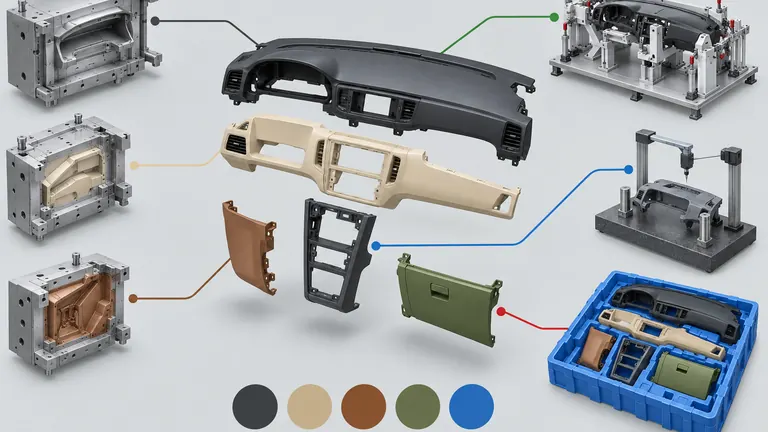
Conceptual illustration; not to scale.
Home › Blog › Quoting a Multi-Part Automotive Plastic Assembly: BOM, Molds and Assembly Scope
Automotive sourcing and manufacturing decision guide
A low total for a multi-part plastic assembly can look attractive until clips, separate molds, assembly fixtures, inspection, packaging, or freight appear as later charges. If each bidder has interpreted a different sellable unit, purchasing is comparing different products and the award decision can create both cost and launch risk.
Build the quotation around one revision-controlled manufacturing bill of materials and one defined delivery level. For every item, state quantity per assembly, make-or-buy responsibility, tooling route, recurring operations, validation evidence, packaging, logistics, and exclusions. Then require each supplier to return the same line-by-line scope matrix; only totals based on that shared baseline should be compared.
The practical work is to move from the shipped unit to child parts, molds, operations, evidence, and commercial terms without counting or omitting any line twice.
In This Guide
- Start With the Shipped Assembly, Then Decompose It
- Illustrative Assembly BOM for Quotation
- Translate BOM Items Into a Mold and Capacity Map
- Quote-Scope Ownership Matrix
- Check the Finished-Assembly Cost Without Hiding One-Time Items
- Release One Quote-Ready Package
Start With the Shipped Assembly, Then Decompose It
Why this matters: Quotations diverge before pricing begins when one supplier assumes loose molded parts and another assumes a tested, labeled assembly. The ambiguity changes material, labor, fixtures, inspection, packaging, and liability at the same time.
Name the exact sellable unit first, then decompose it into controlled child items and operations. Give every item a revision, quantity, supply responsibility, and disposition so the bidder can trace its price back to the same assembly definition.
A bill of materials (BOM) is a structured list of components and quantities, as defined in SAP manufacturing documentation. For a production quote, the structure also needs the operations and subassemblies that turn those components into the shipped unit; PTC’s manufacturing BOM overview makes that distinction explicit.
If suppliers do not quote the same BOM revision and delivery level, their totals are not comparable—even when every quotation contains a mold price and a part price.
Define the item the customer actually buys: one loose molded part, a kitted set, a partially assembled module or a tested and labeled assembly. That answer controls the BOM level, inspection boundary, packaging quantity and responsibility for purchased items.
Give the top-level assembly and every child item a stable identifier and revision. Record the quantity of each child per sellable assembly. If the CAD assembly contains temporary geometry, reference parts or fasteners that are not supplied, mark them as reference-only rather than silently deleting them.
A useful quote baseline also distinguishes customer-supplied, supplier-purchased and supplier-manufactured items. Otherwise, one supplier may include clips, labels and fasteners while another assumes free issue from the customer.
Online molding quotations often allow material, finish, quantity and delivery to change the result; Protolabs’ quoting guidance illustrates why those variables must be locked to a common basis before comparison.
Start the review with a one-sentence delivery statement: for example, “one assembled cable guide containing four molded part numbers, purchased fasteners, an applied traceability label, a documented visual check, and returnable dunnage.” That statement is more useful than a folder name because it gives engineering, quality, logistics, and purchasing the same boundary. Add the delivery plant and point of use when packaging orientation, line-side sequence, or regional labeling can affect the route.
Check the assembly tree against three views: design, manufacturing, and purchasing. Design confirms which components define fit and function. Manufacturing adds consumables, fixtures, joining, marking, and inspection operations that may not appear in engineering CAD. Purchasing identifies free-issued items, nominated sources, and components the supplier must buy. Reconcile these views in a question log. A supplier should never have to infer whether a fastener visible in CAD is included, whether a protective cap is disposable, or whether a reference component is only present to show the interface.
Delivery level
Name the sellable unit and whether it is loose, kitted, assembled, function-checked or ready for the customer line.
Revision baseline
Link assembly CAD, child-part CAD, drawings, specifications and BOM to one issue date or controlled transmittal.
Responsibility
Assign each item as supplier-made, supplier-purchased, customer-supplied or reference-only.
Illustrative Assembly BOM for Quotation
Why this matters: A flat list of part numbers does not show how quantities extend into the finished unit or which cost line owns tooling, purchased components, assembly, and evidence. That makes omissions hard to see.
Use an assembly-level BOM table that extends quantity per assembly and assigns a route and quote line to every child item. Label teaching data clearly and use the table as a completeness check, not as a price benchmark.
Illustrative example — assumptions: one under-dash cable-guide assembly, annual demand of 120,000 finished assemblies, four molded part numbers, two purchased fasteners, no customer-owned tooling, and one finished assembly per shipping pack position. Names, quantities and manufacturing routes below are examples only, not AutoMoldingPro project evidence.
The purpose of this BOM is not to estimate a market price. It exposes the cost and responsibility lines that each bidder must answer.
Read the illustrative table vertically before reading any price. First confirm that every physical item in one shipped assembly has a row. Next multiply quantity per assembly by annual assembly demand to establish component demand. Then inspect the route column: a molded item may require its own tool, a shared family tool proposal, or an insert option; a purchased item needs a released specification and source responsibility; the top-level assembly needs operations, a fixture concept, and an acceptance step.
Illustrative use scenario: one bidder prices three harness clips as three pieces per assembly, while another prices one clip because the CAD folder contains only one clip file. The unit prices may both be internally correct, yet the finished-assembly totals are not comparable. The BOM extension exposes the mismatch before award. The same check catches purchased fasteners quoted as customer supplied by one bidder and supplier purchased by another. Resolve the row, record the clarification, and ask both suppliers to reissue the affected total rather than adjusting a supplier quotation privately in a purchasing spreadsheet.
| BOM item | Quantity, route and quote line |
|---|---|
| A-100 — Guide body | Qty/assembly: 1 Route: molded PA66; new production mold Quote line: mold, molded part, dimensional inspection |
| A-110 — Retainer cover | Qty/assembly: 1 Route: molded PP; shared family mold only if independently accepted Quote line: tooling option and part price |
| A-120 — Harness clips | Qty/assembly: 3 Route: molded parts; cavity strategy to be proposed Quote line: mold, three pieces per assembly, retention validation scope |
| P-201 — M5 fastener | Qty/assembly: 2 Route: purchased component Quote line: source, specification, incoming evidence and unit cost |
| P-202 — Traceability label | Qty/assembly: 1 Route: purchased/printed component Quote line: data content, print verification and label application |
| ASM-1 — Finished assembly | Qty: 120,000/year Route: fixture-assisted assembly and defined checks Quote line: fixture, labor, inspection, packaging and release records |
Translate BOM Items Into a Mold and Capacity Map
Why this matters: Part count alone does not reveal tool count or dependable output. Separate tools, family molds, interchangeable inserts, and different cavity plans can meet the same BOM while creating very different scheduling and maintenance risks.
Create a mold-and-capacity map beside the BOM. It should identify every tool, the parts and cavities it serves, pieces per shot, material and color restrictions, target cycle basis, machine assumptions, secondary bottlenecks, and contingency when a cavity or tool is unavailable.
Do not assume one molded part equals one mold. A supplier may propose separate tools, a family mold or replaceable inserts. Each option changes balance, maintenance, scheduling, spare strategy and the effect of one cavity being unavailable.
For every molded item, ask for mold count, cavity count, part-per-shot relationship, runner system, interchangeable inserts, target material, texture/finish, expected trial stages and the machine/auxiliary assumptions used for the quote. If a family mold is proposed, require the bidder to explain fill balance, ejection, quality segregation and what happens when demand ratios change.
Convert finished-assembly demand into component demand before sizing the tool. In the illustrative BOM, three clips per assembly means 360,000 clips per year before approved service, scrap or contingency allowances. Do not add a generic scrap percentage until the commercial treatment of scrap is defined.
Evaluate tool architecture against the demand ratio, not only the tooling total. A family mold can reduce the number of mold bases and setup events, but unequal part size or demand can create fill-balance, quality-segregation, and surplus-inventory problems. Separate tools cost more initially yet allow independent maintenance, scheduling, process windows, and demand changes. Replaceable inserts can support variants, although insert change control, identification, storage, and validation must be priced and planned.
Ask the bidder to reconcile annual component demand with active cavities, quoted cycle, available production time, expected maintenance, and downstream assembly rate. This is a planning calculation, not proof of capacity; a later production-intent demonstration must test actual losses and bottlenecks. Also ask what happens when one cavity is disabled. A quote based on four cavities should not silently become a two-cavity production plan with the same piece price and delivery commitment. Record whether cavity-specific inspection, spares, hot-runner components, and maintenance access are included in the tool price.
Mold identity
- Mold number and part numbers served
- Cavity and insert identification
- Ownership and storage location
- Quoted steel/base/hot-runner scope
Production basis
- Pieces per shot
- Quoted cycle-time assumption
- Material/color and drying basis
- Secondary-operation bottleneck
Lifecycle basis
- Preventive-maintenance responsibility
- Critical spare parts included or excluded
- Repair/engineering-change rates
- End-of-program tool disposition
Quote-Scope Ownership Matrix
Why this matters: Broad headings such as “tooling,” “PPAP,” or “packaging” conceal different assumptions. A blank or vague line often becomes a change order precisely when the program has the least schedule flexibility.
Require an ownership matrix in which each scope line is marked included, optional, customer supplied, or excluded, with its deliverable and acceptance point. Treat unanswered lines as open commercial questions rather than implied inclusions.
Require each bidder to mark every line as included, optional, customer-supplied or excluded. A blank cell is an unresolved commercial risk, not a saving.
Use the matrix during a joint technical and commercial review. Engineering confirms the tool architecture, DFM depth, correction loops, and released data. Quality confirms the dimensional layout, gauge responsibility, material and functional evidence, and customer-specific submission level. Logistics confirms pack quantity, dunnage ownership, labels, destination, Incoterm, and freight boundary. Purchasing then checks currency, validity, payment milestones, amortization, and exclusions. Keeping those owners in one review prevents a low mold total from masking a separate gauge, fixture, test, or export-crate charge.
Do not force every supplier to include an activity the project does not need. Instead, make applicability explicit. If appearance approval is not applicable, record “not applicable by customer decision”; if a special gauge will be customer supplied, identify the gauge and delivery date. If a supplier proposes an alternative, preserve it as a separately priced option while maintaining a compliant base quote. The matrix is effective when another reviewer can explain every major cost and responsibility without relying on an undocumented phone call.
| Scope area | Ownership and inclusion questions |
|---|---|
| Tooling | • DFM and mold-flow depth • Production molds and assembly fixtures • Trials and correction loops • Critical spares and gauges |
| Piece price | • Exact resin/grade/color basis • Purchased components • Molding, secondary work and assembly • Scrap and normal process loss treatment |
| Validation | • Dimensional layout and measurement method • Appearance/boundary sample activity • Material and functional tests • Customer-specific submission records |
| Logistics | • Pack quantity and dunnage • Labels and traceability data • Incoterm, freight and duties • Returnable packaging ownership |
| Program work | • Project management and reporting • Engineering-change handling • Sub-supplier qualification • Launch containment or safe-launch scope |
| Commercial terms | • Currency and validity • Payment milestones • Volume tiers and price review rules • Warranty, liability and exclusions |
Check the Finished-Assembly Cost Without Hiding One-Time Items
Why this matters: Recurring and one-time costs are easy to mix in an assembly quote. Tool amortization, scrap, freight, and volume tiers can be counted twice or hidden inside piece prices, distorting the award comparison.
Separate non-recurring tooling and program costs from recurring component, assembly, packaging, and logistics costs. Extend every recurring line by BOM quantity, then calculate the finished-assembly total at identical annual and release quantities with each assumption shown once.
Keep recurring and non-recurring costs separate. A useful comparison shows one-time tooling/fixture/gauge/validation amounts, recurring molded and purchased-part prices, assembly cost, packaging, and logistics. Then calculate the finished-assembly amount at the same annual and release quantity.
Illustrative example — arithmetic only: if a component has a quoted recurring unit price of 0.40 currency units and the BOM requires three pieces per assembly, its extended recurring contribution is 1.20 currency units per finished assembly. This multiplication does not include scrap, freight, duties, amortized tooling or price breaks unless those items are explicitly added once.
Avoid amortizing tooling into piece price for one supplier while comparing it as a separate purchase for another. If amortization is requested, show the unamortized base, recovery quantity, amount per assembly, ownership transfer point and treatment if demand stops early.
Build a reconciliation from the bottom up: molded parts, purchased components, secondary operations, assembly labor or automation, inspection, packaging, and delivery. For each line state the unit of measure. “Per shot,” “per component,” “per kit,” and “per finished assembly” are not interchangeable. Confirm whether normal process loss is already embedded in piece price and whether exceptional scrap is handled through an agreed claim process. Keep taxes, duties, freight, and currency conversion outside the manufacturing subtotal unless every bidder used the same basis.
Illustrative decision: Supplier A offers a lower assembled-unit price but amortizes fixtures over the forecast lifetime; Supplier B invoices fixtures separately and has a higher visible unit price. Compare both unamortized manufacturing totals first. Then model the requested recovery method with the same volume and stop-early rule. Ask when ownership transfers and whether the remaining balance becomes payable if demand falls. This prevents an apparently low unit price from becoming a stranded amortization obligation and lets finance test scenarios without rewriting the technical scope.
Release One Quote-Ready Package
Why this matters: A complete analysis can still fail if files, assumptions, and clarifications are issued through unrelated emails. Suppliers may quote different revisions or overlook a decision made after the original package.
Release one indexed quotation package with a controlled transmittal, assembly and BOM revisions, response template, assumptions log, due date, and named clarification channel. Reissue the baseline when a change affects scope or price.
Issue a transmittal that identifies the assembly revision, BOM revision, component files, annual demand, release quantities, destination, validation level and response format. Include a question log and require assumptions to be returned in writing.
Packaging is not a late purchasing detail. Volvo Group’s public North American delivery manual describes technical validation of packaging instructions before first delivery; the actual requirement on your program must come from the customer and plant.
For the first technical review, use the short automotive project RFQ and identify that the scope is a multi-part assembly. If the assembly still needs manufacturability decisions, route the part set through automotive DFM and mold-flow review before freezing tooling.
Scope boundary: This article is a planning aid, not an OEM approval rule. The released drawing, contract, customer-specific requirements and agreed validation plan control the actual project.
The transmittal should list every file by identifier, revision, date, and purpose. Include the sellable-unit statement, BOM, child-part CAD and drawings, material and appearance requirements, demand profile, validation brief, packaging concept, delivery destination, and requested commercial format. Mark superseded files so that a supplier cannot reasonably quote an obsolete drawing stored in the same directory. If a large native assembly is exchanged separately, link it to the same transmittal rather than treating the transfer platform as revision control.
During clarification, number each question and preserve the supplier response, customer disposition, affected quote line, and whether a revised quotation is required. Verbal guidance may accelerate discussion, but the final award baseline should contain written dispositions. Before nomination, perform a last “one assembly” walk-through: point to each physical item and operation, then point to its BOM row, tool or source, recurring price, evidence owner, and packaging position. Any item without that chain remains an open scope risk.
Conclusion
Before comparing totals, freeze one sellable assembly, one controlled BOM, and one ownership matrix. Ask each bidder to return the same mold, component, assembly, validation, packaging, and commercial lines. Submit the BOM, child-part files, annual demand, release quantity, delivery level, and destination when requesting an assembly-scope review.
Related Decision Guides
- Automotive Injection Molding RFQ Checklist: Files, Volumes and Validation Requirements
- How to Compare Automotive Injection Molding Quotes Beyond Mold Price
- Automotive Injection Molding MOQ: Annual Volume vs. Order Quantity
Ask for One Assembly-Level Scope Review
Send the assembly revision, child-part BOM, quantity per assembly, annual demand, release quantity and required delivery level. The first review can identify missing ownership lines before suppliers quote different products.
If the inquiry popup does not open in your browser, use the full automotive project RFQ.