
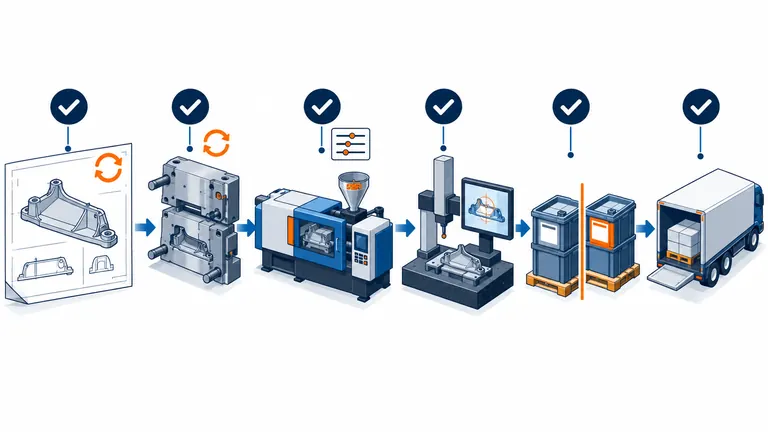
An approved CAD update does not automatically update the mold, process, gauge, work instructions, inventory, or supplier records. If each function acts from a different revision, correct work can still produce the wrong part. Engineering change control must connect authorization, implementation, verification, and the physical effective point.
Use one change record to identify the approved product delta, every affected asset and document, responsible owners, validation requirements, inventory disposition, and the first shipment or serial number governed by the new revision. No steel or production change should begin from an uncontrolled file. Closure requires objective evidence that the authorized change reached all affected controls—not only that CAD was released.
Establish one authoritative change package
The change package must allow a supplier, toolmaker, quality engineer, and planner to reach the same interpretation. Start with identity and authorization before technical detail.
Record the change number, affected customer and supplier part numbers, old and new revisions, reason, requestor, approval authority, release date, target effective point, and urgency. Attach controlled old/new CAD and drawings plus a delta view. Identify whether the change is customer-directed, supplier-proposed, corrective, regulatory, cost-related, obsolescence-driven, or temporary. A temporary deviation needs an expiry or quantity limit and a route back to the approved baseline.
Describe the requirement change in product language before prescribing tool work. For example: a clip engagement surface moves, a sealing interface changes, a resin grade is replaced, or a visible-zone boundary is revised. This lets engineering evaluate alternatives rather than blindly machining the first proposed solution.
List assumptions and unresolved interfaces. Does the mating component revision also change? Are boundary samples valid? Is the material approved by the customer? Must service parts remain backward compatible? Is the effective date tied to customer assembly, supplier shipment, or part production? If an answer could alter steel, validation, or inventory, it is a blocking input or a formally accepted condition.
Control distribution. The authorized record should identify where controlled files reside and who receives notification. Email attachments and local downloads can support discussion, but they should not become independent masters. Access must be restricted appropriately for customer intellectual property.
AIAG states that its APQP third edition includes new material on change management, sourcing, risk mitigation, and gated management (AIAG APQP resources). Use the actual customer-specific process and approval authority that applies to the program; the change record should reference those requirements rather than assert that one generic workflow is universally mandatory.
Build an impact map across product, process, and supply
A change owner should coordinate a cross-functional impact review. The tool is only one node in the system.
Review product interfaces: datums, tolerance stack, fit, sealing, motion, appearance, material state, loads, and tests. Review tooling: cavity/core, inserts, slides, lifters, shutoffs, cooling, gate and runner, venting, ejection, texture, sensors, and spares. Review production: machine, auxiliary equipment, setup, process window, automation, secondary work, error proofing, inspection, packaging, and traceability. Review supply: material and component availability, work in process, finished inventory, open releases, transport, and customer effective point.
Use an affected/not-affected rationale, not check marks alone. A boss move may be “not affected” for resin grade but “affected” for a core insert, cooling, measurement fixture, assembly force, and packaging support. The rationale makes later review possible and exposes assumptions.
| Impact area | Decision question | Typical evidence |
|---|---|---|
| Product definition | What requirement changes and what stays controlled? | Revision delta, interface review |
| Mold/tooling | Which components and functions are affected? | Annotated mold design, work scope |
| Process | Does setup, window, cycle or automation change? | Process review and trial plan |
| Quality controls | Which risks, characteristics, gauges and reactions change? | FMEA/control plan/MSA/inspection updates |
| Validation | Which prior evidence remains valid? | Requirement-by-requirement rationale |
| Supply | How are old/new inventory and downtime controlled? | Phase-in and buffer plan |
| Documentation | Which controlled records need revision? | Document matrix with owners |
| Service/aftermarket | Is backward compatibility required? | Service requirement and disposition |
Do not let the impact review become an administrative exercise. When “not affected” is selected for a critical area, require a concise engineering reason. When affected, identify a deliverable, owner, and due date. Link actions to the same change number.
The mold-change cost and requalification guide covers quotation mechanics. This article owns the larger control system: ensuring the approved change is implemented consistently across assets, records, and shipments.
Decide validation by changed risk, not change size
The number of edited CAD features does not determine validation effort. A small change at a sealing surface or snap interface may have greater functional impact than a large noncritical cosmetic relief.
Map each changed requirement and each process consequence to evidence. Dimensional checks should use the correct drawing revision, datums, material condition, cavity identity, and measurement method. Functional checks need the controlled mating components and assembly state. Appearance review needs the defined lighting, color/gloss/grain criteria, and approved boundary method. Material or supplier changes need grade-specific evidence and customer approval where required.
Determine whether process validation is affected. A change to wall thickness, gate, runner, cooling, or ejection can alter filling, packing, warpage, cycle, or defect modes. Review the process window and capacity rather than copying old settings. If a gauge changes, verify its suitability and measurement system. If a special characteristic or reaction plan changes, update the control documents before production release.
The AIAG quality core tools describe linked roles for APQP, Control Plan, PPAP, FMEA, SPC, and MSA. Customer requirements determine which documents and submission level apply. Avoid two shortcuts: repeating a full launch package without considering relevance, or declaring “no PPAP required” without documented customer authorization.
Create a validation matrix with requirement, risk, sample source, tool/cavity, process condition, test or inspection, acceptance criterion, responsible party, approval authority, and result. Identify which existing evidence is reused and the technical basis. When tests belong to an assembly or vehicle level, state who supplies parts and who owns that decision; do not claim that molded-part inspection approves the system.
Control timing, inventory, and the effective point
An engineering change is not complete when the tool leaves the bench. It is complete when old and new revisions are controlled through production and customer receipt.
Choose an effective-point definition that the parties can observe: production date/time, lot, serial, shipment, release, or customer build. Record the timezone and responsible system if relevant. A date without inventory and transport status can create mixed revisions at the customer.
Inventory disposition covers raw material or purchased components tied to the old revision, work in process, finished goods, samples, and service stock. Decide use-as-is, rework, return, controlled consumption, quarantine, or scrap through authorized channels. If both revisions remain valid for different applications, define physical and digital segregation, labels, scan controls, and order mapping.
Illustrative example—hypothetical. A latch geometry changes after the customer’s assembly trial. There are 8,000 old-revision parts at the supplier, 3,000 in transit, and two customer plants with different phase-in dates. The team cannot simply set “effective Monday.” It must map quantities and arrival dates, obtain disposition for old stock, schedule tool modification and trial, receive approval, create new labels, and link each plant’s releases to the correct revision. The example demonstrates the control logic; actual quantities and approvals are program-specific.
Plan production interruption. Use demand, available approved stock, modification duration, trial, inspection, customer disposition, transport, and uncertainty to determine the buffer. Establish a decision date for aborting, extending, or using a contingency path. If rollback is possible, preserve the required inserts, data, and authorization route. If steel removal makes rollback impossible, highlight that before release.
Notify affected parties with the controlled record: supplier production, toolroom, quality, logistics, customer contacts, sub-suppliers, and service organization where relevant. Require acknowledgement for critical handoffs. A broadcast email is not evidence that the correct routing, BOM, control plan, and labels were updated.
Close the change with configuration evidence
Closure should prove that the physical product, mold, process, documents, and supply records align. Use a configuration audit before declaring the change complete.
Verify the mold and related assets: modified components, revision markings, drawings, purchased parts, spare inventory, maintenance record, photographs, and acceptance checks. Verify production documents: setup, process window, work instructions, inspection program, control plan, FMEA, gauge, packaging, labels, and traceability. Verify business systems: BOM/routing, price if affected, inventory status, order/release mapping, and effective point.
Re-read the validation matrix and close every requirement with actual evidence or an authorized open condition. Record sample quantities, cavities, process conditions, and approval references. Do not convert “trial completed” into “all requirements passed.” If a customer approval remains pending, protect inventory and shipment status accordingly.
Capture lessons without rewriting history. Note actual modification versus plan, unexpected effects, process changes, obsolete items, and future preventive actions. Update the tool history so a later transfer, repair, or restart does not depend on a separate project folder.
A concise change-closure checklist should answer:
- Are old and new revisions unambiguous in every controlled system?
- Does the physical mold match the released design and marking?
- Are affected risks, controls, gauges, and work instructions current?
- Is required customer approval documented?
- Are old inventory, in-transit stock, and service parts dispositioned?
- Can the first conforming new-revision shipment be traced?
- Are price, tooling balance, and ownership records updated if applicable?
- Are open conditions visible with owner and expiry?
When requesting supplier support, send the authorized change package, affected assets, production/inventory position, customer requirements, and effective-point target. Ask for an impact map, implementation plan, validation matrix, and closure package. These deliverables let the buyer approve a controlled change rather than only a tool-shop invoice.
Conclusion
Control automotive engineering changes through one authoritative record, a cross-functional impact map, risk-based validation, and an observable effective point. Closure requires aligned physical tooling, process controls, documents, inventory, and approval evidence. A released CAD revision is the start of implementation, not proof that the change is complete.