
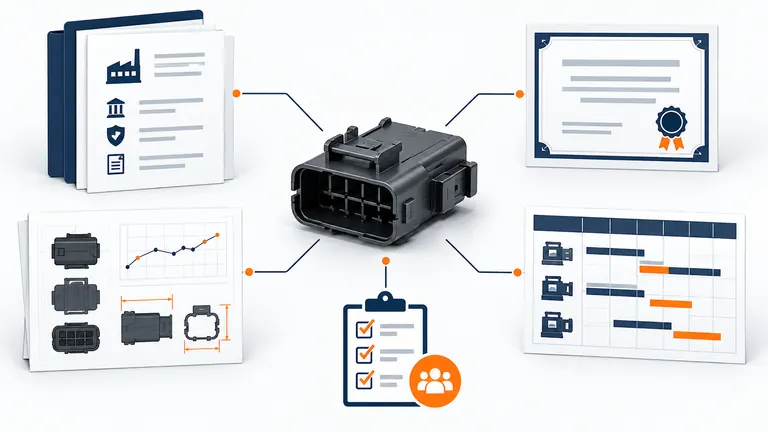
Conceptual illustration; not to scale.
A polished website and a certificate PDF can make several suppliers look equally qualified. The sourcing risk appears later, when the selected plant cannot run the specified resin, control a critical interface, support the required submission, or reserve realistic capacity. A shortlist should therefore be based on evidence that matches the actual part and supply model, not on the volume of sales material.
Before shortlisting a Chinese automotive injection molder, ask for a small, traceable evidence pack covering the legal manufacturing site, quality-system scope, comparable process capability, tooling responsibility, material and change control, capacity assumptions, and customer-specific deliverables. Verify each item against the RFQ. A certificate can support one question; it cannot prove every technical or commercial capability.
Start with the project profile, not a generic supplier questionnaire
Supplier screening becomes useful only after the buyer states what must be supplied. A plant that is suitable for a non-cosmetic polypropylene bracket may not be suitable for a glass-filled electrical housing with inserts, sealing interfaces, appearance zones, special packaging, and customer-controlled validation. Sending the same long questionnaire to every candidate often produces many checked boxes and little decision-quality evidence.
Create a one-page project profile before asking for credentials. Identify the current CAD and drawing revision, resin grade or material approval route, color and appearance requirements, annual demand range, release-order pattern, target production location, expected mold ownership, insert or assembly work, critical characteristics, inspection concept, packaging route, and required customer submission. If some inputs remain open, mark them as assumptions. The supplier should respond to the same baseline so that evidence can be compared.
Separate three decisions. First, can the legal manufacturing site perform the required work? Second, has the supplier demonstrated relevant controls on a comparable process? Third, can the supplier support this program’s specific quality, logistics, and commercial conditions? The answers may come from different records. A business license and site address establish identity. A quality certificate defines a management-system scope. A redacted control plan, capability study, mold-maintenance record, or change notice shows how a process is controlled. A capacity model and delivery scenario show whether the proposed supply plan is executable.
Do not ask for confidential customer drawings or unredacted PPAP files. A responsible supplier should protect other customers’ information. Ask instead for anonymized examples that preserve the document structure, revision controls, characteristic flow-down, approval status, and evidence type. A refusal to disclose customer secrets is not a weakness; an inability to explain the control method without exposing secrets is more significant.
Verify identity, manufacturing scope, and certificate boundaries
Confirm that the quoted company, factory address, bank beneficiary, contract entity, and manufacturing site belong to the same understandable legal arrangement. If tooling, molding, painting, assembly, inspection, or export is performed by another entity, record which company performs each step and who is accountable. A trading company or group affiliate is not automatically unsuitable, but the buyer needs to know where product realization and quality control actually occur.
For ISO 9001 or IATF 16949 evidence, request the complete current certificate rather than a cropped image. Check the legal name, site address, standard and edition, certificate number, issue and expiry dates, issuing certification body, and stated scope. IATF publishes a list of recognized certification bodies, while its Rules material explains that a certificate scope statement reflects the manufacturing processes and, where applicable, product-design responsibility covered by the quality management system. This is why a scope such as mold manufacture should not be interpreted as proof that serial part production is included.
Certification is supporting evidence, not a substitute for project qualification. ISO’s supplier-selection guidance explains how ISO 9001 can support purchasing decisions, and ISO describes certification as an additional layer of confidence rather than a universal requirement. Read the scope first, then ask how the proposed product will enter the supplier’s controlled system. If the certificate is not required by your customer, define the acceptable alternative evidence instead of pretending a label alone resolves risk.
Customer-specific requirements also remain separate. The IATF’s official CSR directory shows that OEM requirements differ and change over time. A Tier 2 buyer may also have its own manual, portal, forms, and approval route. Ask the candidate to identify the direct customer requirements it has reviewed for this quotation. Do not assume that an IATF certificate automatically includes every customer portal, submission level, labeling convention, or change-notification rule.
Ask for evidence that resembles the proposed process
“Automotive experience” is too broad to support a shortlist. Translate the part into process attributes and ask for evidence against those attributes: resin family and conditioning, part mass and projected area, wall and flow complexity, cavity count, inserts, undercuts, cosmetic zones, critical dimensions, sealing or assembly interfaces, secondary operations, annual output, and validation type. The objective is not to find an identical customer part. It is to see whether the supplier controls the difficult elements that your part combines.
Request an anonymized DFM sample showing how findings, assumptions, owners, and approvals are recorded. Ask for a process-flow example, a control-plan extract, a measurement-system example for a comparable characteristic, a cavity-identified dimensional summary, material-lot traceability, and a change-control record. AIAG describes APQP, Control Plan, PPAP, FMEA, MSA, and SPC as connected automotive quality core tools. The supplier does not need to send licensed manual content; it should be able to show how its own records connect design requirements to process controls and approval evidence.
For tooling, request the proposed mold concept, responsibility matrix, maintenance approach, spare strategy, and destination-machine data if the tool may move. For molding, ask which press family is assumed, how shot capacity and clamp needs will be checked, how effective cavities are handled in the rate calculation, and what evidence will establish the production process. For insert molding or assembly, ask how incoming components are approved, stored, oriented, mistake-proofed, tested, and traced.
Use red flags carefully. A sample report from another resin, cavity count, or inspection method is not proof of your process, but it can still demonstrate document discipline. Conversely, a beautiful sample part without revision, material, cavity, machine, process, and acceptance context has little screening value. Score relevance and traceability separately from presentation quality.
Test capacity and delivery claims with an executable scenario
Capacity statements such as “twenty machines available” or “millions of parts per month” are not project evidence. Ask the supplier to show the assumptions behind the quoted program: cycle time basis, effective cavity count, planned shifts, uptime allowance, scrap allowance, maintenance time, changeovers, inspection and secondary-operation constraints, resin and insert supply, packaging rate, and available machine windows. The result should reconcile to the annual demand and peak release pattern without counting the same loss twice.
Use a scenario rather than demanding a promise. For example, ask what happens if the weekly release rises, one cavity is disabled, an imported resin lot is delayed, or the mold requires unplanned maintenance. The candidate should identify decision owners, available alternatives, customer approvals that would be needed, and the lead time to activate the response. This is not a request for a guaranteed emergency recovery time. It is a test of whether the supplier understands the dependency chain.
Check logistics capability in the same way. Ask for a sample production schedule and shipment status format, packaging approval flow, lot identification, export-document responsibility, and escalation contact structure. If the customer uses EDI, a supplier portal, advance shipping notices, or prescribed labels, verify readiness against those specific interfaces. Do not infer readiness from general export experience.
Finally, compare claimed capacity with visible constraints. A candidate may have suitable presses but no controlled drying capacity for the resin, sufficient molding output but inadequate inspection throughput, or enough theoretical hours but no protected tool-maintenance window. The shortlist should show both the nominal production path and the constraint most likely to govern effective output.
Use a compact evidence matrix to make the shortlist decision
The screening record should distinguish received evidence, verified evidence, open assumptions, and items deferred to a later audit or qualification. A simple matrix prevents a missing certificate detail from being treated the same as an unresolved functional requirement.
| Screening question | Evidence to request | What to verify | Shortlist treatment |
|---|---|---|---|
| Who will manufacture the part? | Legal entity, site address, process map | Quoted and manufacturing entities; outsourced steps | Block if responsibility is unclear |
| Does the quality scope fit? | Complete certificate and scope | Site, dates, recognized body, included activities | Supportive evidence; not capability proof |
| Is the process relevant? | Redacted DFM, flow, control, measurement and traceability examples | Similar resin, geometry, cavity and control challenge | Score relevance and record gaps |
| Is tooling responsibility clear? | Mold concept and responsibility matrix | Design, build, maintenance, data, spares, transfer | Conditional if details can close before award |
| Is output credible? | Capacity calculation and constraint map | Good parts per hour, losses, inspection and packaging | Recalculate using the RFQ baseline |
| Can customer requirements be supported? | Requirements review and example submission index | Direct-customer forms, portal, labels, change route | Confirm before nomination |
An illustrative example: a buyer is screening suppliers for a clipped electrical cover in a conditioned engineering resin. Candidate A has a broad certificate but provides no evidence linking moisture condition to dimensional inspection. Candidate B has a narrower customer history but shows an anonymized control flow for resin drying, cavity traceability, snap-fit measurement, assembly checks, and approved packaging. Candidate B may deserve the stronger technical score, while certificate and customer-specific gaps remain explicit conditions rather than being ignored.
Select a supplier for the next stage only when the evidence is relevant enough to justify deeper work. The shortlist is not final approval. Site audit, detailed DFM, commercial negotiation, tooling release, trial, and production approval remain later gates.
What to send with a screening request
Prepare a controlled project profile, STEP data and 2D drawing where available, material and color basis, demand range, release pattern, critical and cosmetic features, secondary operations, validation expectations, packaging route, and target timing. Ask candidates to identify assumptions instead of silently filling gaps. If you want AutoMoldingPro to assess fit for a program, use the request-a-quote page and provide those inputs; capability can then be evaluated against the actual part rather than a generic supplier label.