
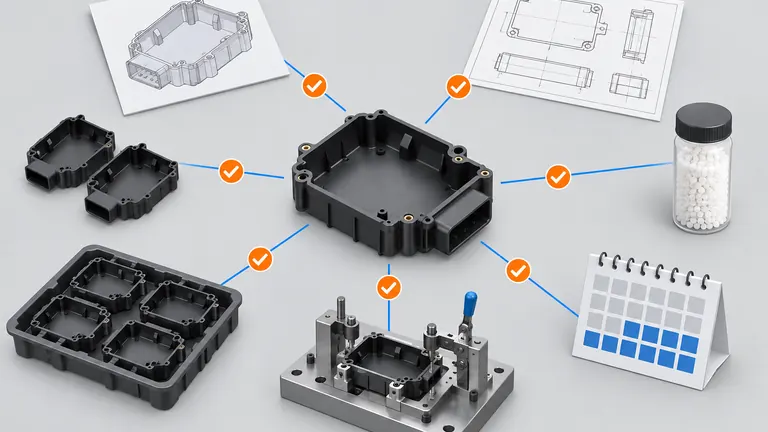
Conceptual illustration; not to scale.
Home › Blog › Automotive Injection Molding RFQ Checklist: Files, Volumes and Validation Requirements
Automotive sourcing and manufacturing decision guide
An RFQ can contain a detailed 3D model and still be unquotable. Missing revision status, resin, annual demand, order cadence, critical dimensions, appearance zones, validation, or delivery scope forces suppliers to guess. Those guesses produce fast numbers that cannot be compared and clarification rounds that consume the planned tooling schedule.
Release an automotive injection molding RFQ only when the supplier can identify the controlled geometry, material basis, demand profile, quality characteristics, validation responsibility, tooling and production scope, packaging, and destination. Separate required first-quote inputs from conditional items, state unknowns openly, and require every supplier to return assumptions and exclusions rather than silently filling gaps.
A useful RFQ checklist is therefore a release gate: it shows what must be controlled now, what may remain provisional, and what becomes mandatory only for a particular part or customer program.
In This Guide
- Use an RFQ Release Gate Before Sending Files
- Required Inputs for a Comparable First Quote
- Conditional Inputs: Include Them When the Part or Program Needs Them
- State Volumes in Four Different Ways
- Write a Validation Brief Instead of “Automotive Standard”
- Require a Structured Supplier Response
Use an RFQ Release Gate Before Sending Files
Why this matters: Teams often send files as soon as CAD exists, although ownership, revisions, demand, and the decision requested from the supplier are still unclear. The result is a quotation built on unstable inputs.
Use a short cross-functional release gate before transmission. Confirm the requested decision, document owner, revision baseline, commercial scope, known unknowns, and authorized recipients; then issue one indexed package rather than an evolving email thread.
An RFQ package is ready when another person can identify the controlled part, calculate the required quantity, understand the manufacturing boundary and list every open assumption. It does not need every validation detail to be final, but unknowns must be visible and assigned.
Use a cover sheet with RFQ number, project name, confidentiality status, issue date, contact, response date and a file register. Put superseded files in a separate archive; do not leave two active drawings in the same folder.
If the design is still moving, state the maturity level and quote purpose—budgetary, supplier nomination or production release. Ask bidders to separate price-impact assumptions that must be revisited when the design freezes.
Start by naming the quotation stage. A feasibility budget, production-tool award quote, transfer-mold assessment, and recurring production quote require different certainty and deliverables. If geometry is preliminary, say which dimensions or interfaces may change and ask for a bounded estimate rather than presenting the package as released. If the decision is tool release, unresolved material, texture, cavity, validation, or ownership questions should have named closure dates and commercial treatment.
Assign one RFQ owner to maintain the file index and question log. Engineering confirms CAD and drawing coherence; quality identifies special characteristics and evidence; supply chain supplies demand, destination, packaging, and commercial terms; the design authority controls deviations. Before sending, open every file from the issued folder, verify units and orientation, and remove obsolete duplicates. A supplier should be able to quote from the transmittal alone without choosing between “final,” “final2,” and an attachment from an older email.
Identity complete
- Part number and description
- 3D CAD revision
- 2D drawing/specification revision
- RFQ issue and response date
Demand complete
- Annual demand by program year
- Order/release quantity
- Service-volume assumption
- Requested capacity or peak pattern
Boundary complete
- Mold only, parts, assembly or full delivered scope
- Validation responsibility
- Packaging and delivery point
- Known customer-specific requirements
Required Inputs for a Comparable First Quote
Why this matters: When basic inputs are absent, suppliers substitute their own resin, cavity, quantity, tolerance, and delivery assumptions. The resulting prices may be precise on paper but refer to different products and production systems.
For a comparable first quote, provide controlled 3D geometry, applicable 2D requirements, material basis, annual and release quantities, destination, expected scope, timing need, and the characteristics that drive tooling, inspection, appearance, or assembly.
Official molding quote workflows commonly ask for a 3D model plus material, finish and quantity; Protolabs’ process guidance also shows that manufacturability feedback is part of turning the model into a moldable scope. Automotive RFQs then need customer-specific approval evidence layered onto that manufacturing baseline.
The following items are normally required to compare mold and part proposals. If one is unavailable, label it as open and instruct suppliers how to price the uncertainty.
The 3D model defines nominal shape, while the 2D drawing or controlled specification should identify datums, tolerances, critical features, notes, finish, and any requirement not safely carried by the model. State the native units and requested exchange format such as STEP; do not rely on a filename to prove revision. If a drawing conflicts with CAD, name which source controls and place the conflict in the question log before steel is released.
Material information must be commercially and technically usable. Give the approved manufacturer and grade when fixed, or define the property, regulatory, color, recycled-content, and customer constraints within which an alternative may be proposed. Demand should include credible annual usage, launch profile, release quantity, and service demand where applicable. Add the ship-to location and packaging unit because the same molded piece can have different logistics and handling cost. Finally, state whether the quotation is for mold only, molded parts, a production program, or a defined combination.
| Required input | What the RFQ should state |
|---|---|
| Part definition | • Native or neutral 3D CAD file • Controlled 2D drawing where dimensions/tolerances apply • Part number, revision and units • Assembly context or mating geometry for critical interfaces |
| Material definition | • Exact grade if released; otherwise required property/application basis • Color and appearance designation • Approved-source or customer-list restrictions • Regrind, recycled-content or traceability rules if applicable |
| Demand definition | • Annual volume by year • Typical and minimum order quantity • Peak weekly/monthly call-off if relevant • Program life and service demand if known |
| Commercial boundary | • Tool ownership and destination • Part delivery location and Incoterm request • Currency and quote validity request • Mold, part, validation and freight lines to show separately |
Conditional Inputs: Include Them When the Part or Program Needs Them
Why this matters: A universal RFQ form either overwhelms simple parts or omits risks unique to visible, insert-molded, safety-related, assembled, or customer-controlled components. Applicability must be decided, not assumed.
Add conditional inputs when the part or program triggers them: appearance standards, mating data, inserts and secondary operations, functional environment, special characteristics, customer submission records, packaging validation, or nominated sub-suppliers.
Conditional does not mean optional after nomination. It means the item is required only when triggered by the drawing, application, customer, appearance class, assembly route or validation plan.
The Volvo Group supplier quality manual illustrates the range of records an automotive customer may request—engineering changes, process flow, Process Failure Mode and Effects Analysis (PFMEA), Control Plan, dimensional and material/performance results, samples, master samples and customer-specific records. It is one OEM’s public system, not a universal submission list.
Use the part function and failure consequences to screen applicability. A visible bezel may need texture source, gloss and color boundary, gate restrictions, and an appearance approval route. A clip or connector housing needs mating-hole, panel, wire, insertion, retention, temperature, fluid, and service conditions. Insert molding requires insert drawings, material, plating, orientation, cleanliness, incoming inspection, and who supplies the insert. Welded or assembled products need joining requirements, fixture datums, purchased-component responsibility, and finished-unit tests.
Do not write “PPAP required” as a substitute for a validation brief. Identify the customer, program stage, requested submission level or record set, sample source, special characteristics, measurement expectations, laboratory constraints, and approval authority as far as they are known. The public Volvo quality manual, for example, separates product, process, and capacity evidence rather than treating approval as one generic document. Your program may use a different route; state that route or ask the supplier to quote a clearly labelled provisional scope pending customer confirmation.
| Conditional input | When and what to provide |
|---|---|
| Appearance | • Color/gloss/texture targets • Class-A or visible zones • Boundary samples and viewing conditions • Gate/ejector/weld-line restrictions |
| Critical characteristics | • Datums and geometric tolerances • Interface dimensions and fit function • Safety/regulatory markings • Capability or special-control requests |
| Testing | • Environmental and aging sequence • Mechanical/functional test method • Flammability/chemical/odor requirements • Laboratory qualification and report format |
| Downstream scope | • Insert molding or purchased inserts • Welding, fastening, labeling or kitting • Leak/electrical/force checks • Customer-supplied parts and fixtures |
| Packaging | • Pack quantity and orientation • Part-protection risks • Label/traceability fields • Returnable versus expendable packaging |
| Approval route | • APQP/PPAP applicability and level • Customer-specific forms and portals • Run at Rate or capacity evidence • Required approval authority and dates |
State Volumes in Four Different Ways
Why this matters: “Annual volume: 100,000” does not tell a molder how demand arrives. Tool cavities, machine planning, resin purchasing, setup frequency, inventory, and packaging all depend on quantities that the annual total hides.
State four quantities separately: annual demand, purchase-order release quantity, intended production batch, and any requested commercial minimum. Add launch ramp, peak period, forecast variability, service demand, and pack multiple when they affect planning.
Annual volume alone is insufficient. Suppliers need annual demand for capacity/tooling strategy, release quantity for setup and commercial batching, peak rate for resource checks, and program life for tool-life and ownership decisions.
For a multi-part assembly, convert assembly demand into each component’s demand using quantity per assembly. Keep the arithmetic and unit basis visible. Do not add launch bank, service parts or scrap twice.
Illustrative example — assumptions: 80,000 vehicles/year, one assembly per vehicle, two identical clips per assembly, typical release of 5,000 assemblies. The gross planning demand is 80,000 assemblies/year and 160,000 clips/year; a typical release requires 10,000 clips before separately approved service or contingency quantities.
Annual demand supports tool-life and broad capacity decisions, but the release quantity drives how often the supplier sets up the mold, purges material, stabilizes the process, performs first-off checks, and packs a shipment. The supplier may combine releases into a larger production batch and hold inventory, or run each release separately. Those alternatives change working capital, revision exposure, storage, traceability, and unit economics; neither should be hidden inside an unexplained MOQ.
Provide a demand table by month or quarter when launch or seasonality matters. Distinguish finished-vehicle demand from pieces per vehicle and spare-parts demand. For a multi-part assembly, extend each child quantity separately. If the forecast is uncertain, give a base case and credible range rather than an inflated “maximum” used only to seek a lower price. Ask suppliers to identify the volume tier, batch size, pack multiple, lead time, and inventory assumption behind each piece price so later quote comparison uses the same demand case.
Write a Validation Brief Instead of “Automotive Standard”
Why this matters: Terms such as “automotive quality,” “full PPAP,” or “standard testing” do not define samples, characteristics, methods, laboratories, timing, records, or approval responsibility. Suppliers may price very different evidence packages.
Translate the applicable customer and product requirements into a validation brief listing each deliverable, source revision, sample population, method, acceptance authority, timing, and owner. Mark uncertain items as provisional and request a priced option.
“Automotive standard” is not an acceptance criterion. Identify the governing customer, drawing/specification, test method, sample conditioning, sample source, quantity basis, report format and approval authority. If a requirement is not yet released, name the responsible person and quote assumption.
AIAG’s current APQP and Control Plan overview emphasizes that implementation is tied to OEM timing and customer direction. Treat Advanced Product Quality Planning (APQP) and Production Part Approval Process (PPAP) as frameworks and submission processes, not proof that a particular part has passed.
Separate design validation from production-process evidence. A material data sheet or prototype test may help select a design, but it does not by itself prove that the serial tool, production process and packaged part meet the customer release basis.
Begin with the released design record and risk analysis. Identify critical and significant characteristics, appearance zones, material declarations or certificates, dimensions, function, environmental exposure, measurement-system needs, checking aids, capability studies, packaging, and traceability. For each, state whether the supplier performs, subcontracts, supports, or only provides samples. If a named external laboratory or customer witness is required, include it because scheduling and cost can be material.
Separate evidence needed for tool trials, pilot builds, production-part approval, and capacity approval. A few acceptable samples may support a geometry decision but not demonstrate a stable production process. AIAG’s current APQP and Control Plan materials emphasize gateways and interdependent deliverables, while customer-specific requirements still govern the actual program. Ask the supplier to return an evidence register with inclusions, exclusions, sample quantities, lead times, and assumptions. This makes missing scope visible before nomination rather than during submission.
Test identity
Specification and revision; clause or method; units; preconditioning and environment.
Sample identity
Tool/cavity, production stage, material lot, process status and sample quantity basis.
Decision identity
Acceptance criteria, report owner, witness/approval authority and deviation route.
Require a Structured Supplier Response
Why this matters: Even a strong RFQ loses comparability when suppliers answer in unrelated formats. Important assumptions remain in emails, optional work is mixed with the base quote, and exclusions are discovered only after award.
Require a structured response that mirrors the RFQ: compliance and deviation log, tooling architecture, recurring and non-recurring prices, lead-time basis, capacity assumptions, validation deliverables, packaging, logistics, risks, and explicit exclusions.
Ask suppliers to return a compliance/exception sheet, mold concept, cavity basis, quoted cycle assumption, machine/auxiliary assumptions, resin basis, validation scope, lead-time milestones, commercial breakdown and exclusion list. Open DFM findings should be numbered and linked to marked geometry.
A DFM report should create a shared understanding of risks and deviations before tooling; Fictiv’s official DFM approval guidance is one example of that control point.
Use the AutoMoldingPro short RFQ route for the first business and technical baseline. Then send controlled CAD and drawings through the agreed channel; the website intentionally does not accept direct file uploads. For design-risk questions, review the DFM and mold-flow service scope.
Scope boundary: This article is a planning aid, not an OEM approval rule. The released drawing, contract, customer-specific requirements and agreed validation plan control the actual project.
Give bidders a response workbook or table with stable line identifiers. Each supplier should mark comply, propose alternative, need clarification, or exclude. A proposed alternative should explain its effect on function, quality, tool life, output, timing, price, and required customer approval. Keep options separate from the compliant base so an attractive alternative does not obscure the absence of a requested item. Require currency, Incoterm, quotation validity, payment milestones, and price-volume tiers on the same basis.
Close the loop with a controlled clarification round. Consolidate questions, issue written dispositions to all bidders when commercially appropriate, and identify which quote lines must be revised. Check that the final revision references the same CAD, drawing, demand, validation brief, and delivery destination. Illustrative use scenario: if one supplier assumes a customer-supplied color masterbatch and another includes sourced pre-colored resin, resolve the material responsibility and ask both to reissue the affected unit price; do not simply subtract an estimated amount from one quote.
Conclusion
Before sending an RFQ, confirm geometry, revision, material, demand cadence, critical requirements, validation scope, delivery level, packaging, and destination. Issue one indexed package and require a mirrored supplier response with assumptions and exclusions. For an initial review, submit STEP, 2D requirements, resin basis, annual volume, release quantity, timing, and the approval evidence you expect.
Related Decision Guides
- Quoting a Multi-Part Automotive Plastic Assembly: BOM, Molds and Assembly Scope
- How to Compare Automotive Injection Molding Quotes Beyond Mold Price
- Automotive Injection Molding MOQ: Annual Volume vs. Order Quantity
Start With the Minimum Comparable RFQ
Provide the part number and revision, current project stage, material basis, annual demand, order quantity, destination and required delivery scope. Mark missing validation details as open rather than guessing them.
If the inquiry popup does not open in your browser, use the full automotive project RFQ.