
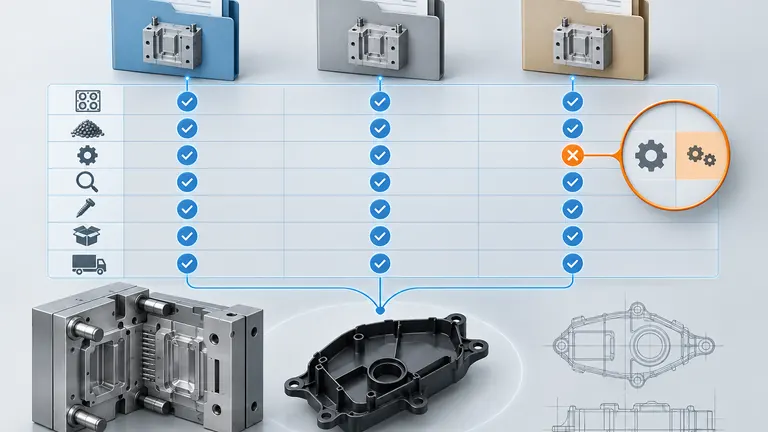
Conceptual illustration; not to scale.
Home › Blog › How to Compare Automotive Injection Molding Quotes Beyond Mold Price
Automotive sourcing and manufacturing decision guide
The least expensive mold quote may assume fewer trials, different steel, a shorter life, customer-supplied resin, no dimensional layout, or ex-works delivery. Awarding from the headline total can turn apparent savings into corrections, validation charges, capacity gaps, or an asset that cannot be transferred or maintained as expected.
Compare quotations only after normalizing the same revision, tool architecture, cavity output, resin and color, production quantity, trial and correction scope, validation, spares, packaging, delivery, ownership, and exclusions. Keep price, technical compliance, capacity evidence, commercial exposure, and unresolved risk as separate decision dimensions; do not use either mold price or a weighted score as a substitute for closing critical gaps.
The comparison process should make unlike assumptions visible, obtain supplier clarification, and preserve both the compliant baseline and any useful alternatives.
In This Guide
- Freeze One Comparison Baseline Before Reading Totals
- Normalize the Mold Architecture and Output Assumption
- Automotive Injection Molding Quote Comparison Matrix
- Screen a Low Quote for Missing Scope Before Escalating Price
- Risk-Adjust the Decision Without Inventing a “True Cost”
- Run One Controlled Clarification Round
Freeze One Comparison Baseline Before Reading Totals
Why this matters: A spreadsheet cannot normalize quotations if suppliers priced different drawings, materials, annual volumes, or delivery levels. Adjusting totals without first aligning inputs creates false precision.
Freeze a comparison baseline and trace every quotation to it. Identify file revisions, material and color, demand and release quantities, finished delivery scope, validation brief, destination, and commercial terms before comparing any total.
Digital quote systems visibly change price when material, quantity, finish and delivery change; Protolabs’ official quote guidance is a useful reminder that a supplier total is inseparable from its inputs. Automotive buyers should make those inputs explicit before treating totals as alternatives.
Create a one-page baseline and put it above the supplier columns. It should name the released or quoted revision, quote maturity, annual demand, typical order quantity, program life, destination, currency, Incoterm request, resin/grade/color, appearance class, validation responsibility and required delivery level.
If a bidder used a different assumption, do not overwrite its proposal. Record the difference, request a normalized alternate and preserve the original. That creates an auditable bridge between the supplier’s engineering judgment and the buyer’s comparison.
Separate firm, budgetary and optional lines. A budgetary resin allowance is not equivalent to a firm price on an exact approved grade; an optional mold-flow study is not included simply because the supplier mentions DFM in its cover letter.
Create a cover sheet with the controlling RFQ revision and a list of later clarifications. For each supplier, record the quotation revision and whether it acknowledges every baseline item. If a bidder priced preliminary CAD while another used released CAD, stop the total-cost comparison and request a revision. The same rule applies when one supplier includes assembly and another quotes molded parts only. Normalization is not adding an estimated assembly amount; it is obtaining a supplier-owned price for the same scope.
Separate required compliance from optional alternatives. A supplier may identify a legitimate cost reduction through a different gate, cavity count, resin, or packaging method. Keep that proposal visible, but first require a price and timing for the requested baseline or record why the alternative is the only feasible route. This protects the technical decision authority and lets purchasing compare alternatives deliberately. Link unresolved questions to the affected line rather than leaving them in meeting notes that are disconnected from the award record.
Technical baseline
- Part/CAD/drawing revision
- Resin, color, finish and appearance zones
- Critical dimensions and validation inputs
- Tool destination and press-interface requirements
Demand baseline
- Annual volume by year
- Typical and minimum releases
- Peak-rate assumption
- Program and service life
Commercial baseline
- Currency and validity date
- Delivery term and destination
- Payment/ownership milestones
- Required breakdown and alternates
Normalize the Mold Architecture and Output Assumption
Why this matters: Two molds for the same part can differ in cavities, steel, runner, cooling, mechanisms, sensors, automation, life assumptions, and maintenance access. Their prices and piece economics are therefore not directly comparable.
Normalize the physical tool definition and production-output basis. Compare cavity count, part-per-shot relationship, steel and hardness basis, runner and gate system, cooling, actions, ejection, interfaces, target life, machine assumptions, and documentation.
A one-cavity mold and a two-cavity mold are different production systems. Compare them on total output, press fit, cycle assumption, balance, maintenance, spare strategy and capacity risk—not on mold price alone.
Record tool steel and base specification only when the supplier states them. Also capture runner type, gate concept, side actions, replaceable inserts, sensors, connectors, lifting/transport provisions, cavity identification and expected maintenance deliverables. Do not convert a vague “production tool” label into a mold-life promise.
Ask which corrections after each trial are included, how many trials are priced, what sample quantities are included, and who pays for resin, special fixtures, third-party tests and freight. A low tooling line can be paired with chargeable trial loops and unpriced validation.
Ask for a mold specification summary rather than relying on labels such as “Class 101,” “export mold,” or “production tool” unless the referenced definition is contractually identified. Confirm mold-base and cavity/core materials, heat treatment, standard components, hot-runner make and model, hydraulic or electrical requirements, lifting and clamping features, connector standards, spare inserts, and whether the destination plant has reviewed compatibility. Tool mass, shut height, tie-bar spacing, nozzle interface, ejection, water circuits, and controller requirements can determine whether the quoted tool can run at the intended location.
Then compare output assumptions. More cavities can reduce machine cost per piece but increase tool investment, balance and maintenance complexity, and the impact of cavity-specific variation. A hot runner can reduce runner waste and support gating, while adding controls, maintenance, and spare-component needs. Enhanced cooling may justify higher tooling cost through a stable cycle, but the quoted cycle remains an assumption until demonstrated. Require the supplier to identify which design choices drive its price and how a disabled cavity affects output and part segregation.
Architecture
Separate/family tool, cavity count, runner/gate, actions, interchangeable inserts and quoted tool destination.
Output
Pieces per shot, cycle-time assumption, target press/auxiliaries, downstream rate and capacity reserve assumption.
Lifecycle
Maintenance plan, spare parts, expected records, repair responsibility and end-of-program disposition.
Automotive Injection Molding Quote Comparison Matrix
Why this matters: Headline totals hide whether engineering, trials, inspection, validation, spares, packaging, freight, and ownership are included. Reviewers need a line-by-line view that keeps scope and evidence beside cost.
Use a common-basis matrix with one row per technical, quality, logistics, and commercial requirement. Record each supplier’s inclusion, deliverable, assumption, deviation, price treatment, and open action before calculating a normalized total.
Use one card row per decision area and assign three values for each bidder: quoted basis, exception/assumption, and normalized commercial effect. “Not stated” is a finding.
Work across the matrix in risk order, not simply from top to bottom. First close identity items: revision, material, tool destination, ownership, and sellable unit. Next close feasibility and output: cavity plan, cycle basis, machine, automation, and secondary bottlenecks. Then close approval evidence, corrections, spares, packaging, transport, and commercial terms. A price shown beside an unresolved critical requirement should remain provisional; do not convert a blank into zero.
Illustrative use scenario: Supplier A includes three trials and a complete dimensional layout but excludes texture and freight. Supplier B includes texture and delivered freight but lists “samples included” without quantity, inspection, or correction scope. Enter the stated inclusions exactly, ask Supplier B to define trial and evidence deliverables, and ask Supplier A to price texture and delivery on the same destination basis. Only after revised responses should the matrix calculate a normalized total. Preserve the original and revised quotations so the audit trail shows what changed and why.
| Comparison line | Common-basis check |
|---|---|
| 1 — Mold and ownership | • Mold count/cavities and specification • Ownership transfer and storage • Trials/corrections included • Spares, gauges and documentation |
| 2 — Molded part | • Exact material/color allowance • Piece-price quantity tier • Cycle/cavity basis • Scrap, regrind and setup treatment |
| 3 — Validation | • Dimensional layouts and capability studies • Material/functional/appearance tests • PPAP/customer-specific package • Run at Rate or capacity evidence |
| 4 — Secondary scope | • Purchased inserts/components • Assembly/welding/printing/labeling • Fixtures and in-process checks • Traceability through sub-suppliers |
| 5 — Packaging/logistics | • Pack design and dunnage • Labels and lot identity • Freight, duties and insurance • Returnable asset ownership |
| 6 — Program controls | • Lead-time milestones • Engineering-change rates • Launch containment • Warranty/exclusions and escalation |
Screen a Low Quote for Missing Scope Before Escalating Price
Why this matters: A low quote can reflect efficiency, but it can also reflect omitted scope, optimistic cycle time, under-specified tooling, or commercial exposure shifted to later changes. Price alone cannot distinguish these cases.
Screen the low quotation with targeted questions tied to the matrix. Confirm scope, technical basis, evidence, correction limits, capacity assumptions, ownership, and delivery terms; escalate only unresolved material risks, not every price difference.
A low quote deserves clarification, not automatic rejection. The supplier may have a more efficient concept. The buyer’s job is to distinguish real design/process advantage from a different scope.
Xometry’s molding service description lists inspection and approval options separately from the core molding offer, illustrating why buyers must verify whether first article inspection (FAI), PPAP or other records are actually included. The required level remains project-specific.
Send a numbered omission query and ask the supplier to mark: included at no additional charge, included in another line, optional with price, customer responsibility, or excluded. Do not accept “standard automotive quality included” as a substitute for named evidence.
Start with the largest deltas and ask for explanation rather than a supplier’s internal cost breakdown that is neither necessary nor comparable. A lower mold price may come from simpler actions, local standard components, a smaller mold base, fewer cavities, or a deliberate life assumption. A lower piece price may come from a faster cycle, higher cavities, lower material price, automation, larger batch, or different scrap and packaging assumptions. Each explanation should connect to a visible technical or commercial choice.
Request evidence appropriate to the claim. For a cycle assumption, ask for the thermal and process basis and later demonstration plan; for material pricing, confirm manufacturer, grade, color, purchasing unit, and escalation mechanism; for tool life, confirm maintenance and wear-part treatment; for “PPAP included,” request the deliverable register. If the supplier cannot resolve a critical omission, leave the quote non-compliant or risk-qualified. Do not average it into a score that lets a large price advantage cancel an unacceptable safety, ownership, or production constraint.
| Possible omission | Clarification to request |
|---|---|
| Common missing tooling lines | • Hot-runner/controller interface • Textures or special polishing • Mold-flow depth • Trial resin and sample freight • Critical spares and dedicated gauges |
| Common missing production lines | • Color/material change setup • Purchased parts and assembly • Inspection frequency • Special packaging/labels • Freight, duties and inventory carrying |
| Common missing approval lines | • Measurement-system work • Capability runs • Third-party tests • Customer portal/document preparation • Correction/retest responsibility |
Risk-Adjust the Decision Without Inventing a “True Cost”
Why this matters: Teams sometimes invent a single “true cost” by assigning unsupported money values to every risk. That can hide judgment, double-count contingency, and imply accuracy the evidence does not support.
Keep the quoted cost calculation separate from a documented risk assessment. Quantify exposure only where a defensible range and scenario exist; otherwise classify the risk, owner, mitigation, evidence, and decision gate explicitly.
Keep quoted price and risk assessment separate. Do not silently add arbitrary percentages to make a preferred supplier win. Instead, score evidence: clarity of assumptions, DFM closure, process concept, capacity method, quality plan, change control, sub-supplier visibility, schedule logic and commercial exclusions.
For each unresolved risk, record consequence, owner, next evidence and decision date. If a risk could change price, request a priced alternate or a ceiling condition. If it could prevent technical release, make it a nomination gate rather than converting it to a monetary guess.
Illustrative example — decision format, not market pricing: Supplier A has the lowest mold line but excludes texture, two validation tests and sample freight. Supplier B includes those lines and uses two cavities instead of one. The correct comparison keeps both original totals, adds supplier-confirmed alternates to the baseline, and compares output/ownership/risk separately. No price is inferred until each supplier answers.
Use a small number of risk categories: product feasibility, tool robustness and transferability, process and capacity, validation, supply continuity, logistics, and commercial terms. For each, record the triggering assumption, consequence, likelihood basis, mitigation, residual risk, and who can accept it. A missing spare quote is usually closeable; an unproven material substitution affecting a regulated or safety-related requirement may require design-authority work and cannot be solved by adding a generic percentage.
Where scenario costing is appropriate, show the arithmetic separately. Examples include freight under the same Incoterm, expected inventory carrying exposure under a stated batch policy, or remaining tool amortization if demand stops at a named quantity. Do not assign fictitious probabilities. The decision record should show the compliant quoted total, optional alternatives, quantified scenarios, and non-quantified risks. This lets management see whether a higher initial price buys required scope or merely different assumptions, without claiming that every uncertainty has an exact monetary value.
Run One Controlled Clarification Round
Why this matters: Uncontrolled clarification can destroy fairness and revision traceability. Different suppliers receive different answers, verbal concessions are lost, and the final spreadsheet no longer matches the quotations it claims to compare.
Run one controlled clarification round with numbered questions, common dispositions where appropriate, due dates, and required quote revisions. Lock the comparison only after each supplier’s final response references the same baseline.
Send the same baseline revision and numbered question set to all bidders. Set a response date, prohibit unmarked substitutions, and ask each supplier to return a revised quote plus a change log. Freeze the comparison after answers; do not mix revision-two commercial data with revision-one technical assumptions.
The Volvo Group supplier quality manual shows that automotive approval evidence spans product, process and capacity—not just a conforming sample. Use that principle to verify that the selected proposal contains the evidence path your customer actually requires.
If the tool concept remains unclear, compare it against the automotive injection mold manufacturing scope. For production assumptions, review the automotive plastic injection molding route. Start a controlled discussion through the project RFQ page.
Scope boundary: This article is a planning aid, not an OEM approval rule. The released drawing, contract, customer-specific requirements and agreed validation plan control the actual project.
Prepare questions directly from red or blank matrix cells. State the baseline requirement, quote reference, clarification needed, and whether the answer must change price, timing, or compliance status. When one question reveals an RFQ ambiguity that affects all bidders, issue the same written clarification to all of them in accordance with your sourcing process. Keep supplier-specific proprietary alternatives confidential while still maintaining a common requested baseline.
At closure, verify that every adjusted matrix value comes from a dated supplier quotation or written confirmation authorized for commercial use. Do not overwrite an old number without retaining the source. Review remaining exceptions with engineering, quality, logistics, and purchasing owners, and record the acceptance boundary. The final award recommendation should explain why the selected proposal is technically acceptable, commercially understood, and supportable at the required volume—not merely why its normalized total is lowest.
Conclusion
Freeze one RFQ baseline, normalize tool and production assumptions, close the comparison matrix, and separate quoted cost from unresolved risk. Ask finalists to reissue their proposals after clarification. To review competing quotes, provide the same drawing revision, demand case, tool destination, validation scope, delivery terms, and each supplier’s complete inclusions and exclusions.
Related Decision Guides
- Quoting a Multi-Part Automotive Plastic Assembly: BOM, Molds and Assembly Scope
- Automotive Injection Molding RFQ Checklist: Files, Volumes and Validation Requirements
- Automotive Molding Capacity: What a Run-at-Rate Trial Should Demonstrate
Normalize the Quote Before Negotiating the Total
Share the common revision, demand tiers, resin basis, validation scope, destination and supplier exception sheets. A review can identify which differences are engineering choices and which are missing commercial lines.
If the inquiry popup does not open in your browser, use the full automotive project RFQ.