
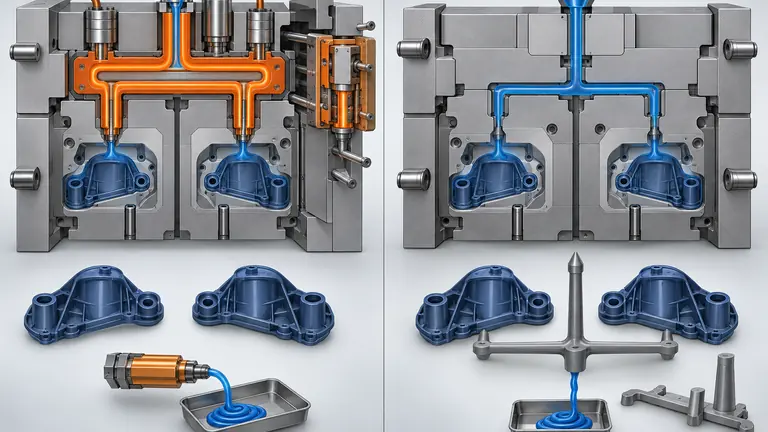
Conceptual illustration; not to scale.
A hot runner can reduce runner scrap, but it adds heated components, controls, spares and maintenance decisions. A cold runner can be simpler to operate and easier to change over, but it creates a runner that must be handled, reground or discarded and may affect cycle balance. Choosing by headline material savings alone can move cost and risk into the production department.
Select hot or cold runner by the complete production case: part and resin, cavity count, material value and regrind rules, color or material change frequency, thermal sensitivity, gate requirements, cycle and output, maintenance capability, spare strategy and downtime consequence. A hot runner is not automatically cheaper or faster, and a cold runner is not automatically wasteful. Price the system and the operating conditions together.
The scope here is runner architecture. Gate-location and fill-pattern design remain part of the DFM and moldflow review.
Compare the architecture before comparing the price
Why this matters: The runner system controls how melt travels from the machine nozzle to the gates, how material is separated from the part, and what the operator must maintain. It also changes mold layout, temperature control, startup and shutdown behavior.
In a cold runner, the runner solidifies with the molded shot and is removed or separated during ejection. The runner may be reground and reused only when the material, customer requirements and process controls permit it. The runner also occupies mold space and can influence balance, pressure loss, cooling and cycle time. For a simple, low-cavity tool or a material with strict thermal limits, this simplicity can be valuable.
In a hot runner, the manifold and nozzles keep the material molten so that the runner is not ejected as a solid part. Hot-runner systems can support valve or thermal gates, multi-cavity balance and gate placement that would be difficult with a cold runner. They require heaters, thermocouples, controllers, wiring, thermal insulation, maintenance access and trained service. The exact benefit depends on system design and process discipline.
Begin with the part: projected area, flow length, wall thickness, cosmetic gate limits, cavity count, material viscosity, temperature window, shear sensitivity, glass content, color, resin cost and allowable regrind. Then define the production: annual demand, order batches, planned changeovers, shift pattern, machine availability, maintenance resources and spare-parts lead time. Runner architecture is a system decision, not a component checkbox.
Ask the supplier to show the runner concept, gate type, temperature zones, valve actuation, start-up and shutdown instructions, cleaning method, spare list and assumptions. A lower tool price that omits a temperature controller, gate insert or service kit is not comparable with a complete hot-runner quotation.
The quote should identify whether the runner system is standard or customer-specific, whether the gate insert is replaceable, and whether the machine controller, cables, thermocouples and service tools are included. For a cold runner, identify the sprue, runner, gate, ejection and separation method. For either system, show how the part is protected from gate vestige, flash and thermal imbalance. The architecture decision is only sound when the part-quality consequence and the production consequence are visible beside the price.
Evaluate material use without assuming regrind is free
Why this matters: Material waste is the most visible hot-runner argument, but the true comparison depends on runner weight, part weight, cavity count, regrind acceptance, color sequence and the customer’s material controls.
For a cold runner, calculate gross shot weight as parts plus runner and sprue. Then identify what happens to the runner. It may be reground and blended under a controlled recipe, sold as scrap, or prohibited from reuse for the application. A regrind allowance may be limited by resin supplier guidance or customer-specific requirements. The value of a runner is not just its mass; it can also create sorting, contamination, drying, storage and traceability work.
For a hot runner, account for the material held in the manifold and nozzles during startup, shutdown, color change, purge and maintenance. A hot runner can avoid a recurring solid runner, but it may still generate purge waste and startup shots. Thermal residence time can matter for heat-sensitive or shear-sensitive materials. The system supplier’s processing guidance and the resin supplier’s limits should inform the changeover and shutdown procedure.
Use a mass balance by production scenario. Record part mass, cavities, runner mass, good yield, startup scrap, purge scrap, allowable regrind fraction, material cost basis and changeover frequency. If the system is multi-material or multi-color, model each sequence rather than using one average. Do not publish a savings percentage without actual data.
The practical decision is often between material efficiency and operational simplicity. A cold runner may be commercially sound when the runner is small, regrind is permitted and changeovers are rare. A hot runner may make more sense when the runner would be large, the material value is significant, the cavity layout benefits from thermal gating or the waste cannot be reused. The customer must verify the material policy before assigning a value to scrap.
Use the same good-part demand and the same accounting basis in both cases. If the cold runner is reground, include grinding, drying, storage, blending, traceability and any reduced material performance or customer restriction. If it is discarded, include disposal and replacement resin. If the hot runner needs purge or startup material, include those quantities. A model that counts only solid runner weight will overstate the benefit of the hot system.
Treat changeovers as a process, not a button press
Why this matters: Color and material changes reveal the operational difference. A hot-runner manifold holds material in heated passages, so the changeover can require a defined purge, temperature strategy, gate inspection and confirmation that old material is cleared. A cold runner has no heated manifold, but it may require more material handling, runner removal and cleaning around gates and the machine nozzle.
Define the changeover matrix: previous resin or color, next resin or color, temperature compatibility, purge method, quantity or endpoint rule, sample inspection, cavity verification, waste disposition and restart approval. The quantity must be established by the equipment, resin and quality plan, not guessed from a universal number. For a heat-sensitive grade, residence time and thermal exposure may control the sequence; for a dark-to-light color change, visual carryover may control it.
Ask who owns the procedure. The hot-runner supplier should provide system operating and maintenance information; the resin supplier should provide processing and degradation guidance; the molder should validate the production procedure on the actual tool and machine. Mold-Masters’ maintenance manual emphasizes trained personnel and safe maintenance practices, while Husky publishes operator and maintenance resources for its hot-runner systems. Those manuals are equipment-specific and do not define a universal automotive changeover cycle.
For a cold runner, confirm runner ejection, separation, recycling, granulation, drying and storage. If the runner is reground, verify that the customer permits the practice and define lot traceability. If runners are discarded, include disposal and material cost in the model. In both architectures, check gates after the changeover and retain a first-off sample when color or material identity is a risk.
Illustrative example: a two-color interior clip is molded several times per week. A hot runner reduces solid runner handling but retains material during frequent changes. The supplier proposes a documented sequence with an approved purge, first-off color inspection and a retained sample. The buyer compares that cost with a cold-runner option that has higher runner handling and a permitted regrind recipe. The choice depends on real changeover frequency and material policy, not a generic claim that hot runners save scrap.
Validate the endpoint with a first-off acceptance rule. A visual color check may be adequate for one product, while a critical material identity or thermal-history risk may need a more specific check. Record the old and new materials, temperatures, purge, samples, operator, time and waste disposition. The method should be safe for the equipment and the resin. A supplier’s operator manual informs the procedure, but the molder owns the validated work instruction for the actual machine and part.
Price maintenance, spares and downtime honestly
Why this matters: A runner system is part of the production process. Its maintenance cost includes scheduled inspection, heater and thermocouple checks, gate or valve service, leakage prevention, cleaning, controller troubleshooting, spare inventory, technician training and the time the mold is unavailable.
For a hot runner, request a system BOM, zone count, controller specification, wiring and connector layout, gate inserts, valve stems or actuators, seal strategy, recommended spares, maintenance intervals and service procedure. Mold-Masters and Husky manuals show that hot-runner maintenance is a controlled task requiring trained personnel and appropriate safety precautions. The buyer should confirm whether the local team can perform the work or whether the system supplier must be called.
For a cold runner, maintenance may be simpler but is not zero. Inspect runner edges, gates, parting-line shutoffs, sprue bushing, ejector and cooling balance. Runner design can create wear or sticking, and the molder still needs a cleaning and inspection method. A cold runner may also need more frequent material-handling equipment or grinder maintenance when regrind is used.
Estimate downtime cost using the actual production plan: parts per hour, good yield, material, labor, customer delivery and the availability of another machine or tool. Do not insert an unsupported failure frequency. Ask the supplier for a response plan if a heater, thermocouple, valve or gate insert fails. Check whether the tool can be repaired in place, requires removal, or has replaceable components accessible from the parting line.
Maintenance compatibility is a design input. Cooling, electrical access, manifold support, thermal expansion, mold opening and safe plate control all affect service. A hot runner that improves the nominal cycle but cannot be maintained by the production site may create a larger business risk. A cold runner that uses a larger mold base but is easy to service may be the better choice for a second source or export tool.
A spare list should identify criticality and replenishment time, not only part numbers. A heater or thermocouple that can be replaced during planned maintenance has a different risk from a manifold component that requires mold removal. For cold runners, include sprue-bushing, gate and runner inspection as well as grinder controls when regrind is used. The production owner should confirm utilities, trained personnel and safe access before the system is approved.
Use a selection matrix and scenario model
Why this matters: Use the following matrix after the resin, part, customer material policy and production plan are known. “High” is not a universal rating; it means the factor deserves more weight in the project decision.
Use the matrix to eliminate architectures that cannot meet the material, gate or maintenance requirement, then compare total cost over the same good-part output with all assumptions shown.
| Decision factor | Hot runner tends to help when | Cold runner tends to help when | Verify before approval |
|---|---|---|---|
| Material efficiency | Runner mass and material value are significant; regrind is restricted | Runner is small or controlled regrind is permitted | Actual mass balance and customer regrind rule |
| Cavity balance and gate control | Thermal gating or valve sequencing supports the part layout | Simple geometry can fill acceptably with a balanced cold runner | Moldflow, pressure and gate concept |
| Changeovers | Change sequence is controlled and frequent scrap is costly | Changes are infrequent and simplicity outweighs purge concerns | Changeover matrix, purge and first-off check |
| Thermal sensitivity | System residence and temperature control are validated | Avoiding a heated manifold reduces residence concern | Resin TDS, thermal history and process study |
| Maintenance | Skilled service and spares are available | Local team values simpler access and repair | BOM, training, spares and response plan |
| Tool investment | Output and material savings justify added system cost | Lower initial complexity is important | Comparable quote including controller and spares |
| Export or second source | Destination team can support the system | Receiving plant needs familiar, simpler maintenance | Plant utilities, interfaces and capability review |
For the scenario model, compare total cost over the same good-part quantity, not the same number of shots. Include material, runner disposition, purge, startup scrap, energy if material to the decision, inspection, maintenance, spares, changeover labor and downtime assumptions. Keep all assumptions visible. If the data is not available, say which variable could change the decision instead of manufacturing a result.
A useful worksheet has one row per production scenario: steady-state run, startup after a shutdown, color change, material change, planned maintenance and unplanned recovery. For each row, record shots, good parts, runner or purge mass, operator time, inspection, downtime and recovery evidence. The buyer can then see whether the hot runner benefit occurs during every order or only during high-volume steady state.
Illustrative example: a four-cavity visible trim part has a large cold runner but changes color only twice per month. The hot runner reduces solid runner handling but adds controller and service cost. A smaller technical part runs frequent material changes and has strict regrind controls. The second case may justify the thermal system, while the first may not. Both decisions are valid if the actual process and customer material rules support them.
Keep the model transparent. A buyer should be able to replace an assumed runner weight, material value or changeover count with a measured value and see the decision move. Do not report savings as a guaranteed result before the molder validates scrap and downtime. A production trial should record actual shot weight, good yield, purge, changeover time and maintenance events so the original architecture decision can be checked against reality.
Conclusion
Choose the runner system from a real mass balance and operating plan. Include material policy, changeovers, thermal history, maintenance, spare parts and downtime—not only mold price. Ask for a complete system BOM and a validated changeover procedure before approving a hot runner; document regrind and handling controls before approving a cold runner.
References
- Mold-Masters, Hot Runner Maintenance Manual — equipment-specific maintenance and trained-personnel requirements.
- Husky, Hot Runner Systems — hot-runner system and material-efficiency considerations.
- Husky, Technical Product Manuals — operator and service documentation for specific systems.
- AutoMoldingPro, Automotive Molding Capacity Run-at-Rate — related article for production-rate evidence after architecture selection.