
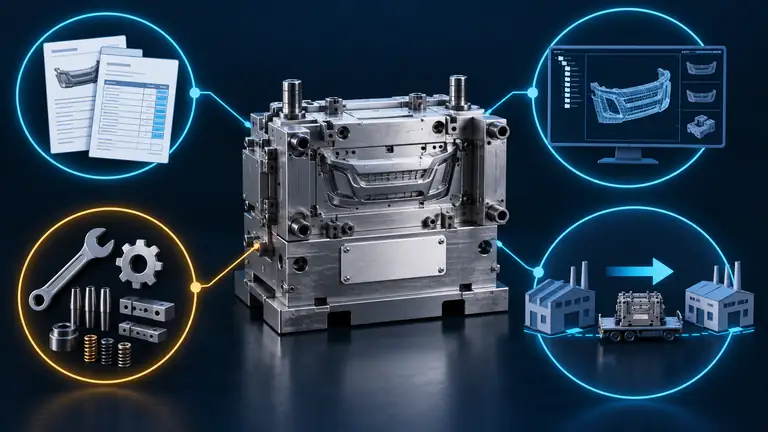
Conceptual illustration; not to scale.
A buyer can pay a tooling invoice and still discover that no one documented who owns the mold base, hot runner, spare inserts, CAD, gages, or the right to move and operate them elsewhere. The dispute usually appears when a program changes suppliers, a company fails, storage fees accumulate, or a tool needs urgent repair—exactly when ambiguity is most expensive.
Resolve ownership, custody, use rights, records, maintenance, access, transfer, and end-of-program disposition in the contract and purchase documents before tooling begins. Then keep an asset register and acceptance trail that match the commercial agreement. This is an operational checklist, not legal advice; contracts, liens, insolvency, intellectual property, tax, customs, and jurisdiction-specific rights require qualified counsel.
Distinguish ownership from possession, custody, and use
The molder may physically hold and maintain a tool without owning it. The buyer may own some assets while the customer owns others. A supplier may own manufacturing know-how while the customer controls product data. Use precise categories instead of the single phrase “customer tool.”
Identify legal owner, payer, physical custodian, authorized users, approved manufacturing sites, and the party responsible for maintenance and insurance. State when title transfers: at purchase order, progress payment, completed build, acceptance, full payment, or another defined event. Address work in progress and materials if the toolmaker or molder becomes unable to complete the work.
Define the asset boundary. A mold may include base, cavity and core inserts, slides, lifters, ejector components, hot runner, manifolds, heaters, thermocouples, hydraulic cylinders, sensors, connectors, locating ring, sprue bushing, insulation plates, lifting hardware, and dedicated controller. Gages, fixtures, end-of-arm tooling, automation nests, spare inserts, service tools, and software may be separate assets.
Record third-party components and licenses. Payment for a hot runner or controller does not automatically transfer every software, drawing, service, or warranty right. Confirm with the applicable supplier terms. If the parties intend the tool to operate only for one customer or part family, state those use restrictions and how scrap, samples, and excess production are controlled.
Also distinguish risk of loss from ownership. The contract should state who bears loss or damage during build, storage, operation, repair, loading, and transit, and what notice and evidence are required after an incident.
Define data and intellectual-property rights separately
Owning steel is not the same as owning product CAD, mold design, simulation, CAM data, process know-how, software, or supplier standard designs. A future transfer may fail operationally if the owner receives only a physical mold and a PDF assembly.
List each data category and the right required: access, use, copy, modify, disclose to an alternate supplier, archive, and transfer. Identify background intellectual property that existed before the project and project-specific work created for it. Protect customer-confidential product information while allowing the operational records needed for maintenance and approved production.
Specify deliverable formats and milestones. Useful tooling records can include native and neutral CAD, released 2D drawings, bill of materials, steel and heat-treatment records, hot-runner and component manuals, cooling layout, electrical and hydraulic diagrams, sensor logic, spare-parts list, maintenance plan, trial and correction history, inspection reports, and final as-built change record. A neutral STEP file can improve portability, but it may not preserve all native design intelligence.
State what happens when supplier-proprietary design elements cannot be transferred. Options may include licensed use, supplier-performed service, replacement with transferable components, escrow under defined conditions, or an agreed abstraction of interface information. Legal counsel should adapt the mechanism; engineering should verify that the chosen record package can actually support repair, change, and relocation.
Test the promised package before final acceptance: open the native and neutral files, locate a replaceable component, trace one cooling circuit, and confirm the receiving organization can identify interfaces without the original designer’s private workstation.
Connect payment milestones to evidence and acceptance
Payment schedules often mention design, T1, and final acceptance without defining what each proves. Tie commercial milestones to observable deliverables and preserve the difference between mold completion, sample conformity, capacity evidence, and production release.
At design approval, require the agreed DFM record, tool concept, machine interface, material and shrinkage assumptions, cavity and gating plan, ejection, cooling, service access, sensor strategy, maintainability, steel specification, and open-risk list. Approval should identify the drawing and model revisions used; it should not excuse the supplier from correcting departures from the agreed design.
At build completion, verify asset identification, component and material records, as-built data, photographs, circuit maps, and safety/function checks. At T1 or later trials, define the sample material, machine, process record, cavity identification, dimensional scope, appearance and functional evidence, and correction log. T1 samples are learning evidence and are not automatically production approval, as explained in T1 sample approval versus production release.
For final tooling payment, state the required tool acceptance, outstanding punch-list treatment, warranty start, spare parts, records, and customer submission status. If retention is used, define release conditions. Do not hold an undefined amount against an undefined concept of “perfect parts”; use measurable obligations and a dispute process developed with counsel.
Make identification, custody, maintenance, and access auditable
An ownership clause is difficult to use if no one can identify the asset or prove its condition. Maintain a register that connects commercial records with the physical tool.
| Register field | Why it matters | Evidence |
|---|---|---|
| Unique asset and tool number | Prevents confusion between revisions or duplicates | Permanent tag and photographs |
| Owner and title status | Shows current commercial status | Contract, PO, invoices and acceptance |
| Product and revision scope | Limits authorized use | Part numbers, drawings and change record |
| Current custodian and location | Supports access and continuity | Plant, storage area and custody acknowledgment |
| Included components and spares | Defines asset boundary | BOM, photos and serialized list where applicable |
| Condition and maintenance | Protects life and supports transfer | PM, repair, shot and inspection records |
| Insurance and risk of loss | Clarifies responsibility | Applicable policy and contract terms |
| Access and audit rights | Enables verification before a crisis | Notice, hours, safety and confidentiality process |
| Transfer and disposition rules | Makes exit executable | Release, packing, freight and end-of-life instructions |
Schedule inventory checks proportional to risk. Confirm tag, location, cavity status, corrosion protection, storage condition, maintenance, major changes, and photographs. Reconcile discrepancies to the commercial record. Do not apply a customer-owned label to assets that the contract does not support.
Link the register to purchase orders, acceptance records, and controlled tool drawings instead of maintaining an isolated spreadsheet. Version history should show who changed ownership, location, condition, or included components and on what authority.
Define routine and extraordinary maintenance responsibility, approval thresholds, records, parts ownership, and consequences of misuse or inadequate preservation. State whether storage, repair, insurance, and inventory fees are included or separately approved. Access rights should account for plant safety, confidentiality, reasonable notice, and business continuity.
Plan transfer rights before a supplier change
Transfer clauses need enough operational detail to move more than steel. Address triggers, authority, notice, outstanding payment, inspection, release of records, preservation, packing, loading, transport, customs, insurance, and receiving cooperation.
List events that can initiate transfer: normal sourcing change, capacity need, quality or delivery escalation, insolvency risk, plant closure, program localization, repair, or end of contract. Counsel should address jurisdiction-specific remedies and lien or insolvency questions; operational teams should define the evidence and safe work needed for release.
Specify condition inspection before removal, including photographs and representatives of the owner, sending custodian, and receiver where appropriate. Reconcile all components, spares, gages, controllers, data, samples, maintenance history, open repairs, and customer-owned material. Identify who resolves damage discovered before loading and how condition is recorded without delaying urgent containment.
The destination must confirm machine and utility compatibility before shipment. Preserve and pack against corrosion, shock, contamination, and unauthorized movement. The receiving plan should include installation, safety checks, dry cycle, controlled trial, comparison with the approved baseline, and customer submission. Use the detailed automotive mold transfer checklist to turn the contract right into an executable move.
Resolve duplicate tools, modifications, and end-of-program disposition
Programs evolve. Contracts and asset registers should explain who owns duplicate molds, replacement inserts, modifications, scrap steel, and improvements paid by different parties.
For a duplicate, define whether it is an independent asset, whether it may use the original design, where it may operate, and whether parts from both tools can be mixed after qualification. Record tool-specific changes and data. If one supplier funds an improvement, clarify ownership and use of that improvement without assuming payment alone decides background intellectual property.
For modifications, require written authority, product and tool revisions, cost responsibility, removed-component disposition, and updated as-built records. Preserve the pre-change condition when reversibility or evidence matters. A repair that replaces a customer-owned insert should state whether the removed insert is returned, retained for analysis, or scrapped with approval.
At program end, decide storage period, service-parts needs, maintenance, relocation, sale, reuse restrictions, de-branding, destruction, recycling, and proof of disposition. Confirm treatment of confidential data, physical samples, labels, and backup files. Environmental, customs, tax, accounting, and legal obligations vary; route them to qualified professionals.
Use a pre-tooling ownership question set
Before issuing the tooling purchase order, obtain written answers to these questions:
- What exact assets are being purchased, and which components are excluded?
- Who owns each asset during design, build, acceptance, production, storage, and program end?
- When does title transfer, and what evidence records that transfer?
- Who may possess, operate, repair, modify, copy, transfer, or dispose of the asset?
- Which product, tool, process, and software data must be delivered, in what format and revision?
- Which supplier background designs, licenses, warranties, or service restrictions remain?
- Who pays for maintenance, storage, insurance, major repair, updates, and inventory checks?
- What access and audit rights apply, and how are safety and confidentiality protected?
- Which events permit transfer, what cooperation is required, and how are liens or disputes handled?
- What are the final acceptance, warranty, service-parts, and end-of-program disposition rules?
Attach the answers to the contract or referenced controlled documents. A sales email that conflicts with the executed agreement may not deliver the intended protection.
Illustrative example: tool paid by a Tier 1 and held at a molder
This illustrative example is operational, not legal advice. A Tier 1 funds a mold built and operated by a specialist molder. The quotation says “customer-owned tooling,” but it does not list the hot-runner controller, spare inserts, inspection fixture, or native design data.
Before the order, the parties create an asset schedule. The Tier 1 will own the mold, dedicated spares, and fixture after the defined payment and acceptance milestone. The molder owns its general controller but must supply the interface specification and a compatible control requirement. Product CAD remains customer-controlled; project-specific as-built tool data is delivered under the agreed use and confidentiality terms; supplier standard design elements remain identified.
The schedule also defines tagging, annual inventory confirmation, maintenance records, insurance responsibility, transfer support, and final disposition. When a later capacity review considers moving the tool, the team can identify what physically moves, what data is available, and what controller must be sourced. The agreement does not eliminate engineering work, but it prevents ownership language from blocking it.
Conclusion
Resolve mold ownership as an asset, data, custody, and transfer system before steel is cut. Send AutoMoldingPro the tooling scope, part revisions, intended plants, machine interfaces, expected life, owner/custodian model, data deliverables, and acceptance plan for a technical tooling review; use qualified counsel for legal terms.