
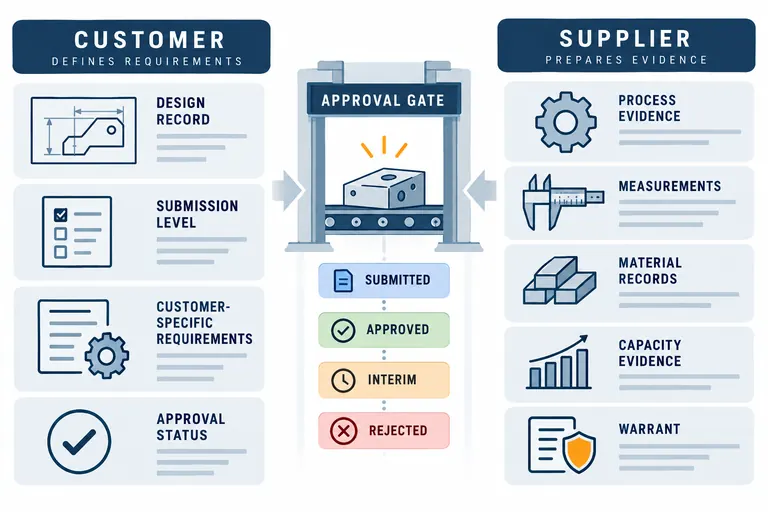
PPAP delays often begin before any documents are compiled. The customer assumes the supplier understands the submission level, tests, sample source, and approval route; the supplier assumes a standard package is enough. Both can produce substantial evidence that does not answer the actual approval question.
Define PPAP scope at project launch: governing customer requirements, submission reason and level, applicable elements, production-intent run, sample and laboratory rules, responsibilities, timing, and approval status. The supplier prepares and retains evidence, but the customer must communicate requirements and issue the disposition. A submitted package is not the same as an approved part.
Establish which requirements govern this submission
Start with the direct customer’s purchase order, drawing, specifications, supplier quality manual, portal instructions, and customer-specific requirements. Identify the PPAP manual edition or alternative approval process required by contract. AIAG describes PPAP as the industry process for showing that design-record and specification requirements are understood and can be met consistently (AIAG PPAP-4). The manual is licensed; project teams should use their authorized copy rather than a copied checklist found online.
Record why submission is required: new part, engineering change, new or transferred tool, new manufacturing location, material or supplier change, correction after rejection, extended inactivity, or another customer-defined trigger. The reason determines affected evidence. Do not recycle an old package with a new cover page when the process or product baseline changed.
Clarify design responsibility. A build-to-print molder still owns process design, manufacturing controls, and conformity, while customer engineering normally controls the released product design unless assigned otherwise. Design-responsible suppliers may have additional design records and validation responsibilities. Tool ownership does not by itself determine product-design responsibility.
IATF’s FAQ emphasizes that an organization must evaluate the requirements of its direct customers, including requirements in supplier manuals or other documents (IATF 16949 FAQ). Do not automatically apply an OEM rule to a Tier 2 if it is not contractually flowed down; ask the direct customer to resolve ambiguity.
Agree the submission level and element-by-element scope
Submission level describes what is sent to the customer, not whether the underlying work may be skipped. Customer instructions can modify defaults and add forms. An AIAG-hosted supplier manual, for example, states a default Level 3 but also requires documentation to be complete and available regardless of requested submission level; that is a customer rule, not a universal statement for every program (FNST supplier manual).
Create a launch matrix rather than relying on “Level 3” alone:
| Scope item | Customer defines | Supplier prepares/retains | Approval evidence |
|---|---|---|---|
| design baseline | released record, specifications, authorized changes | controlled copy and feasibility review | revision confirmed |
| submission reason/level | trigger, due date, portal and level | package plan and retention | written agreement |
| sample source | production run expectations and special conditions | run plan, lot/cavity identity and samples | run accepted for PPAP |
| measurements/tests | characteristics, methods, labs, quantities, acceptance | results linked to samples and equipment | customer review/disposition |
| process evidence | customer-specific format or additions | flow, PFMEA, control plan, MSA/SPC and records as applicable | element status |
| material/declarations | specified grade and reporting systems | certificates and submissions | accepted material status |
| capacity | quoted rate and customer method | production evidence | customer decision |
| warrant/status | authorized signatories and submission route | accurate warrant and package | approved/interim/rejected status |
Mark each element required, retained, submitted, not applicable with customer agreement, or pending. Assign owner, source document, due date, reviewer, and status. This prevents the supplier quality engineer from discovering at the final upload that the customer expects an external lab, special capability format, or separate appearance approval.
Define the production-intent run and sample genealogy
PPAP evidence should represent the intended production process. Agree mold, cavities, machine class or assigned equipment, resin manufacturer and grade, colorant, inserts, automation, gages, operators, line rate, packaging, and manufacturing location. If temporary tooling, manual trimming, prototype material, or a different machine is used, disclose the deviation and obtain direction.
Plan the run with the project’s capacity and validation needs. The customer may require a Run at Rate or another capacity demonstration before warrant submission; AIAG’s published PPAP errata notes that such a run may be required by certain customers, not universally (AIAG PPAP errata). Keep that distinction clear.
Trace every submitted sample to date/time, resin lot, cavity, process record, inspection report, and test allocation. If samples are conditioned, assembled, aged, or sent to a laboratory, preserve the chain. Random parts from a mixed container cannot support cavity-specific dimensions or a defensible failure investigation.
For molded parts, identify family-tool and cavity considerations, start-up stabilization, process window, material drying, regrind rule, inserts, and secondary operations. Samples that meet dimensions only after undocumented sorting do not demonstrate the intended process.
Divide responsibilities without creating gaps
The customer or design authority must release unambiguous requirements, identify special characteristics and customer-specific rules, answer feasibility questions, define submission and approval routes, provide mating parts or system-level conditions when needed, and issue a documented status. The customer also decides whether a deviation or interim approval permits shipment and under what quantity or expiry.
The molding supplier must review feasibility, control documents and changes, build the intended process, qualify measurement systems, collect truthful evidence, retain records, identify nonconformities, and avoid shipment before authorized release. Sub-tier material, heat-treatment, plating, laboratory, or component evidence remains part of the supplier’s controlled package when applicable.
Shared items need named owners. Who creates the ballooned drawing? Who approves appearance? Who pays the external test lab? Who supplies production-intent mating parts? Who enters IMDS? Who performs capacity verification? Who uploads to the portal? Who closes comments? “Supplier/customer” in a responsibility cell is not enough; name one accountable owner and one approver.
If AutoMoldingPro is quoting molded parts, PPAP scope affects sampling material, press time, cavity layouts, fixtures, laboratory charges, documentation effort, and schedule. The related PPAP and sampling cost guide helps buyers include those costs in the RFQ rather than treating approval as free administration.
Review evidence for linkage, not document count
Effective review follows one requirement through the package. A special drawing characteristic should appear in risk analysis where relevant, the control plan, inspection method, measurement-system evidence, dimensional result, reaction plan, and production record. Material grade should match drawing, purchase record, certificate, process, declaration, and warrant. Revision identifiers must agree.
Check reports for actual sample identity, cavity, lot, date, condition, equipment, method, result, specification limit, and disposition. A green summary can hide missing cavities or measurements made in the wrong conditioning state. Ensure external laboratories and calibration meet customer rules. Review capability calculations only after confirming a stable process and suitable measurement system.
Use a closure list:
- Are all requirements and authorized changes represented by the same revision?
- Were samples made by the intended production process and rate?
- Can each result be traced to lot and cavity?
- Are test conditions and acceptance criteria explicit?
- Are nonconformities disclosed with approved deviations or corrective actions?
- Do process flow, PFMEA, control plan, instructions, and records agree?
- Is material and sub-tier evidence current?
- Has the authorized customer issued approved, interim, or rejected status?
Do not treat PSW signature, portal upload, or email receipt as approval unless the customer’s process says so. Retain the actual disposition and any limits.
Before final submission, run an independent completeness check against the agreed matrix. Resolve blank fields, inconsistent revisions, unexplained results, missing signatures, and files that cannot be opened. The review should verify substance as well as filenames.
Control interim status, changes, and post-approval production
Interim approval is conditional. Record affected part, revision, quantity or time limit, open items, containment, labeling, authorized destination, and exit plan. Prevent an interim status from silently becoming normal production. Rejected status requires controlled material and a resubmission plan.
After approval, freeze the baseline: exact material, source, mold and cavity configuration, process, location, inspection, packaging, and approved deviations. Evaluate proposed changes against customer notification and resubmission rules before implementation. Update linked documents and segregate old and new revisions.
PPAP does not replace ongoing control. The approved package establishes evidence for a defined state; control plans, traceability, maintenance, change control, and repeat-order discipline keep that state effective. If demand, tooling condition, resin, equipment, or design changes, determine the approval impact rather than assuming the old warrant covers it.
Conclusion
Agree PPAP scope before tooling and sampling: governing requirements, reason, level, elements, production run, samples, responsibilities, timing, and disposition. Send AutoMoldingPro the drawing, annual volume, material, customer manual, required level, test matrix, and target date through the contact page for a scoped molding quotation.