
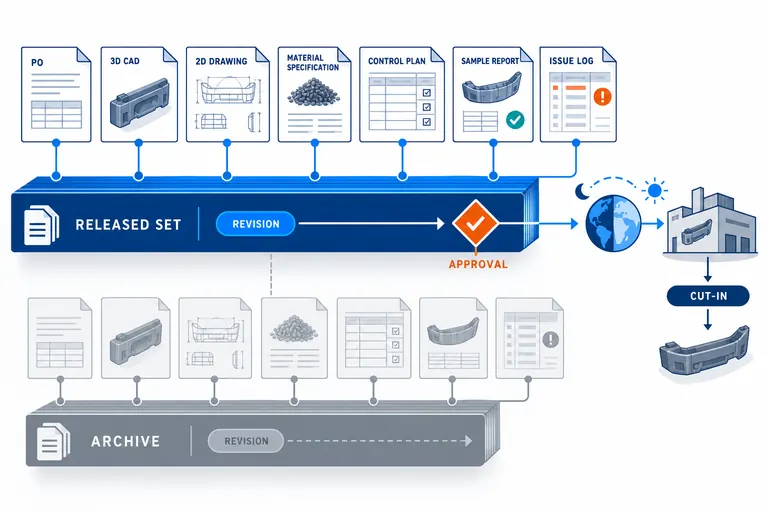
Time-zone distance is rarely the direct cause of a wrong-revision part. The real failure is an uncontrolled handoff: a new CAD file arrives without a matching drawing, an approval is buried in chat, a purchase order names an old revision, or production changes before material, tooling, inspection, and inventory are aligned.
Use one released technical-data set, one numbered issue list, explicit approval states, and a documented cut-in plan. Every change must connect the current CAD, drawing, specifications, tooling action, quality documents, inventory, samples, and shipment identity. Meetings and messages support that system; they are not the system.
Create one released set before asking for action
List every controlled input: purchase order, 3D model, 2D drawing, material and color specification, appearance standard, BOM, approved deviations, tool specification, packaging, validation plan, process flow, PFMEA, control plan, inspection plan, and sample report. Give each a file name, part number, revision, date, status, and owner.
Choose one controlled exchange location or transmittal process. Email and chat can announce a release, but the message should point to a complete released set and identify what it supersedes. Prevent production files from being assembled from different message threads. Archive superseded packages read-only and clearly mark them obsolete.
Before quotation and again before tool manufacture, run a cross-file check. Do 3D and 2D describe the same geometry? Are material, texture, critical characteristics, and tolerances consistent? Does the PO name the correct part and revision? Are referenced specifications available? Record conflicts in the issue list rather than letting the supplier choose silently.
The IATF-hosted Fiat process-audit checklist requires drawing/design models, authorized change control, updated quality documents, removal of uncontrolled documents, disposition of old material, and documented customer approval in its stated scope (IATF process audit checklist). Even when that customer document is not contractually applicable, the visible control logic is useful: revision, approval, implementation, and verification must remain linked.
Use an issue log that ends in decisions
An issue log should contain a unique ID, date opened, part/revision, category, clear question, affected requirement, owner, required responder, due date, response, evidence link, status, and closure approval. Attach marked screenshots or redlines when they clarify geometry, but tie them to the controlled file revision.
Use states such as Open, Supplier Action, Customer Action, Proposed, Approved, Rejected, Implementing, and Verified. “Closed” should mean the decision is incorporated into the released baseline or formally rejected—not merely discussed in a meeting. Keep commercial and technical effects visible.
| Issue field | Weak entry | Controlled entry |
|---|---|---|
| question | “Please check rib” | “Confirm whether rib R3 may move 0.6 mm to clear ejector; drawing Rev B remains governing until approval” |
| evidence | chat screenshot | marked CAD view linked to issue G-014 and current model hash/revision |
| response | “OK” | approved/rejected by named authority, with date and affected documents |
| implementation | “supplier will change” | tool insert, CAD, drawing, control plan, samples and cut-in actions assigned |
| closure | meeting completed | revised set released and first affected parts verified |
Send a pre-read before cross-time-zone meetings. Use live calls for complex choices, then record decisions in the log within the agreed period. Silence is not approval. Translation assistance should preserve dimensions, tolerances, technical terms, and responsibility; bilingual summaries do not replace controlled drawings.
Define approval authority and freeze points
State who may approve product design, DFM changes, mold design, material alternatives, appearance, samples, deviations, PPAP, packaging, and shipment. The buyer’s sourcing contact may not have authority to accept a design deviation; the supplier’s sales contact may not have authority to release steel cutting. Put names or roles into the responsibility matrix.
Use freeze points suited to the project: RFQ baseline, DFM release, mold-design release, steel-cut authorization, T1 configuration, correction release, PPAP baseline, and production cut-in. At each gate, list required documents and unresolved exceptions. Freeze does not forbid change; it ensures later change is visible and approved.
Avoid approvals that combine unrelated items. “Mold design approved” should not imply material, texture, or dimensional deviation approval unless those are explicitly included. Conditional approval needs conditions, owner, due date, and whether work may proceed at risk.
For rapid projects, define a limited proceed-at-risk mechanism. Record the assumption, cost and schedule exposure, reversible work, responsible authority, and expiry. Do not turn urgency into undocumented steel changes.
Control engineering changes through cut-in
Every change notice should state reason, affected part and revision, description, files replaced, validation impact, tooling and inventory effects, cost, timing, requested approval, and proposed cut-in. Suppliers should assess effects on mold steel, hot runner, fixtures, gages, automation, process, PFMEA, control plan, packaging, and sub-tier items.
Choose the cut-in definition: first molding lot, first approved batch, first shipment, purchase-order date, or serial/lot boundary. Record old inventory at supplier, in transit, at customer, and at sub-tier operations. Decide use-as-is, rework, return, scrap, or segregated service use. Labels and shipping documents must let the customer identify the revision received.
Verify implementation at point of use. Check the machine instruction, mold revision, current resin, gage program, inspection plan, packaging, and operator documents. Then link first-off samples and reports to the new revision. Updating the server file is not proof that the shop used it.
If the change affects fit, function, material, process, location, source, or previously approved evidence, determine customer notification and PPAP requirements before shipment. The PPAP scope guide becomes public on the prior scheduled date; until then, use the customer’s current manual and approved process.
Make time-zone communication predictable
Agree response windows by issue class: production stop, quality escape, approval blocker, routine DFM question, and weekly status. Provide primary and backup contacts, working hours, holiday calendar, and escalation path. “24-hour support” should not be promised unless it is staffed and contracted.
Use a regular cadence with a fixed agenda: safety/quality, schedule, open approvals, tool or process status, sample and validation results, logistics, commercial changes, and next 48-hour actions. Publish the issue log and schedule before the meeting. Record only decisions and actions afterward, avoiding long narrative minutes that hide ownership.
File naming should survive language and platform differences. Include part number, document type, revision, and release date; avoid “final,” “latest,” and “new.” Use checksums or controlled-system version history when files move through external sharing. Confirm large CAD transfers completed and open correctly.
For a mold correction, the supplier can send the marked steel area, proposed dimensional direction, reason, risk, and expected sample date at the end of its workday. Customer engineering reviews during the opposite shift, records approval or questions in the issue log, and only then does the supplier release machining. This cadence uses time zones without converting chat into authorization.
Audit the system with a real part
Select one active part and trace backward from a packed lot. Verify shipment label, inspection report, process batch, control plan, drawing, CAD, material, mold revision, approved deviations, and change notice. Then trace forward from the latest change to inventory disposition, shop documents, samples, and customer approval.
Look for mixed revisions, local desktop copies, unapproved redlines, orphaned gage programs, old labels, and quality documents that lag the drawing. Ask operators which revision they use and where it comes from. A polished procedure is not proof of actual control.
Before supplier selection, request an example anonymized document register, issue log format, change workflow, and sample traceability method. Evaluate clarity and evidence, not meeting frequency or response speed alone.
Protect commercial instructions from technical ambiguity
Purchase orders, change orders, and approval messages should reference the same released technical set. If a quotation assumes one material, cavity count, validation scope, or packaging method, carry that assumption into the order or resolve it explicitly. Do not let an engineering discussion authorize unpriced work, and do not let a commercial order override a technical hold without the responsible approver.
Track cost and schedule effects by issue ID. The supplier should identify whether a proposal changes steel already cut, purchased components, inspection fixtures, sampling, or material commitments. The buyer should state whether the change is approved commercially, technically, both, or neither. This avoids a common failure in which engineering says “proceed” while purchasing believes the original price and delivery still apply.
Confidentiality and access also need control. Grant suppliers the minimum project access required, remove departing users, define whether sub-tier suppliers may receive files, and avoid transferring customer-controlled specifications outside the approved channel. Keep downloadable files watermarked or access-logged when the customer process requires it, but make sure production personnel can reliably obtain the current released version.
Conclusion
Overseas communication works when the released set, issue decisions, approvals, changes, inventory, and cut-in evidence remain connected. Send AutoMoldingPro the controlled CAD/drawing set, material, annual volume, target timing, approval roles, and validation needs through the contact page to start a revision-controlled project review.