
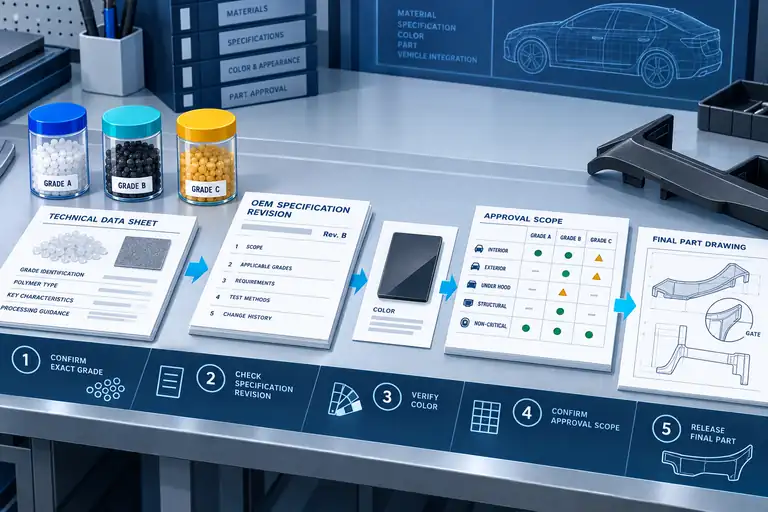
A drawing that says only “PA66-GF30, black” can still leave several commercially different resins in play. Heat stabilization, hydrolysis package, impact modification, laser marking, color formulation, recycled content, regional supply and an OEM specification revision may all change whether a grade is acceptable. If these details remain open, bidders can price different materials while appearing to answer the same RFQ.
The buyer should release a material identity package, not a polymer family. It must connect the manufacturer and exact commercial grade to the current customer specification, approved application and site scope, color or additive variant, required material reporting, processing condition and finished-part validation. A database listing or supplier statement is supporting evidence; it does not by itself approve a molded part for every customer, plant, color or duty.
Start with the controlling requirement, not a familiar resin name
Separate four layers that are often collapsed into “approved material”: the part drawing, the customer or OEM material specification, the resin producer’s exact grade documentation, and the program’s approval record. Record the document number, revision or effective date, owner and applicable vehicle or component scope. If the drawing references a controlled customer document that the molder cannot access, the customer must provide the applicable requirements or a formally approved interpretation. A supplier cannot reliably quote unseen obligations.
A family description is useful for screening but weak for release. Two PA66 compounds with the same nominal glass content can use different stabilizers, impact modifiers, pigments and processing windows. Likewise, a color suffix can identify a formulation with a different approval or supply status. Ask the resin producer or authorized channel for the current technical data sheet, processing guidance, safety information and declared product identity. Check region and production site when the customer approval is site-specific. Do not infer equivalence from similar data-sheet values.
This article starts where family-level selection stops. PP vs. ABS vs. PC/ABS for Automotive Interior Parts: A Selection Framework (ID 464) compares PP, ABS and PC/ABS as starting families for interior parts — screening, not a final specification — and PA6 and PA66 for Under-Hood Parts: Grade, Moisture, and Temperature Questions (ID 467) compares PA6 and PA66 as complete grade systems against an under-hood duty. Use those guides to narrow the family or grade system; use this article to confirm the exact commercial grade, color, resin site, molding site and specification revision that result — and whether that exact combination is actually approved for this part, color and application. A family or grade system that screens well is not yet an approved material.
Map what an approval actually covers
Build an approval-scope matrix with rows for exact grade, color, supplying resin site, molding supplier site, part family, specification revision and intended service environment. Mark each item confirmed, conditional, not applicable or open, and attach the evidence reference. BASF’s public automotive specification database, for example, distinguishes material, color and paint approvals. That structure is a useful reminder that one approval label may not cover every variant, though the customer remains the authority for the project. Where the specification invokes flammability recognition, confirm the UL 94 grade, thickness and color scope rather than transferring a family-level rating.
Treat IMDS and material compliance as another linked scope rather than a substitute for engineering suitability. The IMDS public guidance states that creators and receivers share data-quality responsibility and that system checks still require human investigation. Confirm who creates the material data sheet, which company ID receives it, what deadline applies, and whether the exact supplied grade and color formulation are represented. A successfully accepted MDS does not demonstrate dimensional stability, assembly strength or environmental performance of the finished component. GM’s published IMDS guidance, for example, distinguishes a reporting declaration from authorization to change the part; follow the current program’s engineering approval route.
Write an RFQ material line that bidders cannot reinterpret
State manufacturer, complete commercial designation, color code, customer specification and revision, required approval evidence, permitted supply sites, virgin or permitted regrind status, moisture/packaging expectations, and change-notification rule. If equivalents may be proposed, keep the required grade as the compliant base and request alternatives on a separate line with a difference statement and approval route. “Or equivalent” without evaluation criteria transfers a product decision to the bidder.
For customer-directed grades, clarify commercial responsibility: who nominates the source, who buys it, who owns minimum-order or aged-stock risk, and what happens if the approved grade is unavailable. Ask for quotation validity tied to the named material basis. If the resin price or color masterbatch is provisional, label the affected cost rather than silently substituting a commodity family. The automotive RFQ checklist can carry these inputs with the CAD, volumes and validation package.
Verify incoming material and molded-part identity
Receiving controls should connect purchase order, supplier batch, packaging label, certificate or shipment record, dryer or handling record, machine lot traceability and molded-part batch. The evidence depth depends on the customer and risk; a certificate of analysis may be requested for defined characteristics, but it should not be treated as proof of every part requirement. Define how mixed, damaged or unidentified bags are segregated and who can disposition them.
Part validation must reproduce the intended material condition. Moisture-sensitive resins may show different dimensions or properties depending on conditioning, while pigments and additives can affect appearance, flow or joining. Record specimen state, molding condition, cavity, time and test method. Grade approval establishes permission to use a material within a scope; drawing, assembly and environmental evidence establish whether the actual part is acceptable. For exposed exterior parts, a grade or pigment change also needs a review of the applicable weathering and color-stability evidence.
Control changes without freezing an obsolete material forever
Require notification for changes that matter to the approved identity: commercial grade, formulation or color code, manufacturing site, compliance status, declared substances, key process guidance, packaging or an obsolete specification revision. The exact notification threshold must follow the customer agreement. On receipt, classify whether the change is documentary, requires material-data resubmission, needs molding trials, or requires part revalidation and customer approval.
Maintain an approved-material register linked to active part revisions and alternate states. It should show effective dates, stock disposition and the first production batch after a change. Do not delete superseded evidence; archive it so field or inventory questions can be traced to the applicable state. If the customer grants a temporary material deviation, limit it by grade, quantity or period, affected parts and validation obligations rather than editing the permanent drawing informally.
Evidence worksheet for the sourcing or release review
Complete this matrix for each exact resin and color combination. Keep material approval, MDS acceptance and component validation as separate dispositions, with the applicable customer and manufacturing site identified.
| Evidence line | What the reviewer should be able to verify |
|---|---|
| 1. released part drawing and specification revision | Drawing and customer material specification identify matching revisions; any inaccessible requirement has a controlled customer clarification. |
| 2. complete resin manufacturer and commercial grade | Purchase designation, manufacturer documentation and approval record name the same full grade, including suffixes; a polymer/filler family is insufficient. |
| 3. color, additive and modifier designation | Color code and any masterbatch, stabilizer or modifier match the approved formulation; an alternate is separately identified for review. |
| 4. approved resin production and molding sites | Approval evidence identifies each applicable resin plant and molding location, part/application scope and effective revision; an address change is not assumed covered. |
| 5. current TDS and processing guidance | The TDS and processing guide apply to this grade and revision; comparisons identify different specimen, conditioning or test-method conditions. |
| 6. IMDS or required compliance-data responsibility | The MDS identifier/version, creator, recipient company ID and acceptance status correspond to the supplied composition; engineering approval remains separate. |
| 7. part-level validation plan and sample condition | The plan ties required dimensions, assembly and environmental tests to identified production-intent samples, cavities and conditioning. |
| 8. change-notification and stock-disposition rule | The agreed change triggers identify the decision owner, affected stock and first batch under the new approval; obsolete evidence remains traceable. |
Questions that expose weak assumptions
| Question | A useful supplier answer should include |
|---|---|
| Which exact document and revision controls the material? | The released drawing and referenced customer specification numbers, revisions and any approved interpretation—not just the resin family. |
| Does the evidence cover this grade, color, source site and application? | An approval-scope matrix linking full grade, color, applicable resin/molding sites and intended application to dated approval evidence; open scope stays conditional. |
| Who submits and receives the required material data? | The responsible creator and recipient company ID, MDS identifier/version, due date and acceptance status for the actual supplied composition. |
| What must be revalidated if the grade or site changes? | A documented change comparison and customer decision on affected processing, dimensions, joining and environmental tests; a site or grade change is not automatically transferable. |
| How will each molded batch retain resin-lot identity? | Receipt labels and batch records connecting resin lots, any permitted mixing, dryer/machine use and the finished molded lot. |
| Which commercial risks follow a customer-directed material? | Responsibility for procurement, minimum order, aged stock, shortage proposals, price validity and approval costs; alternatives quoted separately from the required grade. |
Illustrative example
A buyer receives two quotations for an under-hood housing. Both say PA66-GF30, yet one assumes a general heat-stabilized black grade and the other uses a customer-listed hydrolysis-resistant color formulation. The prices cannot be compared until the buyer identifies the controlling customer specification, exact commercial grade, approved color and supply site. If the first material is proposed as an alternate, it needs a documented gap review and customer approval route; matching polymer and filler labels are not enough.
What to send for a project-specific review
For a material-approval review, send the drawing and customer specification revisions, exact grade and color, approval-scope evidence, proposed supply sites, MDS status and any alternate-grade comparison through the project RFQ. Identify unavailable customer requirements before asking for a compliant quotation.
Resolve alternates and shortages without losing the approved baseline
When the named grade is constrained, begin with the duty and approval gap, not a search for a similar generic designation. Compare manufacturer, full commercial grade, polymer and reinforcement, stabilization package, color, processing guidance, declared substances, source site and every characteristic tied to the customer specification. A side-by-side TDS comparison is only a screen because values may use different specimens, conditioning and methods. What must be approved before a substitute is used — and in what order — is set out in Specified Automotive Resin Unavailable: What Must Be Approved Before Substitution? (ID 432). This article does not repeat that approval route; it states only the baseline rule for this article’s scope: preserve the original grade as the baseline until an authorized record says otherwise.
Keep commercial urgency separate from technical authorization. Purchasing can evaluate lead time, minimum order, regional availability and price while engineering and quality evaluate suitability and approval. State whether the alternate would be temporary, second-source approved or a permanent drawing change. Preserve the original grade as the baseline until an authorized record says otherwise.
Use production-intent samples to confirm processability, appearance, dimensions, joining and applicable environmental or functional results. Record whether the mold or process needed adjustment; a substitute that passes only after an irreversible steel change may not remain interchangeable. Define stock segregation and the cut-in or cut-back batch.
The decision is complete only when the part drawing, customer material requirement, supplier grade data, material reporting record and supply agreement identify the same state. Archive superseded evidence so later inventory and field questions can be connected to the material actually molded.