
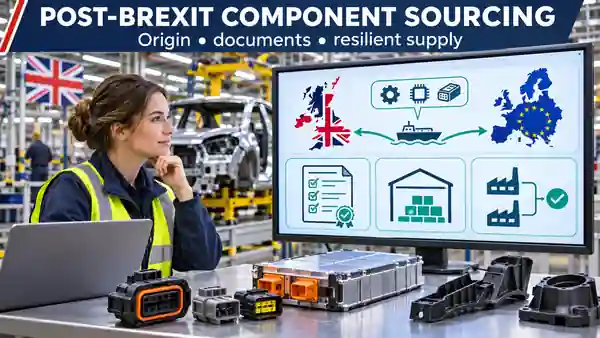
A UK-built vehicle can pass every engineering test and still miss its margin target because of where its parts come from. A connector housing from the wrong supplier, a missing supplier declaration, or a pallet waiting at Dover can turn a sound sourcing plan into a tariff exposure or a line-stoppage risk. Post-Brexit automotive component sourcing is manageable, but only when origin, documentation, logistics, and supplier quality are planned together.
UK automotive manufacturers still source most components through integrated European and global supply chains. What has changed is how they manage them. They track UK and EU content to qualify for tariff-free trade under the UK–EU Trade and Cooperation Agreement (TCA). They collect supplier declarations as evidence of origin. They hold more buffer stock and dual-source critical parts. Where the volume justifies it, they also localise high-value content such as battery cells. EU suppliers remain central because EU-made parts count as originating content for UK-built vehicles.
This guide is written for UK OEM and Tier 1 buyers, supplier quality engineers, and programme managers who source molded plastic parts, tooling, and assemblies. It covers rules of origin, the EV battery deadline at the start of 2027, supplier documentation, customs procedures, regulatory divergence, and how to choose between UK, EU, and Asian sources for injection molded parts. Policy details change often, so treat this as a decision framework. Confirm final positions with your customs adviser and the official guidance linked below. Policy details change often, so treat this as a decision framework. Confirm final positions with your customs adviser and the official guidance linked below. This guide is current as of 15 November 2026; rules of origin, battery-origin thresholds, and UK REACH positions change, so confirm the current position before acting on any rule stated here.
Where Do UK-Built Vehicles Get Their Components Today?
Many sourcing teams assume Brexit pushed UK plants toward local suppliers. That is only partly true. When a programme manager benchmarks a part against "UK-only" quotes, the capacity, the resin grades, or the tooling depth often isn’t there. The project then falls back to the same European supplier, but with less time to set up the documentation that supplier now has to provide.
UK vehicle plants still rely heavily on imported components, and the EU remains the largest supply base. UK-sourced content in domestically built cars is widely reported to be well below half of the vehicle value, but the share varies by model and by how it is measured, and no source for the figure is cited in this guide — confirm the share for your own model from its bill of materials before relying on it. Specialist items such as electronics, wiring harnesses, powertrain components, and battery materials often come from Asia, North Africa, or Turkey. The EU and UK also depend on each other in the other direction: EU manufacturers sell more automotive components to the UK than to any other global market.
Why the EU supply base is hard to replace
SMMT’s September 2026 analysis of EU–UK automotive interdependency describes the UK and EU as each other’s largest passenger car export markets, with the automotive trading relationship worth about €80 billion a year. The underlying analysis is not linked in this guide, and the figure is a dated snapshot — confirm the current value before relying on it. That scale reflects decades of integrated tooling, engineering, and logistics. You can’t rebuild it by moving one part number.
For molded plastic components, the practical barriers to reshoring are specific:
- Resin and compound availability. Many OEM-approved grades, such as specific glass-filled PA66, flame-retardant PBT, or low-emission interior PP, are compounded in continental Europe or Asia. A UK molder still imports the pellets.
- Tooling capacity. Large interior and exterior molds need big presses and experienced toolrooms. Capacity for these is limited in any single country.
- Approved-source status. Changing a molding site usually triggers a customer notification and a new or updated PPAP. That is a real cost and schedule commitment.
What this means for your sourcing strategy
In practice, UK manufacturers don’t replace EU parts with UK parts across the board. They keep EU suppliers where capability and origin both work. They localise where scale and logistics justify it. They use global suppliers for specialist or cost-driven items, but they track those items carefully because they count as non-originating content.
A common mistake is to make sourcing decisions on piece price and tooling cost alone, then discover later that the part’s origin or documentation status creates a tariff or approval problem. Add origin status, document readiness, and logistics route to your sourcing scorecard from the RFQ stage. For a comparison with how continental suppliers handle the same risk, see how German automotive suppliers navigate global component sourcing.
How Do Rules of Origin Shape UK Component Sourcing Decisions?
The TCA promises zero tariffs, but only for goods that prove they qualify. A vehicle or part that fails its rule of origin is charged the normal third-country duty. For passenger cars, that duty is 10%. A sourcing change that adds too much non-UK, non-EU content can quietly push a model over its threshold. Nobody notices until an origin audit or a margin review.
Under the TCA, automotive goods trade tariff-free between the UK and EU only if they meet the product-specific rule of origin for their commodity code. Bilateral cumulation lets UK producers count EU-originating materials as originating content, and EU producers can do the same with UK materials. Parts from China, Japan, the US, or Turkey count as non-originating unless another agreement applies. Parts from China, Japan, the US, or Turkey count as non-originating unless another agreement applies. For US–Mexico–Canada programmes the equivalent origin framework is the USMCA — see Understanding USMCA Impact on Automotive Component Sourcing; it governs North American content, and it does not change the TCA treatment of US content for a UK-built vehicle. Without preference, tariffs are typically 10% on cars and low single digits (often about 2–4.5%) on many parts. Always verify the rate for your exact code and direction of trade.
How origin treatment changes by source
| Component source | Origin treatment for a UK-built vehicle exported to the EU | Typical sourcing implication |
|---|---|---|
| UK supplier, UK-originating materials | Originating | Strongest origin position; check capacity and cost |
| EU supplier with valid origin evidence | Originating through bilateral cumulation | Commercially attractive; collect supplier declarations |
| UK or EU supplier using imported non-originating materials | Depends on processing and the product-specific rule | Ask for origin analysis, not just the supplier’s address |
| Asian, Turkish, or US supplier | Non-originating under the TCA | Count against the threshold; may also pay UK import duty |
| Parts with unclear or missing documentation | Treated as non-originating in practice | Creates audit and tariff risk |
The trap of "made in the UK"
Final assembly location alone doesn’t decide origin. HMRC’s guidance on proving originating status for UK–EU trade explains that preference is claimed through either a statement on origin or the importer’s knowledge. It also explains that the claim can be verified later. Exporters must keep the statement on origin and supporting records, such as suppliers’ declarations and invoices, for 4 years.
For molded plastic parts, the key question is usually how the part’s origin is affected by imported resin and inserts. Molding a part from imported pellets involves real processing and a change in classification. Whether that is enough depends on the product-specific rule for the part’s commodity code. Don’t assume. Ask your customs adviser to check the rule against your actual bill of materials.
Practical decision criteria
- Classify each significant part and assembly correctly before you calculate origin.
- Identify which parts are high-value non-originating items, such as electronics, motors, and cells. Plastic housings are rarely the biggest number.
- Model the origin effect of any proposed supplier change before you award the business.
- Keep a margin below the threshold. Currency moves and price changes can shift value-based calculations.
What Changes for EV and Battery Components in 2027?
EV programmes face a tighter version of the same problem. The battery is the most valuable part of the vehicle, and much of its cell chemistry and material supply still comes from Asia. Many current origin calculations rely on transitional rules that end on 31 December 2026. If your 2027 production plan still uses 2026 assumptions, the tariff exposure is already built in.
The EU–UK transitional rules of origin for electric vehicles and batteries run until 31 December 2026. From 1 January 2027, the permanent rules are scheduled to apply: for relevant EVs, the non-originating content cap falls to 45% of the ex-works price, and the propulsion battery pack must itself be originating. Guide to Sourcing Automotive Components for European EV Startups; this section keeps only what is specific to UK-built programmes — the confirmed caps below, the industry position, and what the change means for plastic and electrical component suppliers. Rule positions in this section are stated as of 15 November 2026. Until an official change is adopted, plan for the stricter rules.
What has been confirmed and what is still uncertain
The European Commission confirmed that the EU–UK Partnership Council extended the current EV and battery rules of origin until 31 December 2026. A Menzies summary of the 2027 TCA requirements notes three things: relevant EV battery packs face a 30% non-originating cap, cells and modules face a 35% cap, and the 2023 extension decision stated that no further postponement should be considered.
The industry hasn’t stopped pushing. In September 2026, ACEA asked EU leaders to change the battery rules of origin. ACEA estimated at the time that 82% of expected EU electric car and van exports to the UK in 2027 would not meet the rules and would face a 10% duty. That is an industry estimate made before any decision, not a decided outcome, and the underlying estimate is not linked in this guide — confirm the current position before relying on the figure. A proposal is not a decision. Build your plan on the rules in force, and treat any relief as upside.
What it means for plastic and electrical component suppliers
Battery enclosures, cell holders, busbar carriers, high-voltage connector housings, and charging components are usually lower in value than the cells. They still matter in two ways:
| Issue | Why it matters | Action |
|---|---|---|
| Origin evidence for battery-pack components | Pack-level origin depends on the value and origin of its inputs | Collect supplier declarations for all pack-level parts |
| Flame-retardant and insulating resins | Often imported compounds with specific UL or OEM approvals | Confirm grade approval before any material or site change |
| Local battery cell supply | Projects such as AESC in Sunderland and Agratas in Somerset aim to localise high-value content | Align enclosure and connector sourcing with the cell supplier’s location and timing |
| Supplier changes late in the programme | New sources can disturb both origin and PPAP status | Freeze sources early, or plan the change with full validation |
Watch the "Made in Europe" debate
There is a second policy risk for UK suppliers that sell into EU programmes. In April 2026, SMMT called on the EU to amend its proposed Industrial Accelerator Act so that UK-built vehicles, parts, and batteries are treated as equivalent to EU products. If you are a UK supplier quoting an EU programme, ask early how your customer treats UK content in its localisation plans.
What Origin and Quality Documents Should UK Buyers Request from Suppliers?
Origin compliance only works if the evidence exists. A common problem is that a supplier ships compliant parts for months but never issues a valid supplier declaration. Or it issues one that has expired. When HMRC or an EU customs authority asks for proof, the manufacturer can’t support its preference claim. Quality documentation has the same weakness when nobody defines it in the purchase order.
UK buyers should request two separate sets of documents. The first set covers origin and customs: supplier declarations or long-term supplier declarations, commodity codes, country of origin, and Incoterms. The second set covers quality: PPAP or the customer’s equivalent approval evidence, material certificates, dimensional reports, and traceability records. Origin documents prove tariff eligibility. Quality documents prove the part is fit for production. One can’t replace the other.
Mandatory requirements vs. recommended practice
| Document | Status | Practical note |
|---|---|---|
| Supplier declaration supporting origin, where you claim preference | Required as evidence when your origin claim relies on it | Must follow the TCA wording; see below |
| Statement on origin or importer’s knowledge for UK–EU imports claiming preference | Required to claim preferential duty | Keep records for 4 years |
| Entry summary declaration for goods entering Great Britain | Legally required; submitted by the carrier | Confirm your logistics provider handles it |
| PPAP or customer-specific approval | Customer requirement, not a customs rule | Scope and submission level are set by the customer |
| Material certificates and lot traceability | Usually a customer requirement | Define it in the PO and the supplier quality agreement |
| Origin data field in the RFQ | Recommended best practice | Stops origin gaps before supplier award |
HMRC’s guide on using a suppliers’ declaration to support a proof of origin explains that a declaration can cover a single consignment or regular supplies. It also explains that where bilateral cumulation applies, suppliers must use the wording in Annex 6 of the TCA. HMRC’s TCA origin guidance states that a long-term supplier declaration can cover supplies for up to 2 years. Put the renewal dates in your supplier calendar.
Supplier document request checklist
- Commodity code proposed by the supplier, with your own classification check
- Country of origin and preferential origin status, stated separately
- Supplier declaration or long-term supplier declaration, with its validity period
- Resin grade, compounder, and compounding site, matched to the approved drawing and material specification
- PPAP elements and submission level confirmed by the customer
- Lot traceability from resin batch to shipping label
- Certificate of conformance, plus measured inspection data where the customer requires it
Don’t confuse a certificate with evidence. Our guide to the difference between a certificate of conformance and inspection results explains why. For approval scope, see how PPAP scope and responsibilities are defined for automotive molded parts.
How Do Customs Procedures Affect Lead Times, Inventory, and Duty Costs?
Just-in-time supply depends on predictable transit. Since Brexit, every UK–EU shipment carries customs declarations. From 31 January 2025, goods imported into Great Britain from the EU also need safety and security filings. A data error can hold a trailer at the border while the assembly line is still running. Many plants have responded by holding more stock, and that ties up cash and warehouse space.
UK manufacturers reduce border friction in three main ways. First, they build buffer stock and longer lead times into their plans for EU-sourced parts. Second, they use trusted-trader status such as Authorised Economic Operator (AEO) to reduce checks and simplify procedures. Third, they use customs special procedures to suspend or reduce duty on non-preferential imports. These procedures include inward processing, customs warehousing, and Freeport customs sites. Each one needs an authorisation and good records, so it fits recurring, high-volume flows better than occasional shipments.
Customs tools compared
| Tool | What it does | Best suited to | Watch-outs |
|---|---|---|---|
| Inward processing | Suspends Customs Duty and import VAT on goods imported for processing and then re-exported | Imported resin, inserts, or subcomponents used in exported assemblies | Needs authorisation; duty may be due if goods stay in the UK |
| Customs warehousing | Delays duty and VAT on stored imported goods | Buffer stock from non-preferential sources | Stock control and record-keeping must be accurate |
| Freeports | Customs and tax measures inside designated sites | New investment or relocation decisions | Site-specific; check controlled and excluded goods |
| AEO status | Trusted-trader status with lower risk scores and simplifications | High-volume, repetitive UK–EU flows | Requires a robust compliance system and an HMRC audit |
HMRC states that AEO Security and Safety status is covered by mutual recognition arrangements with partners including the EU. Listed benefits include faster clearance and fewer interventions. That helps, but it doesn’t remove the need for clean shipment data.
Who files what at the border
HMRC’s guidance on entry summary declarations places the legal duty to submit them on the carrier. In practice, the carrier needs accurate data from the shipper. Wrong commodity descriptions, weights, or consignee details are common causes of delay.
Planning recommendations
- Set lead times for EU-sourced parts based on observed border performance, not pre-2021 averages.
- Size buffer stock part by part, using criticality, changeover risk, and the number of approved sources.
- Agree Incoterms that make clear who is the importer of record and who pays the duty.
- For molds shipped into the UK, plan the customs entry, commodity code, and on-site trial before the production start date.
How Should UK Manufacturers Manage Regulatory Divergence?
A component that is fully compliant in the EU is not automatically compliant in Great Britain. The reverse is also true. Separate chemical registration, product marking, and vehicle approval systems now run side by side. Problems tend to show up late, for example when a resin additive isn’t registered for GB import or a component approval doesn’t cover the market the part is sold in.
The main areas of divergence for automotive components are UK REACH, GB type approval, and UKCA marking. UK REACH requires GB importers of chemical substances to hold registrations unless a non-GB supplier has appointed an Only Representative. GB type approval, run by the Vehicle Certification Agency, covers vehicles and components placed on the GB market. UKCA rules apply to some products outside type approval. Map each part to its regulatory route before you award a supplier.
Where divergence affects molded components
According to the HSE’s guidance on UK REACH roles, GB businesses that relied on EU REACH registrations held further up the supply chain became importers under UK REACH. That matters if you import resins, masterbatches, release agents, or adhesives directly. The HSE also notes that substances in articles may need registration if they are intended to be released during use.
On the vehicle side, the Vehicle Certification Agency states that the GB type approval scheme applies to manufacturers placing vehicles and components on the GB market. Northern Ireland uses a separate route that relies on EU type approval. Lighting, glazing, and safety-related parts deserve extra attention.
Divergence checklist for sourcing teams
| Area | Question to ask | Owner |
|---|---|---|
| UK REACH | Who is the GB importer of each substance, and is it registered or covered by an Only Representative? | Buyer, with the supplier’s regulatory team |
| EU REACH and SVHC reporting | Does the part go into EU-sold vehicles, and are SVHC declarations current? | Supplier quality |
| Material reporting | Is the material declared in the OEM’s required system? | Supplier |
| Type approval | Is the component subject to approval in GB, the EU, or both? | Homologation team |
| UKCA or CE | Does the product fall under a marking regime outside type approval? | Compliance team |
One practical approach is to build regulatory status into the material approval record. That way, a resin change triggers both an engineering review and a compliance review. Our article on confirming automotive OEM material grade approval scope explains why the exact grade, compounding site, and specification revision must be fixed before sourcing.
Should UK Programmes Source Molded Plastic Parts from the UK, EU, or Asia?
For injection molded components, the choice of source country is rarely simple. A UK molder offers short logistics but may have limited tooling capacity. An EU supplier offers strong origin status but adds border paperwork. An Asian supplier may offer lower tooling cost but adds non-originating content, transit time, and remote engineering-change risk. Choosing on mold price alone usually creates expensive surprises later.
The best source depends on the part’s value, volume, criticality, and origin sensitivity. Many UK programmes use a hybrid model. The injection mold is built where tooling capability and cost are strongest, often in Asia. The parts are then molded in the UK or EU to keep logistics short and origin positions clear. Low-value, stable parts can be sourced globally. Critical parts that change often, or that are sensitive to origin, are better produced close to the assembly plant.
Sourcing option comparison
| Criteria | UK molding | EU molding | Asian molding and import | Asian-built mold, UK or EU molding |
|---|---|---|---|---|
| Origin under the TCA | Strong, depending on materials | Strong via cumulation | Non-originating | Depends on molding site and materials |
| Tooling cost | Often higher | Varies | Often lower | Often lower |
| Logistics lead time | Shortest | Short, plus customs steps | Longest | Mold shipping once, then short |
| Engineering-change response | Fast | Fast to moderate | Slower, remote | Mold changes need a plan |
| Border and document load | Lowest | Moderate | Highest | Moderate, mostly at mold import |
| Main risk | Capacity and cost | Paperwork and transit | Transit, duty, origin | Mold-transfer and trial quality |
When each option makes sense
- UK molding: suits parts that are critical to just-in-time supply, change frequently, or are sensitive to origin.
- EU molding: suits parts that need specialist capacity or specific approved materials, as long as origin evidence is managed.
- Asian molding and import: suits stable, low-value, low-weight parts where duty and transit are acceptable and non-originating content isn’t a constraint.
- Asian-built mold with local molding: suits programmes that want lower tooling cost and local production control.
The hybrid model only works if the mold is designed for the destination press and validated before shipment. Common failures include a wrong clamp interface, mismatched hot-runner controllers, or cooling connections that don’t fit, all discovered after arrival. If you are moving an existing tool, plan the move as a controlled automotive mold transfer and repair project, not a simple shipment. For new tools, specify destination press data at the RFQ stage. Our export automotive injection mold service page explains how destination-press interfaces, trials, documentation, and shipment preparation are handled.
How Do You Qualify a Second Source or Overseas Molding Supplier for a UK Programme?
Single-source parts became a bigger risk after Brexit. One border disruption, supplier insolvency, or capacity squeeze can stop a vehicle line. A rushed second-source project that copies a mold without released data or defined equivalence criteria often produces parts that measure differently. They then fail PPAP, and you end up with two unreliable sources instead of one.
Qualify a second source in four steps. First, define the reference: released CAD, drawing revision, approved material, and master samples. Second, set equivalence criteria for critical dimensions, appearance, and function. Third, check the supplier’s quality system against your customer-specific requirements. IATF 16949 certification is a common expectation, but it is a quality-management certification, not proof that a specific part is approved. Fourth, complete trials, capability studies, and PPAP before switching volume.
RFQ checklist for UK programmes
To get comparable quotes from UK, EU, or overseas molders, include the following:
- STEP file and 2D drawing with the revision level, critical-to-function dimensions, and GD&T
- Approved resin grade, color, and material specification, with any OEM approval restrictions
- Annual volume, ramp-up profile, and expected programme life
- Required mold life, cavitation expectations, and hot-runner preferences
- PPAP submission level and customer-specific requirements, as confirmed by your customer
- Packaging, labeling, and traceability requirements
- Incoterms, delivery point, and who acts as importer of record
- A request for country of origin, preferential origin status, and supplier declaration capability
Supplier questions that reveal real capability
| Question | What a strong answer looks like |
|---|---|
| How do you control revisions with overseas customers? | A documented process for CAD, drawings, and change cut-in |
| Who owns the mold, and how is it identified? | A clear ownership statement, asset tag, and maintenance records |
| How do you prove equivalence to the current source? | A dimensional correlation plan and functional tests |
| Can you issue supplier declarations for origin? | A named contact and an understanding of TCA wording |
| What happens if T1 fails critical dimensions? | A defined correction loop with time and cost responsibility |
Revision control is a known weak point with remote suppliers. Our guide to overseas automotive supplier revision control covers it in detail. If you are building a backup source, the automotive secondary sourcing page explains how released data, approved samples, and equivalence criteria are used. When you are ready to compare options, prepare your STEP file, drawing, material requirement, annual volume, and PPAP expectations, and request a quotation or DFM review.
Conclusion
Post-Brexit automotive component sourcing in the UK still depends on EU and global suppliers. Success depends on proving origin, managing documents, and planning logistics with discipline. Before you approve tooling or a supplier change, review four things: the part’s origin effect, supplier declaration readiness, regulatory status, and PPAP scope. For EV programmes, test sourcing against the 2027 rules now. Compare suppliers on full landed cost and risk, not mold price alone.